_______________________
September 7, 2027, will mark 100 years from the day when electronic television was invented. This website and podcast are counting down the Top 100 Milestones from the First 100 Years of Television over 100 weeks until the Centennial.
________________________
________________________
When Franklin Roosevelt took to the airwaves to calm the depression-weary populace and sell the New Deal with his Fireside Chats in 1933, roughly half of the U.S. population lived in its urban centers. The other half still lived in the rural countryside.
Over the decades that followed, dynamic forces altered that ratio.
Mechanization reduced the need for farm labor, and the Depression drew workers to urban industries. The nationwide mobilization for WW II accelerated those patterns.

After the war, housing construction, manufacturing, and the interstate highways lured ever increasing numbers of people toward ever-expanding metropolitan areas.
The spread of radio across the continent ran parallel to those migrations.
Life that once revolved around local news and culture was modulated with more distant affairs. Farmers in the Midwest started listening to the same voices, jokes, ballgames, and political speeches as shopkeepers and bus drivers in the cities. Vaudeville stars, orchestras and big bands, comedians and celebrities were almost all urban voices coming out of places like New York and Chicago.
The Urban Migration
By 1960, more than 70% of the American populace lived in or near the cities. And thanks in large part to that concentration, nearly 90% of the total population lived under the electronic penumbra of television.
It comes as no surprise that the country’s political landscape shifted along with the changes in its demographics. And nowhere is this shift more apparent than in the role of the president of the United States.
For the first 150 years of the Republic, the American president was just that – the presiding officer of a far-off Federation, a remote figure whose name appeared in newspapers and hovered over civic life from afar.
Some individual presidents earned fame or notoriety – Jackson for his populism, Lincoln for preserving the Union, Teddy Roosevelt for his trust-busting – but political life unfolded mostly in print, in party meetings, or on the stump. Congress legislated policies and presidents executed them. They were not entertainers, and they certainly didn’t drop into the nation’s parlors every evening.
Electronic media changed all that.
Roosevelt’s Fireside Chats created a new level of presidential familiarity, but even FDR was only an occasional presence. His voice graced living rooms just a few times a year, and the medium still acted mostly as an extension of newspapers. Radio made the presidency audible, but it did not make it ubiquitous.
That escalation was far better suited to television.
TV Alters The Landscape
As noted in Countdown #94 – Now We Add Sight to Sound – Franklin Roosevelt was the first U.S. President to appear on television in any form, when he addressed the1939 New York World’s Fair in front of RCA’s cameras. With all civilian electronics production paused for the duration of World War II, it was 8 years before another U.S president appeared on television.

On October 5, 1947, Harry Truman made the first televised address from the White House, to enlist aid for postwar Europe. Speaking from the Diplomatic Reception Room (not the Oval Office)F Truman’s address was carried by CBS, NBC, and the DuMont Network. And, although it reached an audience of fewer than 50,000 receivers, Truman’s 1947 address is recalled as start of routine presidential appearances on television.
When Truman’s inauguration was televised on January 20, 1949, there were still only about a million TV sets in use nationwide, reaching only 2% of America’s households.
But the audience for that event included department stores, bars, hotel lobbies, union halls, and fire stations that shared the event with gatherings of 20, 50, even 100 people at a time, thus reaching between five and ten million Americans who, for the first time, witnessed a presidential inaugural in real time.
The influence of television in national affairs grew exponentially through the 1950s.
By the time of the 1952 campaign, there were more than 15 million television sets in the country, all tied together through a nationwide web of coaxial cables. For the first time, the networks – NBC, CBS, and the upstart new ABC – offered “gavel-to-gavel” coverage of both the Republican and Democratic National conventions.1

The presence of television cameras transformed the conventions. As the delegates were encouraged to wave their signs and chant their slogans on cue for the cameras, the myth of the “smoke filed rooms” dissolved into a made-for-TV spectacle – making politics a televised form of national theater.
After its convention nominated General Dwight D. Eisenhower, the Republican National Committee hired Madison Avenue executive Rosser Reeves to create the first television advertisements for a presidential campaign.
In Eisenhower Answers America (aka the I Like Ike ads), Reeves cobbled voter questions together with crisp, reassuring answers from the Republican candidate in a series of TV spots that injected the now-familiar techniques of commercial advertising – brevity, repetition, and clarity – into national politics.
________________________________
The first “I Like Ike” campaign commercial from 1952
________________________________
Eisenhower’s Democratic opponent Adlai Stevenson disdained such tactics, complaining that “the idea that you can merchandise candidates for high office like breakfast cereal is the ultimate indignity to the democratic process.”
No surprise, then, that Eisenhower handily defeated Stevenson in 1952.
By the time of their rematch in 1956, TV reached more than 70 percent of American homes and for many families had become their primary source of news.
Now the incumbent, Eisenhower used television to project his calm, grandfatherly authority. His press conferences were televised, carefully lit, and timed for maximum evening-news exposure.
Stevenson continued to struggle with the new environment. His intellect and eloquence – easy grist for print reporters – did not translate well to the altered attention span of visual media.
Needless to say, Eisenhower defeated Stevenson again in 1956.
Eisenhower continued to use television effectively, and by the end of his second administration, penetration had reached nearly 90% of American households.
Kennedy / Nixon
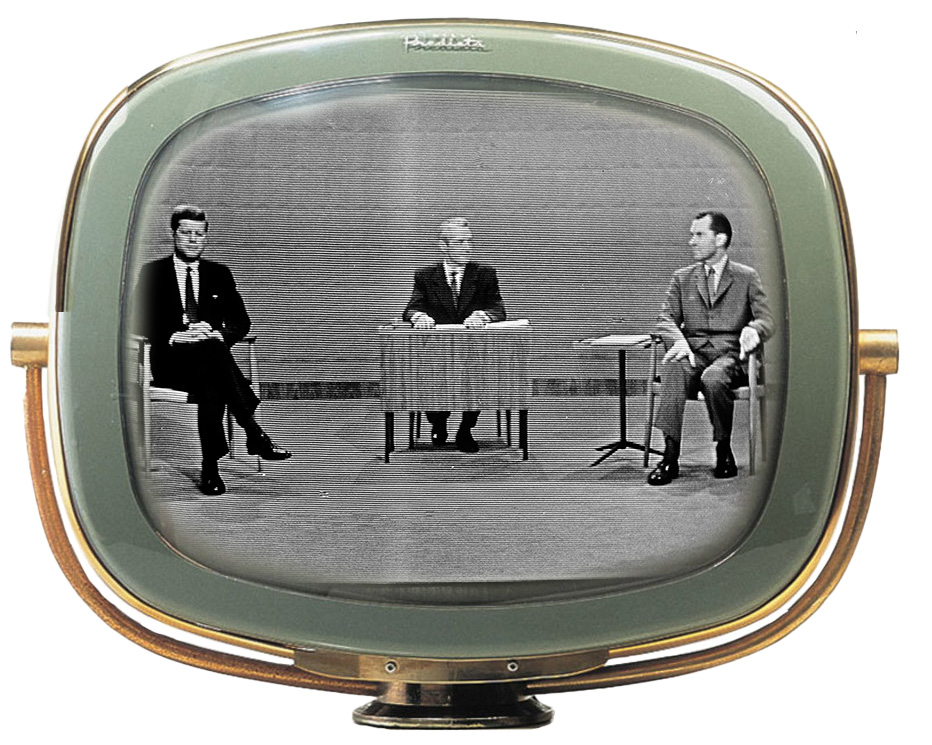
Television was ready to stake its claim as the pre-eminent forum for American politics when Democratic Senator John F. Kennedy squared off against Republican Vice President Richard M. Nixon for the first-ever televised presidential debate, staged at WBBM-TV in Chicago on the evening of September 26, 1960.
Surprisingly, there had never been a direct debate between the two major presidential candidates – not in person, not on radio, nor on television – until Kennedy and Nixon met in 1960.2
One reason such an encounter had not happened during the broadcast era was the FCC’s arcane “equal-time rule,” which mandated that all candidates for any office be given similar airtime. That meant that in a presidential race, any debate would have to include not only the Republican and Democratic party candidates, but also candidates from The Socialist Labor Party, The Prohibition Party, The Constitution Party, and any other independent who’d qualified for the ballot.
All it took to get past that provision was an act of Congress.
In the summer of 1960, the networks successfully lobbied Congress to pass a temporary suspension of section 315 – a bill whose sole purpose was to allow the networks to host a two-candidate debate. With no objections from the minor parties, once President Eisenhower signed the legislation, the networks went full speed ahead on organizing a debate.
Now all they had to do was get the two candidates to show up.
Given his stature as the sitting Vice President and the most likely successor to Eisenhower, Nixon was initially opposed to the networks’ proposal.
Kennedy, on the other hand, wanted the debates to establish his legitimacy among an electorate who saw him as young, untested and – unlike any previous occupant of the office – Catholic. Kennedy knew he was telegenic and was certain that appearing side-by-side with Nixon would make him look equally presidential.
Once it was obvious that neither candidate could plausibly decline the invitation – especially after Congress had changed the law – the ground rules were set.
For that first debate, Kennedy and Nixon were each given 8 minutes to offer opening remarks, followed by a panel of journalists alternating questions posed to the candidates. Each answer was given up to two-and-a-half minutes and could be followed by up to one-and-a-half minutes of rebuttal. There were no direct questions between the candidates, nor were any interruptions permitted.
The format varied over the course of a total of four broadcasts, the last one on October 21,1960 from New York, but it was that first Kennedy-Nixon debate that permanently altered the priorities of American politics.
____________________________________
Highlights from the 1960 Kennedy/Nixon Debate, moderated by Howard K. Smith
____________________________________
On television, Kennedy came across as composed, confident and – most importantly – camera-ready.
Nixon, who was recovering from an illness and recent knee surgery, looked pale and drawn, with a visible five o’clock shadow and beads of anxious sweat that glistened under the hot studio lights. The contrast was stark: it was Kennedy who exuded “presidential” while Nixon seemed out of place.
The debates were watched by an enormous audience: estimates place viewership for the first debate at roughly 70 million – the largest audience for any television event to that date.
The debates were also carried on radio, and, ironically, those who listened on radio were inclined to think Nixon had won the debate on substance. But to the tens of millions who watched on television, Kennedy was the clear victor.

After the debates, polling showed Kennedy moving into a slight but consistent lead over Nixon.
Throughout the year Kennedy’s team – especially speechwriter Pierre Salinger and media advisor Ted Sorensen – designed the campaign around pictures, more than words. Kennedy held more televised press conferences than any candidate in history to that point.
The results of the 1960 presidential election produced one of the closest margins in history. Those 70 million viewers (pretending for a moment that they were all voters) split almost evenly: the difference of roughly 118,000 more votes for Kennedy amounted to less than one-fifth of one percent.
Image and Demographics
Regardless of the margin, the consensus that has rippled through decades is that television was instrumental in Kennedy’s victory. That may be true – but entirely not for the reasons most often cited.
Yes, Kennedy came across as cool, calm, and confident compared to Nixon. But the deciding factor may have been less a matter of image than one of demographics.
Although the popular vote margin was razor thin, in America’s peculiar way of electing its presidents – the state-by-state Electoral College – Kennedy won by a wide margin: 303-219. Much of that difference can be traced to where television was and where it wasn’t.
By November 1960, the forces that had been gathering since the 1930s – urban migration and broadcast saturation – put a much larger portion of the electorate in dense urban areas than sparsely populated rural regions.
The states Kennedy carried were the great urban and industrial centers where television had become as common as indoor plumbing: New York, Pennsylvania, Illinois, Michigan, Massachusetts, and even rapidly growing Texas.
Nixon dominated the rural and sparsely populated states of the Midwest, the Mountain West, and parts of the South – places with fewer TVs and fewer electoral votes.
In effect, the Electoral College mapped the nation’s shifting technological and cultural landscapes, rewarding the candidate who performed best in the places where the audience was largest. Kennedy didn’t win the presidency because of television alone, but the medium amplified the demographic shifts that delivered him the states that mattered most.
After 1960, there was a long hiatus before the country would witness such a spectacle again.
In 1964, Lyndon Johnson – cruising toward a landslide – had no incentive to share a stage with Barry Goldwater. And Richard Nixon—still convinced the medium had burned him in 1960 – refused to debate when he ran again in 1968 and 1972.
Televised presidential debates did not return to the air until 1976, when Gerald Ford and Jimmy Carter revived the format that Kennedy and Nixon had pioneered almost a generation before.
Despite the long hiatus, the Kennedy / Nixon debates were pivotal in American history – four nights when the political, cultural, and technological stars aligned on the nation’s television sets.
In 1960, the visual imperatives of television converged with the demographic trends that had been building for several decades, and the Kennedy-Nixon debates can be seen in retrospect as the moment when American politics shifted from substance to style.
____________________________
Got an hour to spare? Here’s that whole first debate – September 26, 1960.
____________________________
1 Television was used only minimally during the 1948 presidential election. There were fewer than 200,000 sets, concentrated mostly in a handful of major cities. The Truman campaign managed a small milestone when parts of the Democratic National Convention were televised live from Philadelphia. Truman’s acceptance speech reached a tiny but fascinated audience, and the Republican convention received similar treatment. But beyond these symbolic moments, the 1948 campaign still belonged entirely to newspapers, radio, and the whistle-stop train tour.
2 The most famous debate in American politics prior to 1960 – the Lincoln–Douglas debates of 1858 – were not between presidential contenders. Republican Abraham Lincoln and Democrat Stephen A. Douglas were candidates for the U.S. Senate from Illinois.
________________________