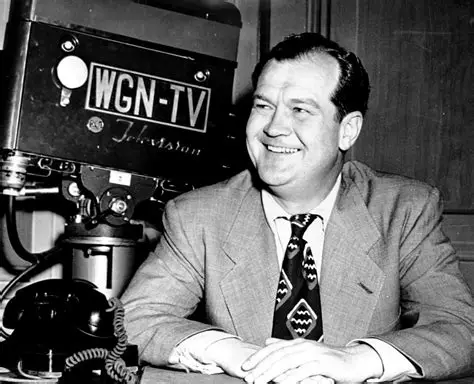

Above is a shot of my RCA TK10 from WGN…one of the original eight TK10s the station had in their studios, with four RCA TK30s in use on two mobile units.
WGN, Channel 9, is one of the nation’s first and only enduring independent stations, but it wasn’t always that way. In the beginning, they dual network affiliations with both CBS and Dumont, which early on wasn’t that uncommon in new TV markets, or markets with only one station.
The interesting part is, they shared that dual affiliation with WBKB, Channel 4, there in Chicago…until CBS bought WBBM. After that, WGN became one of Dumont’s strongest affiliates, as well as a major production center for that network.
Several Dumont programs were produced from the station’s facilities, including “The Al Morgan Show”, “Chicago Symphony”, “Chicagoland Mystery Players”, “Music From Chicago”, “They Stand Accused”, “Windy City Jamboree” and “Down You Go”.
The station lost the Dumont affiliation when the network ceased operations on August 6, 1956; at that point, WGN became an independent station. The rest, as they say, “is history”. -Bobby Ellerbee
https://copilot.microsoft.com/shares/artifacts/u7UA75wYr3Utk9uCJb1MA
Eyes Of A Generation…Television’s Living History
Vintage: WGN-TV
April 17, 2014·35 Photos·Chicago Tribune Historical Archive
WGN-TV newsreel photographers Fred Giese, on the curb, and Leonard Bartholomew, positioned on the car, shoot pictures in the Loop on March 22, 1948.
Chicago Tribune historical photo
WGN-TV operated from the organ loft at the Chicago Stadium during its first scheduled telecast at the Golden Gloves fights on March 5, 1948.
Robert MacKay, Chicago Tribune
The finals of the Golden Gloves was the first scheduled televised show on WGN-TV with Jack Brickhouse, center at table, as the first voice at the Chicago Stadium on March 5, 1948.
Chicago Tribune historical photo
Spencer Allen, seen here in 1953, was the first news director for WGN-TV when they started in 1948. Allen had been a WGN Radio news reporter and writer since 1938.
Chicago Tribune historical photo
Angel Casey, Chicago model and radio actress, in front of the camera for WGN-TV, circa April 4, 1948.
Chicago Tribune historical photo
A model of the post-war television studio is viewed at the Palmer House by G. William Lang, WGN chief engineer; Frank P. Schreiber, WGN general manager; and others on Aug. 28, 1944.
Chicago Tribune historical photo
The WGN-TV mobile unit shoots pictures of the polar bears at Brookfield Zoo, circa April 23, 1948.
R. A. Farrell, handout
The WGN-TV mobile unit in operation on the street as it rehearsed programs for opening tonight at Illinois Street and the WGN Building on April 4, 1948.
Hardy Wieting, Chicago Tribune
Engineers monitor the reception inside WGN’s mobile unit at Illinois Street and the WGN building. The unit was put into operation for the opening of WGN-TV on April 4, 1948.
Hardy Wieting, Chicago Tribune
A WGN-TV mobile unit is parked outside Wrigley Field for a Cubs game, circa May 8, 1949.
Chicago Tribune historical photo
Spencer Allen of WGN-TV news room, left, and television cameraman William Rockar, right, televising the fire at North Pier Terminal Warehouse from the 6th floor of Tribune Tower on April 22, 1950.
Robert MacKacy, Chicago Tribune
Flower Vocational High School student Esther Riff practices a cooking demonstration for the WGN-TV program “Women’s Magazine of the Air”, circa Sept. 19, 1951.
Chicago Tribune historical photo
Ukulele playing disc jockey Eddie Hubbard in a promotional picture for his show “Catalog Quiz” on WGN-TV, which premiered on Sept. 12, 1949.
Chicago Tribune historical photo
J. E. Faragan, program director for WGN-TV, explains the workings of a television camera to students of the Chicago Public Schools’ radio workshop, circa Sept. 19, 1951.
Chicago Tribune historical photo
A view of the floating television studio in WGN’s building, in Tribune Square, which began operations on Jan. 25, 1950, featuring “Chicago Cooks with Barbara Barkley,” one of television’s earliest homemakers.
Chicago Tribune historical photo
According to the Tribune, “Two dollies try out a two-man dolly unit on which the camera can be raised, lowered, and moved,” circa April 4, 1948.
Chicago Tribune historical photo
The WGN-TV studios next to Tribune Tower, shown here in 1955 before the station relocated to the Northwest Side.
Chicago Tribune historical photo
Frazier Thomas with the puppets Garfield Goose and Beauregard Burnside III with Thomas’ son Jeff, 5, behind the camera at WGN-TV studios, circa June 1958. Garfield Goose and Friends aired from 1955 to 1976.
Chicago Tribune historical photo
Frazier Thomas, right, hosted the WGN-TV produced “Garfield Goose and Friends”, is with his son Jeff, 5, circa June 1958.
WGN handout
Peppy Wonso of Agnes McDonald High School and Bob Dipper of Evergreen Park High dance for the television cameras on May 29, 1956, during Bandstand Matinee, a WGN-TV rock ‘n’ roll program.
Chicago Tribune historical photo
Carol Johnson and Bob Dipper look into the camera during WGN-TV’s Bandstand Matinee on May 29, 1956. WGN and popular disc jockey Jim Lounsbury hosted the rock ‘n’ roll show for thousands of gyrating teenagers from 1954 to 1963.
Chicago Tribune historical photo
Teenagers dance to rock ‘n’ roll in the main studio at WGN-TV during an hour-long radio show called the “Hi-Fi Club” on April 16, 1959.
William Bender, Chicago Tribune
Bob Newhart hams it up at the WGN-TV studio in 1960.
Chicago Tribune historical photo
Mary Jane Dlouhy, seen here in 1961, was the host of the WGN-TV morning children’s show “Treetop House.” Dlouhy hosted the show with Mr. Widgin, a marionette.
Handout
Throughout his career with WGN-TV, Rayner would play many characters, including Sergeant Pettibone on “Dick Tracy”, Oliver O. Oliver on “Bozo’s Circus,” and eventually his own show “Rayner and His Friends.”
Chicago Tribune historical photo
WGN television cameras covered the ballpark for their at home viewers in the 1960s.
WGN handout
A Girl Scout troop from Palatine learns about the operation of WGN-TV studios during a tour given by guide Frank Kapanowski, circa Nov. 19, 1965.
Chicago Tribune historical photo
Jack Brickhouse at the WGN-TV microphone during a White Sox game, circa July 30, 1967.
Chicago Tribune historical photo
Bob Bell, the actor who played Bozo the Clown, at WGN-TV studios in Chicago in 1968.
Chicago Tribune historical photo
Robert “Bob” Bell as Bozo the Clown in 1967.
Chicago Tribune historical photo
“Bozo’s Circus”, a television program targeted to kids, became more popular in Chicago than in any other television market. Bozo’s original cast is shown here with Bob Bell as Bozo, in 1966.
Chicago Tribune historical photo
Bob Bell as Bozo the Clown, left, and Ray Rayner as Oliver O. Oliver, right, during “Bozo’s Circus” in 1967.
Chicago Tribune historical photo
Ray Rayner as Oliver O. Oliver, right, is shown with Ringmaster Ned Locke, left, and Bob Bell as Bozo the Clown, center, during the WGN-TV produced show “Bozo’s Circus,” in 1967.
Chicago Tribune historical photo
Ray Rayner on the set of “The Ray Rayner Show” with Chelveston the duck and Cuddly Dudley, in the mid-1970s.
WGN handout
Talk show host Phil Donahue on the set of the “Donahue” show during the 1970s.
Chicago Tribune historical photo