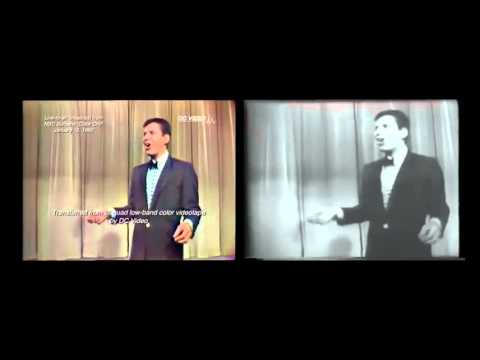
In Case You Missed It…Color Video Tape Comparison To Kinescope
In Case You Missed It…Color Video Tape Comparison To Kinescope
Obviously color makes a big difference, but so does the quality of videotape over kine. This is the “laughing cameraman” sketch that I posted yesterday in a side by side comparison with some neat special effects inserts.
Thanks to Joao Antônio Franz dos Santos for sharing this, but most importantly, thanks to David Crosthwait at DC Video in Los Angeles for making this after transferring the show from a 2″ quad, low band videotape to a digital format for the Lewis family archives. Enjoy and share! -Bobby Ellerbee
‘Tonight’…Son Of ‘The Knickerbocker Beer Show’
‘Tonight’…Son Of ‘The Knickerbocker Beer Show’
When ‘Broadway Open House’ left the air in August of ’51, late night television got put on the back burner as NBC’s Pat Weaver was busy putting together ‘The Today Show’, which debuted in January of 1952. After a year or so of intense focus on the early mornings, Pat began to think about late nights again.
Ted Cott, a successful radio executive who had recently moved into television at the NBC affiliate, suggested Steve Allen as host for the venture. and was interested in a west coaster that had recently shown up for some extended club dates and radio work in NYC. This was of course Steve Allen, and Weaver tested the water by giving Allen a half hour of late night air time on NBC’s local station, WNBT near the end of 1953.
At that time, WNBT and its late night movie program was getting clobbered by a better package of films being broadcast every night on the CBS affiliate, WCBS.
Knickerbocker Beer, which was then a major brand, decided it wanted to sponsor something other than late movies on WNBT…say, a variety show. Ted Cott, a successful radio executive who had recently moved into television at the NBC affiliate, suggested Steve Allen as host for the venture.
At the end of August of 1953, a 40 minute weeknight program called ‘The Knickerbocker Beer Show’ debuted. Steve Allen was the host and the legendary Dwight Hemion was directing one of his first shows which originated from Studio A of the WOR 67th Street Studios. At the time, the studio was still owned by WOR and NBC was leasing space, but that changed the next year when the ‘Home’ show with Arline Francis came to the air…NBC took over the whole complex then.
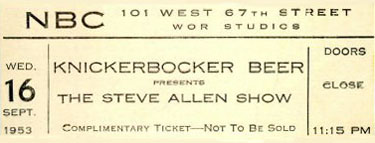
A few weeks after the debut, the show’s name was changed to ‘The Steve Allen Show’ but Knickerbocker was still the sponsor. In the comment section, I’ll show you ticket from the September 16th show.
Done at first without writers and always without much of a budget, Allen’s local show was an immediate success, garnering both critical acclaim and the desired higher ratings. On the show, Allen would play the piano, chat with audience members or guests, bring on Steve Lawrence and/or Eydie Gorme to sing a song (as in this clip) and have fun with the bandleader Bobby Byrne. Allen was basically laying the foundation for all TV talk shows to come. Less than a year later, most of the operation would be moving over to do a network show called ‘Tonight’ which debuted September 27, 1954! Below is a clip from that first night. Enjoy and Share! -Bobby Ellerbee
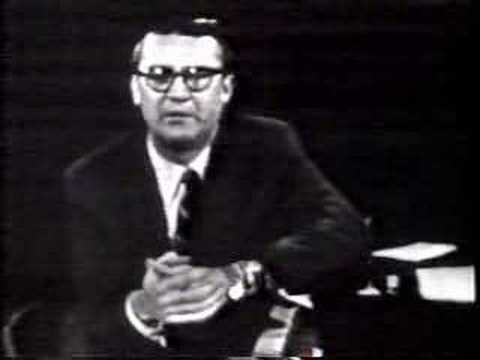
September 27, 1954…’Tonight’ Debuts From The Hudson Theater
September 27, 1954…’Tonight’ Debuts From The Hudson Theater
Happy 60th Birthday To ‘Tonight’! May you have 60 more!
At the link are the opening minutes of the very first ‘Tonight’ show with Steve Allen. I’m not going to go into great detail on this as we have spotlighted this show’s history many times here, BUT…in the next post, I will give you something Ultra Rare!
As Steve jokes in the last few seconds on this debut video, “if ‘Tonight’ is successful, NBC will have a new show called Son Of Tonight”…actually, this show is the “son of” NBC’s local New York show which we will look at in today’s next post. The original name of that show was ‘The Knickerbocker Beer Show With Steve Allen’.
More on the way. Enjoy and Share! -Bobby Ellerbee
https://www.youtube.com/watch?v=n8AYUfBt1dE
Taken from the documentary series “Television”, this is a clip from the first episode of the Tonight show with Steve Allen.
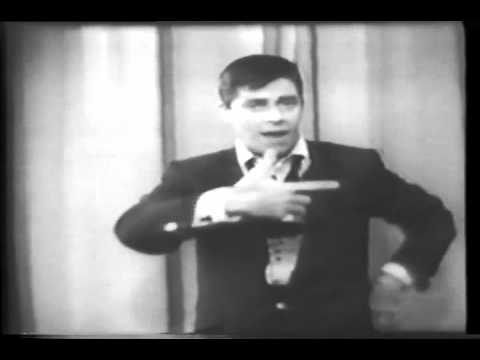
Jerry Lewis…The Laughing Cameraman Sketch
Speaking Of Jerry Lewis…Here’s The Laughing Cameraman Sketch
In the last post about the delayed SNL debut, I mentioned that Tom Snyder and his guest Jerry Lewis filled the hole left by the one week push back. Lewis and NBC have a long history going back to ‘The Colgate Comedy Hour’ days of the early 50s, and here is a clip from his show from Burbank in 1960.
The laughing cameraman is comedian Joey Faye who was in a lot of Sinatra and Lewis movies. We get to see the RCA TK41s around 2:33 but the intro to “Witchcraft” include a typical Lewis bit about the time delay of this live show.
By the way, he did this bit again in 1967 and I’ll post that clip in Comments. Enjoy and Share! -Bobby Ellerbee
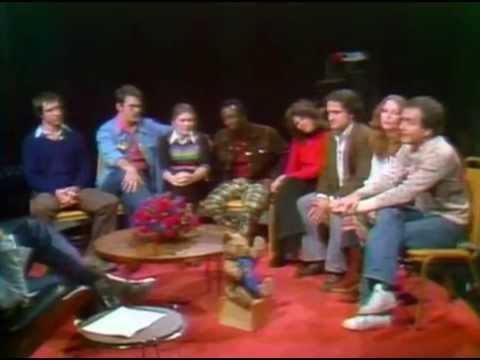
The Television Debut Of The SNL Original Cast…Rare & Surprising!
The Television Debut Of The SNL Original Cast…Rare & Surprising!
As it turns out, “The Not Ready For Prime Time Players” were not even ready for late night television! Really! Here’s the story…
NBC’s new 90 minute, live comedy show ‘Saturday Night Live’ was scheduled to debut at 11:30 on October 4, 1975. The plane truth is, they just could not get the show ready in time for a number of reasons, with timing and blocking among the biggest hurdles to overcome.
Although Tom Snyder’s ‘Tomorrow’ show was a one hour, Monday – Friday production, NBC called on him at the last minute to do special 90 minute Saturday show to cover the SNL hole in their schedule. Fortunately, Jerry Lewis was in town and agreed to do the show. For the first 85 minutes, he was the single guest. The last five minutes were reserved for the introduction of the SNL cast and it’s producer Lorne Michaels.
In this clip, you will see the first ever network appearance of the original cast of ‘Saturday Night Live’. Break a leg tonight SNL and happy 40th Anniversary! Enjoy and SHARE! -Bobby Ellerbee
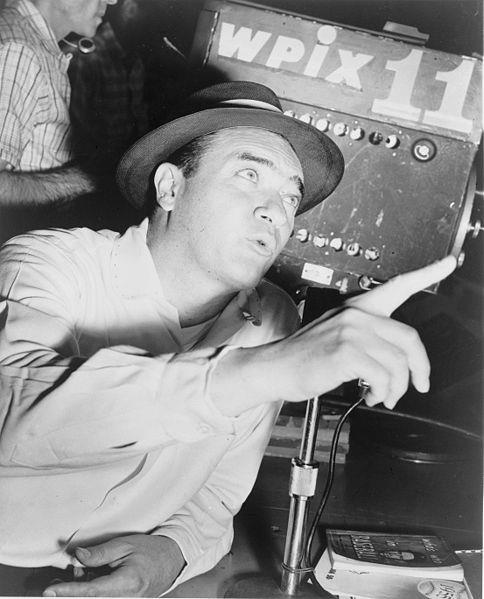
I Wonder What Mel Allen Would Have Said About Jeter Last Night?
I Wonder What Mel Allen Would Have Said About Jeter Last Night?
In one of the most surreal and remarkable farewells in Yankee history, leave it to Derek Jeter to deliver the dramatic game-winning hit in the Yankees’ 6-5 triumph over the Baltimore Orioles, just minutes after the Yankees had blown a 3-run lead.
As the longtime voice of the Yankees, it would be interesting to know what Mel Allen would have had to say, but here is a little known story about a conversation he once had with Lou Gehrig that may give us some insight. This will put a lump in your throat.
Allen once recounted an event that occurred during his first full season as the announcer of the Yankees. Lou Gehrig had been forced to retire the previous year due to what would be a fatal illness. Speaking with Allen in the team’s dugout, Gehrig told him “Mel, I never got a chance to listen to your games before, because I was playing every day. But I want you to know they’re the only thing that keeps me going.” Allen waited until Gehrig left, then broke into tears. Enjoy and share! -Bobby Ellerbee
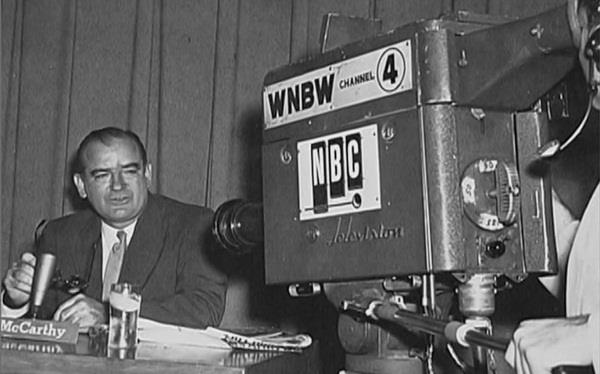
The Bad Old Days
Here’s Red Scare monger Sen. Joseph McCarthy in his favorite position…in front of a camera. Thank God for real newsmen and journalists like Edward R. Murrow who took him on and took him out.
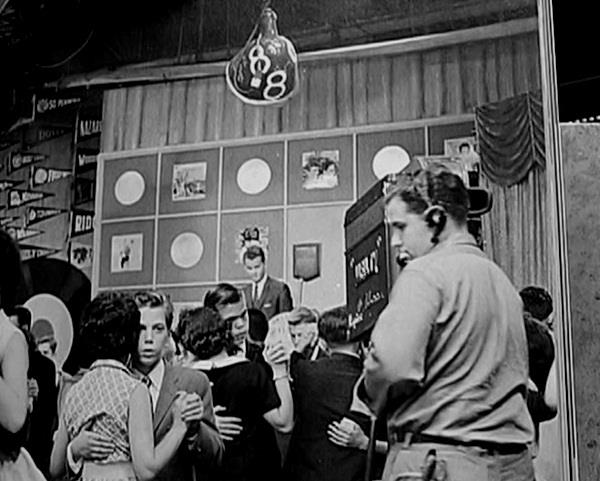
The Good Old Days
Thank God for Dick Clark and American Bandstand! Boy, how this show changed things in music and for teenagers. Did you watch? Got a story?
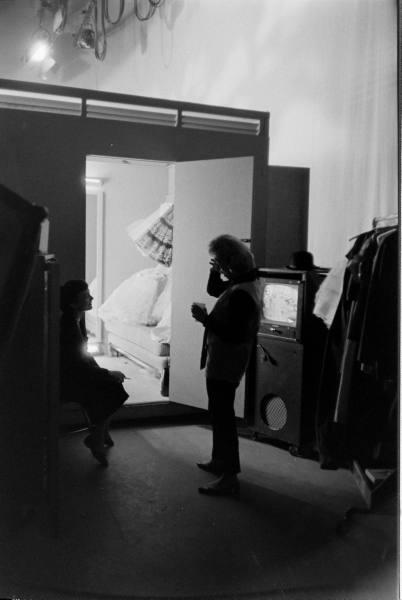
Shades Of SNL…On The Set Wardrobe Changes
Shades Of SNL…On The Set Wardrobe Changes
In live television, a lot of things happened just on the other side of the set walls. Here at Television City, a door opens to a quick change space where actors could make a change on the set. More often than not, there was no time to make it to a dressing room and back before they had to hit their marks.
This photo is from a ‘Playhouse 90’ production…one of television’s most cherished and respected anthology series. Enjoy and share! -Bobby Ellerbee
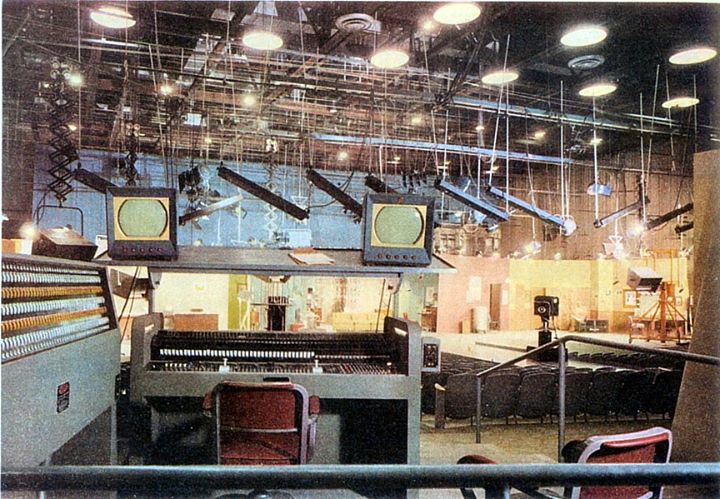
A Rare Color Photo of CBS Television City Studio 33
A Rare Color Photo of CBS Television City Studio 33
Perhaps the most famous of the TVC studios is 33. This is the only one left that has the side wings and the built in theater seating. Here is a shot from behind the lighting directors console from around 1953.
As mentioned in the post just before this, the dynamics of production changed as with this much space, you could have horizontal production with the cameras and crew moving from side to side on stage instead of operating in a maze of set walls as was necessary in most NYC productions. I think this set is either ‘My Friend Irma’ or ‘My Favorite Husband’.
You can’t see the wings, but you can see how far the center ramp comes out into the audience. Studio 31 was originally a mirror image of 33…the only difference was that in 31, the lighting board was on the other side of the control room which we see the corner of at the far right in this photo. Enjoy and share! -Bobby Ellerbee
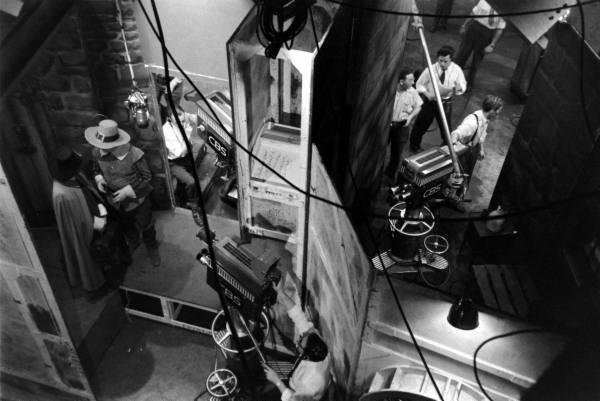
A-MAZE-ING: Live Television
This NYC shot is a stark contrast to the way live production changed once bigger studios, like the ones at Television City, allowed horizontal staging…sets, all in a row that allowed crews and cameras to move side to side on the stage.
This photo could possibly be from the newly converted CBS Studio 50, which is now home to David Letterman. It was converted from radio to television in 1950 and this shot from the catwalk shows three RCA TK10s within 6 feet of each other ready to shoot three different scenes on this maze like set. The production is the 1950 “Studio One’ presentation of ‘The Scarlet Letter’. In 1950, ‘Studio One’ won an Emmy for Best Kinescope.
Notice the low camera in the top left is shooting into the rear of a fireplace opening and soon, will give us an image of one of the characters putting wood on the fire from inside the fireplace, but first the camera on the other side of the wall has to move. Enjoy and share! -Bobby Ellerbee
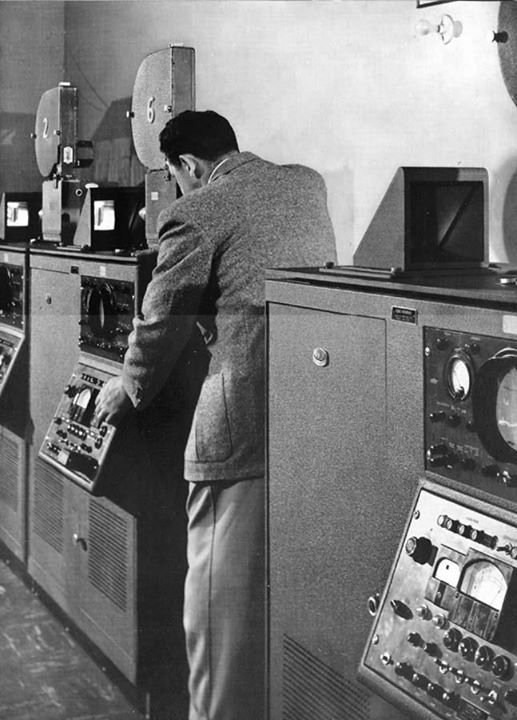
Dumont Kinescope Machines
Dumont Kinescope Machines: Quite a rare photo
Before there was video tape, tele transcription was done via the kinescope process. Inside the cabinet, behind the panel door there is a cathode ray, or picture tube pointing up so the image can be seen via the mirror box. The image is then recorded by a small film camera as seen here with the film magazine above it. The operator can adjust the picture quality and audio with the oscilloscope and control panels shown here.
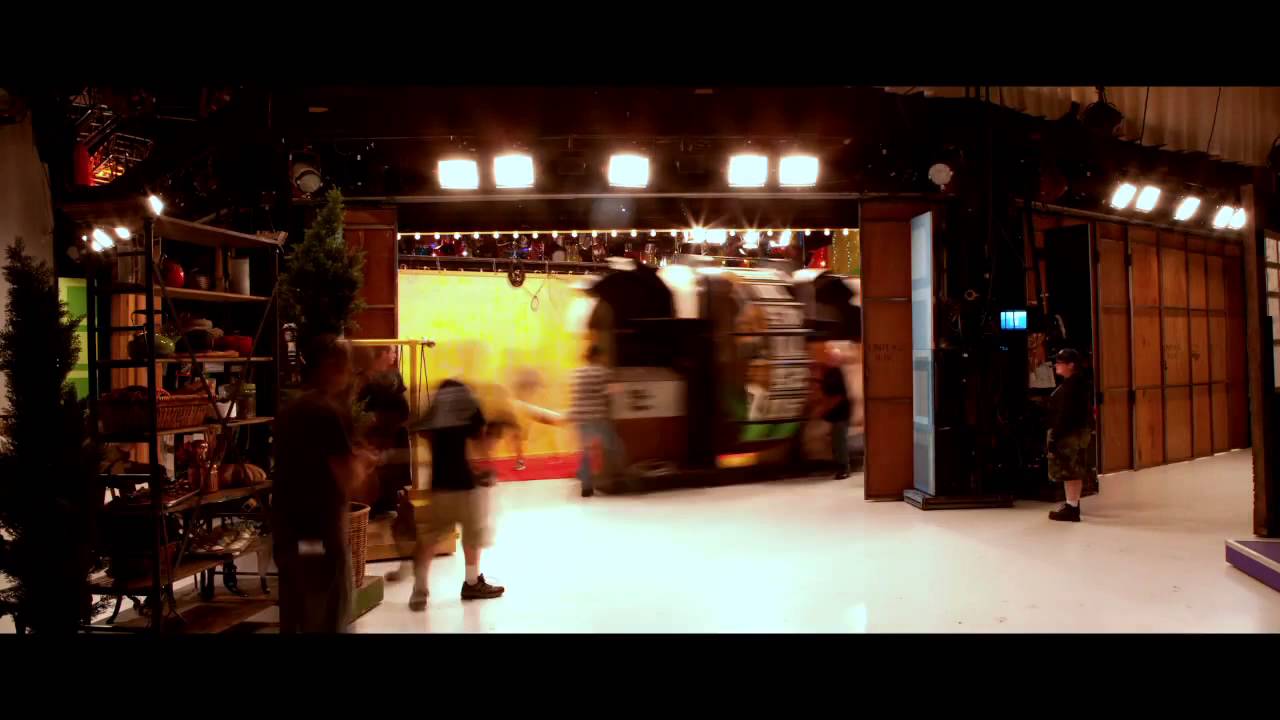
‘The Price Is Right’…One More Behind The Scenes, Timelapse
‘The Price Is Right’…One More Behind The Scenes, Timelapse
This is not only fast and furious, it was produced and paid for by Drew Carey. Enjoy and share! -Bobby Ellerbee
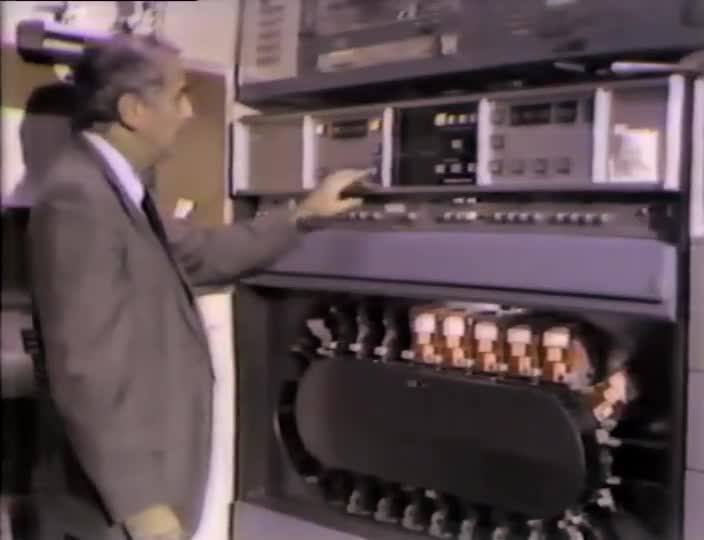
Short But Sweet…NBC NY & Burbank Quick Shots, Early 70s
Short But Sweet…NBC NY & Burbank Quick Shots, Early 70s
Thanks to our friend John Schipp, we are able to see a little over a minute’s worth of rare footage inside 30 Rock and Burbank.
This is from a behind the scenes episode of NBC’s ‘The Go Show’ which aired briefly around 1973. It was a unique show, shot mostly in the field with RCA TK 76 ENG cameras and recorded on Ampex VR-3000 VTRs, a portable 2-inch quad machine.
With a little help from NBC’s Dennis Degan, here’s what we are seeing. “The first two shots look like Studio 5H Control Room, originally built in 1954. The TCR-100 (tape cartridge machine) shown in the clip was Machine #31, the one furthest to the left in a line of six TCR-100’s at NBC-NY. My maintenance shop was on the other side of the wall seen in the shot. The clip jumps to Burbank and Studio 4’s elephant doors, then home to ‘The Flip WIlson Show’ and ‘Midnight Special’. You can also get a glimpse of the set for ‘Sanford & Son’ which I think was in Studio 3. Then we flip back to NY for a shot of Frank Blair at his news desk, most likely Studio 3K and I think the closing moments are in Studio 4 again. I believe the clip was probably made in 1973. The TCR’s were first brought to market no earlier than 1972.” Comment, enjoy and share! -Bobby Ellerbee
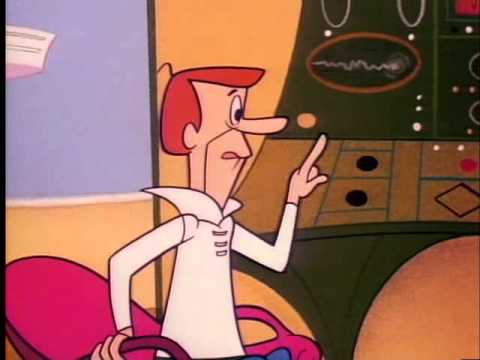
September 23, 1962…’The Jetsons’ Debuts As First Color For ABC
September 23, 1962…’The Jetsons’ Debuts As First Color For ABC
This video clip is quite good as Bill Hanna and Joseph Barbera reminisce about the show.
Here’s a little known fact…at the time ABC did not have any color equipment, but NBC did, and that’s how ‘The Jetsons’ got on the air. Each week, ABC took a 35 and 16MM copy (master and safety) to NBC Burbank on Sunday afternoons. NBC would rack both and play them simultaneously (in case the film broke) down two AT&T lines to ABC New York for the east coast and do the same four hours later when the fed the signal to ABC Hollywood.
‘The Flintstones’ was produced in color and preceded this show by two years, but those first couple of years were broadcast in black and white. Even if they had been broadcast in color, most ABC affiliates were not equipped to handle color yet and only about 30% of the ABC stations were able to broadcast ‘The Jetsons’ in color.
I think ABC’s first color ability came in 1963 when they installed an RCA color film chain in Hollywood at the Prospect lot. Enjoy and share! -Bobby Ellerbee
https://www.youtube.com/watch?v=1oDaHRbIDH8
A short documentary featuring the history of the Jetsons with rare commentary clips from Bill Hanna and Joe Barbera. This documentary is from the excellent J…
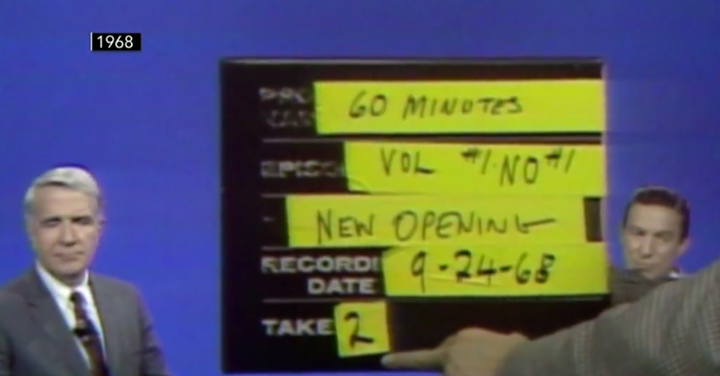
September 24, 1968…’60 Minutes’ Debuts On CBS
September 24, 1968…’60 Minutes’ Debuts On CBS
https://youtu.be/iRxQI8r8X9E?t=122
Forty six years ago, television history was made when CBS debuted ’60 Minutes’. Below, we see the slate for that first broadcast and at the link above, we have a great farewell to Mike Wallace.
At the two minute mark, we enter the ’60 Minutes’ studio which looks almost the same now as is did back in 2006. Enjoy and share! -Bobby Ellerbee
The Little Known Story Of Nautilus Television
The Little Known Story Of Nautilus Television…
This topic came up in one of the posts yesterday, so here’s the very odd story of Arthur Jones and his 35 RCA cameras and 95 video tape machines.
This will start at the 4:56 mark where the television facility is described. As the creator of the line of Nautilus Fitness Equipment, Jones is a multi millionaire, but a very opinionated and cantankerous character. This all happened in the early 80s in a tiny town in Florida and it all went away almost as quickly as it was created. By the way, the studio cameras are RCA TK46s. I think they also had some RCA TKP 45 and 46 portable cameras. Enjoy and share! -Bobby Ellerbee
‘Price Is Right’…Best Ever Behind The Scenes
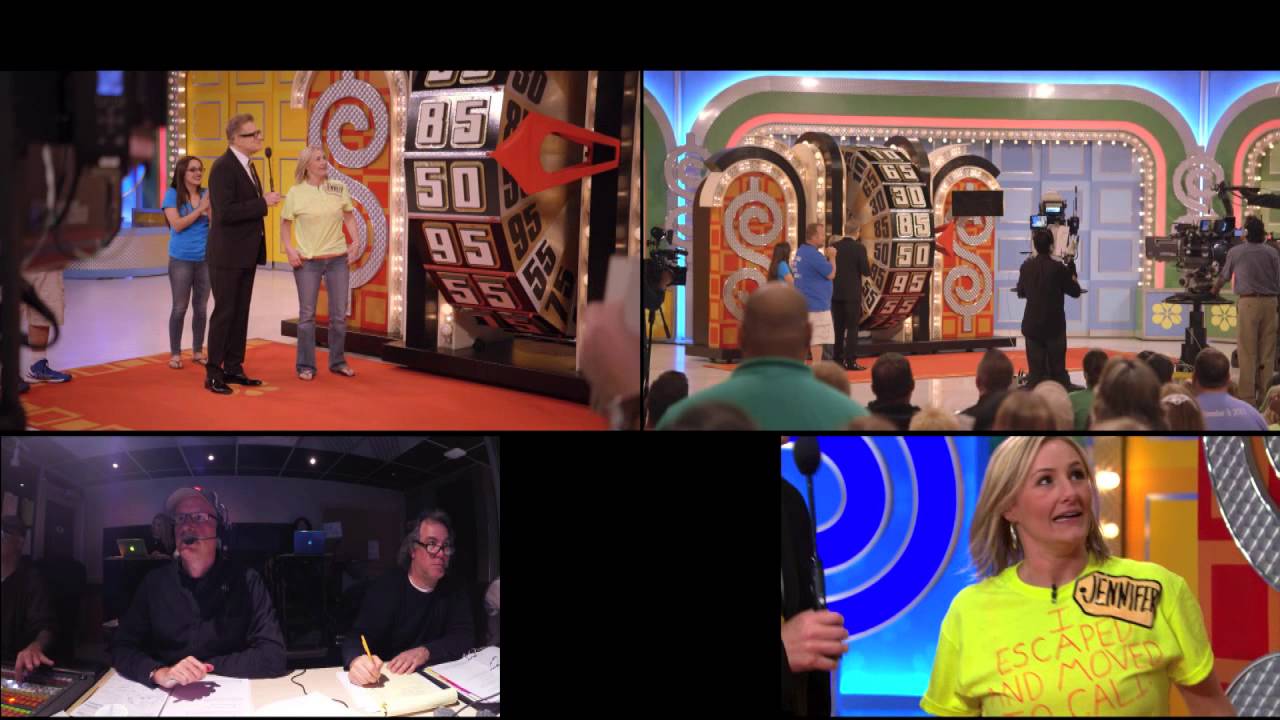
‘Price Is Right’…Best Ever Behind The Scenes…1 Hour In Studio 33
This is a fantastic trip behind the scenes of this legendary show and covers everything! Notice the cameras are wireless! Yes, there is a cable from the camera head to the yellow and white car batteries on the pedestals, but no floor cables. You can see the transmitters and antenna on top of the lens and mounted on the right side of the cameras.
The Steadicam operator is Hector Ramirez…the most nominated Emmy winner ever. With these multi screens, we get to see more than you could even if you were there. Thanks to Howie Zeidman for the clip. Enjoy and share! -Bobby Ellerbee
#t=176″ target=”_blank”>https://www.youtube.com/watch?v=-2mp6S_kDTU #t=176
The Price Is Right is giving you Behind the Scenes access like never before! Watch as Drew Carey, Rachel Reynolds, Amber Lancaster, George Gray and The Price…
Speaking Of Bob Barker…
Speaking Of Bob Barker…
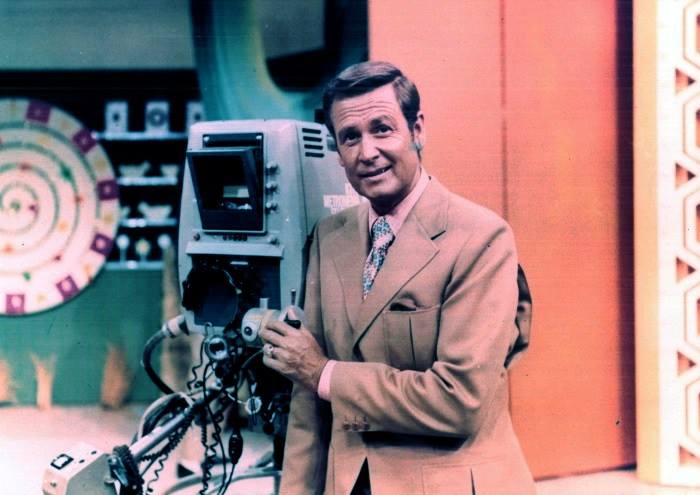
In the video post just before this, we saw Bob on TPIR set, but this is him in 1970 on the ‘Truth Or Consequences’ set at Metromedia Studios with a Norelco PC70. I would love to have one of these old “captains wheel” Zoom demand controls (that Bob has his hand on) for one of my Norelcos. This style demand was original equipment. Anyone happen to have one? If so, please let me know…these are hard to find. Thanks, enjoy and share! -Bobby Ellerbee
‘The Price Is Right’…Behind The Scenes, 1982
‘The Price Is Right’…Behind The Scenes, 1982
This is 10 years into Bob Barker’s reign as host and 3 years before the passing of Johnny Olson. Before seeing this, I had never thought of Johnny as a disco dancer…after seeing it, I still don’t but you have to give him an A for effort.
Interestingly, there is a stop tape occurrence in this piece as one of the game board displays peters out. The cameras in Studio 33 look to be the single cabled Norelco PC70s. Enjoy and share! -Bobby Ellerbee