If you want to understand where British television engineering stood in the early 1950s, the EMI C.P.S. Emitron is the camera that tells the story. This wasn’t just another post‑war studio box — it was the first generation of British cameras built around the C.P.S. (Cathode Potential Stabilised) Emitron tube, a major leap forward from the pre‑war Emitron and Super Emitron designs.
According to the Science Museum Group, EMI began developing the CPS tube before WWII, but it wasn’t finished until after the BBC restarted service in 1946. The tube made its first major public appearance at the 1948 Olympics, where it delivered higher sensitivity and a more stable picture than earlier Emitrons. It used an orthogonal scanning geometry — the electron gun scanned at right angles to the target plate.
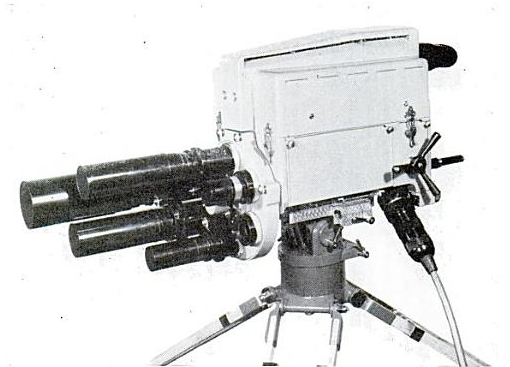
By 1951, EMI had built complete camera systems around this tube. The Museum of the Broadcast Television Cameras documents a 1951 EMI 6‑lens CPS camera, shown at the Festival of Britain and later at the Television Society exhibition. It featured a 6.5-inch viewfinder, remote control capability from an OB van, and export‑ready 625‑line operation — a forward‑looking design for its time.The turret design is one of the camera’s signatures: a six‑lens turret slung low under the front of the camera body, giving it a distinctive silhouette and at the link below to the TVCameraMuseum.org, we get several angles of the camera. Notice in the page we open to, the taking lens seems to be low on the left side, where the lens is off to give us a look.


The CPS tube itself continued to evolve. The TV Camera Museum notes that the 5907 CPS Emitron tube — a later refinement — added a mesh for stability under high light levels and was used in industrial and special‑purpose cameras. They also document BBC use of CPS‑based cameras in difficult locations, including submarine broadcasts.
So, the 1951 CPS Emitron sits at a very specific moment in broadcast history: post‑war British television rebuilding itself, adopting a new tube architecture, and trying to keep pace with the explosive American Image Orthicon era — but doing it with its own engineering philosophy.
That I know of, none of these cameras survived, but the independent museum sources confirm its specs, its public exhibitions, its tube lineage, and its place in the evolution of British TV technology.