_______________________
September 7, 2027, will mark 100 years from the day when electronic television made its first appearance on Earth. To generate interest in the Centennial, this website and accompanying podcast are going to Count Down the Top 100 Milestones from the First 100 Years of Television over 100 weeks until September 7, 2027.
________________________
________________________
As we have worked our way through the evolution of television and its impact on the world, we have talked mostly about the technology and the earliest forms of programming.
Today we’re going to talk about the actual viewing experience.
By the mid-1960s In the U.S., there were somewhere between 35-50 million television sets in American homes, representing between 75 and 80% of total households.
In Britain, where regular programming had been introduced several years before the U.S., some six million sets represented less than 40% of total households.1 Service expanded slowly beyond London after the war, just reaching the Midlands in February of 1956 and Northern England in May. A large portion of the U.K. still had no television at all.
Screen sizes varied from 7″ measured diagonally to 21″, and in the U.S. fewer than 25,000 of those nearly 40 million televisions were in color, which had been introduced just two years earlier. That $1,000 price tag for a 19″ color set still represented nearly a whole year’s salary for the average worker, leaving color mostly a curiosity in department store windows.

The typical television in the mid 1950s was equipped with a dial that could only tune into twelve channels2, and too often even that was easier said than done. You have to be of a certain age to remember rooftop antennas, or all the hacks homeowners used to improve TV reception, like tin foil wrapped around the tips of set-top rabbit ears.
Early television broadcasting was notorious for interference between stations. That meant that empty channels had to separate the channels you could get, which typically meant that only three to five channels were available in any given metropolitan area – usually the three national network affiliates and a couple of local stations.

To further avoid interference between adjacent channels, those in-between channels were relegated to other, distant markets. For example, in the nation’s largest market, New York City, television was broadcast on channels 2, 4, 5, 7, 9, 11 and 13. Channels 3, 6, 8, 10 and 12 were assigned to stations in Philadelphia. If your father was clever enough to pick up a Philadelphia station in New York, then he was probably an electrical engineer with a degree from MIT.
During the mid-1950s, television service spread slowly around the rest of the world. For those countries that did have the new medium, the content covered the now familiar spectrum of sitcoms, variety shows, quiz shows, westerns, police and crime shows, children’s and family programming, and news and documentaries.
But wherever in the world televisions could be found, regardless of nationality or content, the viewing experience had one thing in common: the television sat on one side of the room and was watched from a couch or chair on the other side of the room. That meant that if you wanted to change the channel, somebody had to get out of their seat, cross the room, and twist a knob.
Then you futzed with the antenna to get a decent picture. And if the sound wasn’t loud enough when you returned to your seat? Well, up you go again.
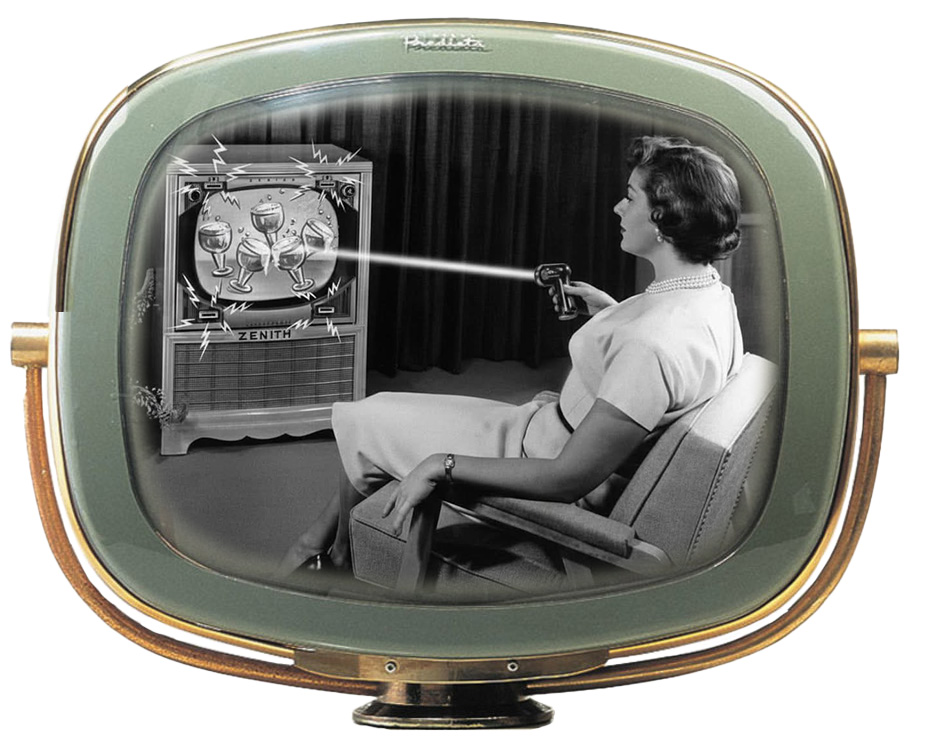
Not much changed until the fall of 1956, when Zenith introduced the first invention that truly altered the viewing experience: the Space Command – the first practical TV remote control.
The Zenith Radio Corporation – like RCA – traced its roots to the dawn of radio. The company was started as the Chicago Radio Labs in 1918 by two radio enthusiasts, Ralph Matthews and Karl Hassel, who built their first products on a kitchen table. Hassel operated an amateur station with the call sign 9ZN. A now-unknown employee playfully added “ith” to the the call sign, giving the fledgling company its first brand name: Z-Nith

In 1921 Matthews and Hassel teamed up with Eugene McDonald, a flamboyant, self-made millionaire and Navy veteran who was known as “The Commander.” McDonald’s flair for innovation and energetic style eventually found their way into the company’s products and advertising.
With “Commander” McDonald at the helm, Zenith grew into one of America’s leading manufacturers of consumer electronics like portable radios, FM stereo systems, and early color TVs. When the company took the plunge into television in the early 1950s, it staked its reputation on a quest for convenience as well as performance, which led Zenith to develop the first TV remotes.
The Space Command was not the company’s first attempt to offer a remote. As early as 1950, Zenith offered the Lazy Bones remote, a wired device that let users turn the TV on and off and change channels. While innovative for its time, the Lazy Bones was tied to an electrical cord – both unsightly and potentially hazardous – between the controller and the TV.
In 1955, Zenith tried again with the Flash-Matic,3 which used a beam of light aimed at photocells on the TV – but that design didn’t work well in bright rooms and could even be confused by sunlight.
In June of 1956, Zenith’s assistant director of research, Dr. Robert Adler, filed a patent for a remote control that used ultrasonic sound waves – mechanically generated signals rather than wired or optical signals – to transmit commands.

Once it was offered to the public as part of Zenith’s premium line of new TVs in the fall of 1956, the ultrasonic Space Command quickly became the first widely used wireless TV remote control. It allowed viewers to change channels and adjust the volume with a satisfying metallic “click” from aluminum rods inside the remote – a sound so iconic that the early remotes became known as “clickers.”
Adler’s elegant design was quickly integrated into high-end Zenith models, paving the way for a new fixture in American homes. In the early 1980s, the industry shifted from ultrasonic remotes to infrared (IR), which enabled whole new levels of control, convenience and affordability. With IR, remotes became ubiquitous to the point that every American household had a junk drawer full of them.
As the remote control moved from novelty to standard feature, the culture of television viewing shifted in profound ways. Viewers could change channels, change the volume, and turn the power on and off without leaving the couch.
And, as one TV commercial noted without irony, the remote would “shut off the sound of loud, annoying TV commercials.”
__________________________________
A 1972 commercial for the Zenith Space Command, the gizmo that could turn off the sound of TV commercials.
__________________________________
This new level of convenience naturally lent itself to satire, which eventually became part of the vernacular.
On July 15, 1976, California counter-culture humorist Tom Iacino called his friend, the cartoonist Robert Armstrong. Iacino and Armstrong were part of a humor club called the “Boob Tubers,” whose mission was to sit on a couch, watch TV and eat junk food. So when Armstrong’s girlfriend answered the phone, Iacino said, “Hey, is the couch potato there?” She looked at Armstrong sitting on the couch and started laughing.

When the laughing stopped Iacino and Armstrong collaborated to turn the idea into a lumpy potato-on-a-sofa with The Potato Press, an underground newsletter. With comics and merchandise, they made “Couch Potatoes” a tongue-in-cheek social club that celebrated watching TV as its own peculiar art form.
The TV remote has come a long way since Zenith’s Lazy Bones, Flash-matic and Space Command. With the proliferation of new technologies like WiFi and Bluetooth, by the 21st century the average home had upwards of a half-dozen remote controls. Today’s smart-TV ecosystems allow voice control, motion control, and integration with home-automation systems like Amazon’s Alexa and Apple’s HomeKit.
The television remote introduced a profound shift in how viewers interacted with the screen. Like Winky Dink4 in 1953, the introduction of the Space Command in 1956 foreshadowed the ultimate direction that television would take and the role video would come to play in modern life: not just a passive, sit-back-and-watch experience but a fully interactive environment that would eventually integrate into almost every aspect of daily existence.
__________________________________
Former Zenith engineer Robert Adler discusses the invention of the Space Command as part of the TV Academy Foundation’s Interviews series.
_______________________
1 Regular television service was introduced in London in 1936, as covered in Milestone #95; RCA introduced limited service to the public in 1936, as covered in Milestone #94. Television in both countries was suspended during World War II and resumed in 1946.
2 Those 12 original channels occupied a portion of the spectrum known as Very High Frequency (VHF), from 54 to 216 MHz. In 1952, the FCC expanded the television spectrum to include another 70 channels in the Ultra High Frequency (UHF) range, from 470 to 890 MHz. Most television sets of the 1950s lacked UHF tuners, so viewers who wanted UHF stations needed a separate converter box – but those signals were notoriously weak and easily lost to distance, terrain, or even bad weather.
After the passage of the All-Channel Receiver Act of 1962, manufacturers were required to include UHF tuners in all new sets, leading to gradual growth through the 1960s and ’70s. Still, VHF stations dominated ratings and advertising. By the time UHF gained technical parity in the 1980s, cable television had already made the distinction between VHF and UHF largely irrelevant. A few UHF pioneers – most notably Chicago’s WGN and Atlanta’s WTCG (later WTBS) garnered large national audiences once their signals were distributed by cable.
3 Caption: Flash-Matic, was invented by Eugene J. Polley.
4 Winky Dink – the first ‘interactive” television experience, is covered in Milestone #66.
________________________