_______________________
September 7, 2027 will mark 100 years from the day when electronic television made its first appearance on Earth. To generate interest in the Centennial, this website and accompanying podcast are going to Count Down the Top 100 Milestones from the First 100 Years of Television over 100 weeks until September 7, 2027.
________________________
________________________
By the fall of 1952, just over one-third of America’s 43 million households owned at least one television set—a nearly four-fold increase from the start of the decade. The median family income was roughly $3,900 (about $50,000 in 2026 dollars) and the average cost of a television set was around $200.
In that prosperous postwar moment, as suburbs sprawled and incomes climbed, those millions of households were introduced to the family that would define the white-picket-fence American Dream for years to come: Ozzie and Harriet.
Originally from Jersey City, New Jersey, Oswald George Nelson was studying the law when he surrendered to the siren of the Jazz Age in the late 1920s and formed the Ozzie Nelson Orchestra. What he lacked in flashy showmanship he made up for with an ear for stylish arrangements and a nose for the booking side of the business. By the mid-1930s, his band was a steady draw on the hotel ballroom circuit and on the radio.
Peggy Lou Snyder, the daughter of vaudeville performers from Des Moines, Iowa, began singing with local bands as a teenager. When she joined the Paul Ash Orchestra and began performing in New York clubs, she adopted the stage name Harriet Hilliard — “Harriet” sounded more sophisticated than “Peggy,” and “Hilliard” was a name her father had used on stage.

Starting in 1930, Harriet landed small roles in such forgettable films as Follow The Leader (1930) and Sea Devils (1931), but was impressive enough to be signed to RKO Pictures in Hollywood in 1932.1 She continued singing between film assignments, performing at clubs on both coasts.
In the winter of 1932, Harriet Hilliard was fronting a floor show at the Hollywood Restaurant in Manhattan when Ozzie Nelson ducked in and was smitten with the blonde singer working the room. He introduced himself, invited her to join his band, and they were married in 1935.
For the next decade, Harriet was the photogenic centerpiece of the Ozzie Nelson Orchestra. They weathered the Depression and war years by expanding into radio, landing a regular spot on The Red Skelton Show. 2 When Skelton was drafted in 1944, the Nelsons were offered their own radio program.
With its debut on the CBS radio network in October 1944, The Adventures of Ozzie and Harriet didn’t really invent the domestic comedy. Shows like Fibber McGee and Molly (NBC, 1935–1959), Blondie (CBS, 1939–1950) and The Aldrich Family (NBC/CBS, 1939–1953) had already drawn the template for light marital banter, gentle misunderstandings, and a supporting cast of quirky neighbors and friends.
What set Ozzie and Harriet apart was their self-contained family brand: real-life spouses playing themselves as well as their own kids, David and Ricky, who joined the cast in 1949. And, true to the business savvy he’d learned as a bandleader, Ozzie wrote, directed, and supervised every episode, setting an aspirational tone that offered catnip for advertisers targeting the emerging suburban middle class.
Unwittingly perhaps, Ozzie and Harriet conjured up a format that was uniquely suited for television.
Determined to maintain control of his winning formula, Ozzie negotiated a deal with ABC that gave him complete ownership and creative control of the TV version – an arrangement that he could never have reached with the older, more established networks like NBC and CBS. 3
Prior to launching their series on TV, the Nelsons released a theatrical feature, Here Come the Nelsons, which introduced audiences to the family they would be asked to invite into their own homes the following fall.
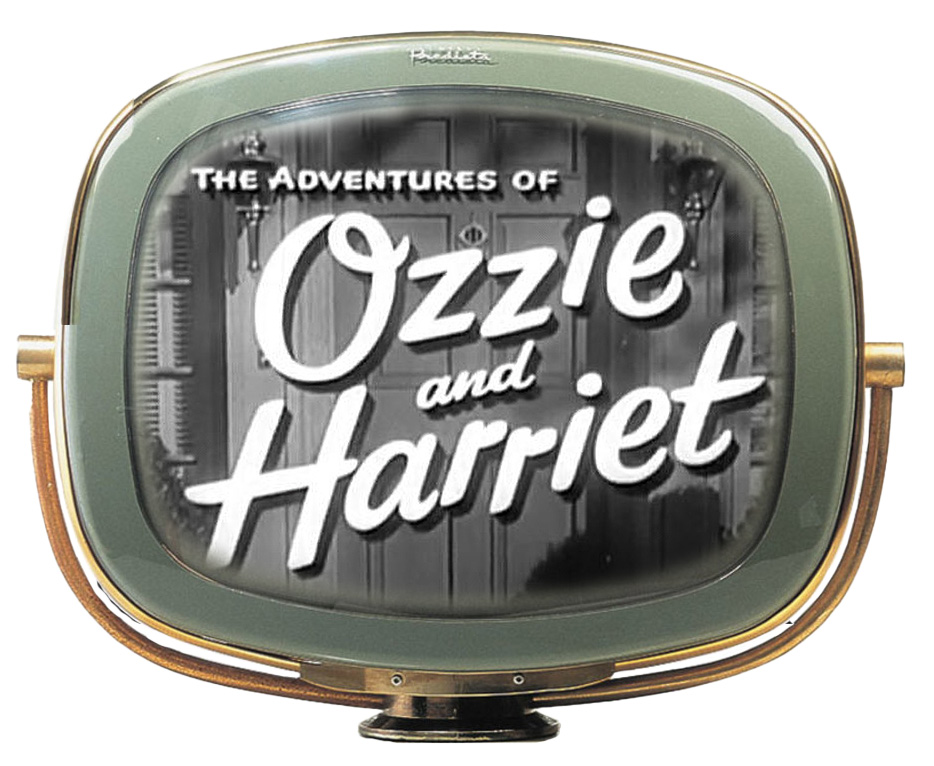
The actual invitations went out at 7:30 PM on Friday, October 3, 1952, in the televised premier of The Adventures of Ozzie and Harriet.
The basic framework for the show was easy to replicate from week to week: genial domestic comedy built around benign plots like a burnt dinner, a mix-up at the hardware store, or one of the boys’ teenage schemes.

To add authenticity to their screen presence, ABC’s set designers photographed and measured the Nelsons’ real home, then meticulously recreated it on a soundstage.
For Ozzie and his crew, the faux setting afforded total control over lighting, staging, and camera placement.4 For viewers, it created the illusion that they had been welcomed straight into the Nelson home, to hang out with a stay-at-home mom who was always camera-ready, two clean-cut sons, and a dad who was always around without ever seeming engaged in any form of employment.

The televised Adventures of Ozzie and Harriet landed in a perfectly primed postwar economy. Between the GI Bill and the explosion of affordable, single-family homes in new communities like Allentown and Levittown, the Nelsons reflected an aspirational lifestyle that radiated within reach of the nearest television tower.
In this electronic petri dish, the Nelsons incubated the culture the new medium demanded: the white, increasingly affluent audience that advertisers wanted to reach, and the suburban lifestyle viewers aspired to attain.5
Over the prior hundred years, America had gradually shifted – from rural, individual, and agrarian to urban, corporate, and industrial. The rapid adoption of electronic mass media accelerated that trend in the decades between the world wars.
After the Second World War, TV shows like The Adventures of Ozzie and Harriet delivered a Trojan horse to America’s doorstep at the subliminal rate of 30-frames-per-second. Hidden within each half-hour episode was the seductive corporate ideal of the American Dream.
Over the ensuing decade, Ozzie and Harriet’s saccharine portrayal of American family life was replicated across the prime time continuum. Among their offspring:
- Father Knows Best (CBS/NBC, 1954–1960)
- Leave It to Beaver (CBS/ABC, 1957–1963)
- The Donna Reed Show (ABC, 1958–1966)
- My Three Sons (ABC/CBS, 1960–1972)
Even The Real McCoys (ABC/CBS, 1957–1963) managed to adhere to the “family works through problems together” model, albeit in a rural rather than a suburban setting.

Ozzie and Harriet added another valuable ingredient to the family formula when 16-year-old Ricky Nelson – already a heartthrob for female fans – launched a recording career by singing I’m Walking on the show in April, 1957.
Ricky’s new career presented another bonanza for Ozzie, who readily saw the crossover potential between his son’s performances on television and his records. He negotiated a contract with Imperial Records, and while the label owned the masters (in exchange for paying for the sessions), Ozzie held on to the TV rights.
In an echo of the old “one sponsor” model, Ozzie’s deal blurred the line between programming and promotion: the TV show attracted a youthful audience. That brought the label a national platform. And the Nelson family earned both TV royalties and a share of Ricky’s recording income in a self-sustaining loop in which the TV exposure, record sales, and music publishing revenue all fed one another in a self-sustaining loop.
16-year-old Rick Nelson makes his debut as a singer on April 10, 1957
By the early 1960s, Ricky Nelson was one of the most successful recording artists in the country – and the Nelson’s TV home was a pipeline for both family-friendly comedy and a palatable version of teen rebellion delivered with the imprimatur of parental approval.
Ozzie and Harriet was the right show at the right time. As television wove itself ever more deeply into the fabric of the nation, the Nelsons portrayed conformity and stability in 30-minute flagons of consumer confection. Their lives were frictionless, the house was always tidy, the family stayed together, and the outside world rarely intruded.
And viewers could easily have all that they saw onscreen so long as they purchased the right household products.

The last original episode of The Adventures of Ozzie and Harriet aired on ABC on on April 23, 1966. With a total of 435 episodes over fourteen seasons, the show that was created by a man with no discernible job still holds the record for the longest live-action sitcom ever aired on television. 6
The world that witnessed the Nelson’s cancellation in 1966 was vastly different from the one that had enjoyed its premiere in 1952. By 1966 the country had withstood a presidential assassination, The Beatles and the British Invasion, escalating tension over the war in Southeast Asia, and the struggle for equal rights at home.
But the end of its network run was hardly the end of the Nelsons on TV. After dropping “The Adventures of” from the title, ABC started offering syndicated reruns of Ozzie and Harriet, packaging mostly the later seasons – after Ricky had become a pop star – to appeal to younger audiences. The show never achieved the rerun success of I Love Lucy, and by the 1990s only popped up occasionally on nostalgia cable channels like Nickelodeon’s Nick at Nite. Suffice it to say that Ozzie and Harriet’s idealized portrayal of life in postwar America did not age well in the last decades of the 20th century or the first decades of the 21st.
Ozzie Nelson stayed active in television production until his death in 1975 at age 69; Harriet acted occasionally and became recognized as matriarch of television before she died in 1994 at age 85. David moved into directing and producing until his death in 2011 at the age of 74.
Rick Nelson’s music career continued into the 1970s, though it was eventually overtaken by personal and professional struggles. Rick and most of his Stone Canyon Band perished when their DC-3 caught fire and crashed in Texas in 1985, when Rick was just 44 years old.
Though the show never topped its slot in the ratings nor won an Emmy award, The Adventures of Ozzie and Harriet remains an icon of its time. For more than a decade, the Nelsons reflected American ideals and projected American aspirations. Their family and their show left an indelible imprint on both the medium and the country, but neither the medium nor the country were immune to change.
__________________________
There are countless episodes and clips of The Adventures of Ozzie and Harriet on YouTube. Here’s one from the first season, an episode called “The Pills.”
_______________________
1 In 1936, Harriet landed her most visible screen role opposite Fred Astaire and Ginger Rogers in Follow the Fleet — a credit that still appears on every movie channel that runs the film.
2 From 1941 to 1943, the Ozzie Nelson Orchestra was the house band for The Red Skelton Show on radio, providing music between Skelton’s monologues, sketches, and recurring characters like Clem Kadiddlehopper and Deadeye. Skelton brought those characters to television in 1951, beginning on NBC and then moved to CBS in 1954, running for a total of 20 years until 1971.
3 ABC, as the “third-place” network with a thin prime-time lineup, was more willing to make deals favorable to talent in order to attract recognizable names and proven shows. That included granting Ozzie Nelson complete ownership and creative control of the TV version.
4 Ozzie & Harriet did not use the three camera before a live studio audience format that Desi Arnaz had developed for I Love Lucy. Ozzie opted instead for the single-camera style on 35 mm film, just like a movie. With no studio audience, a laugh track was added in postproduction.
5 The Adventures of Ozzie and Harriet rarely included anything other than white characters in its
depiction of suburban life. If Black actors did appear, it was typically in peripheral parts – as delivery men, service workers, or musicians — and they were not integrated into the Nelsons’ social circle or storylines. There were no recurring Black characters on the show, and no episodes where a Black guest star was central to the plot. Nevertheless, Los Angeles and Southern California – where the Nelsons lived – were actually quite racially diverse.
6 In its 14 seasons from 1952 to 1966, The Adventures of Ozzie and Harriet’s 435 episodes remain the record for a live-action sitcom (though some dramas, most notably Law and Order and Grey’s Anatomy aired more than 435 episodes). The Simpsons has aired more than 700 episodes but is animation, not live-action . It’s Always Sunny in Philadelphia began in 2005 and entered its 17th season in 2025, so it has arguably run longer than Ozzie and Harriet in years. But with shorter modern seasons producing only about 170 episodes, Ozzie and Harriet remains the undisputed champion in total episodes produced.
________________________