_______________________
September 7, 2027 will mark 100 years from the day when electronic television made its first appearance on Earth. To generate interest in the Centennial, this website and accompanying podcast is going to Count Down the Top 100 Milestones from the First 100 Years of Television over 100 weeks until September 7, 2027.
________________________
________________________
Though he is largely forgotten in the public imagination, it is genuinely intriguing how often the legacy of Philo T. Farnsworth drifts in and out of the history of television. Reminders of his inventions can often be found lingering on the periphery of the industry if you know where to look.
Television’s annual Emmy Awards is a good example. Fittingly, the story begins with another relative unknown.
During World War II, Sydney (Syd) Cassyd worked with the U.S. Army Signal Corps, writing and directing training films and learning the logistics of production. After the war, he worked in development at Paramount Pictures during the period when the film industry was trying to sort out how television was going to fit into its business.

Syd Cassyd was neither a celebrity nor a mogul. He was a networker, driven by the firm conviction that television could serve civic and educational purposes in addition to its obvious potential for entertainment. In this regard he shared the vision that had partially motivated Philo Farnsworth – that TV could elevate public discourse and human understanding. Cassyd’s background in film, and working out of Los Angeles rather than the broadcast corridors of New York, gave him a different perspective on the industry’s promise.
When he observed how little community structure existed around the new medium, Cassyd began inviting writers, producers, engineers, and executives to informal meetings to talk about television’s potential and the need for industry goals, education, and recognition.
In November, 1946 these informal gatherings led to the formation of the Academy of Television Arts and Sciences (ATAS). The name was an echo of The Academy of Motion Picture Arts and Sciences (AMPAS), the organization that began awarding the trophies known as “Oscars” in 1929.
As the titular founder of ATAS, Syd Cassyd at first resisted the idea of creating an award like the Oscars. He did not want ATAS to become a self-congratulatory trade group. He hoped instead to foster a forum for discussion, education, and other scholarly pursuits. And he disliked the idea of competition in the arts, especially for a new medium that was still finding its creative footing.
Despite his reservations, it did not take long for Cassyd to realize that awards could help legitimize television and elevate its reputation for lowbrow entertainment. In 1948, the Academy set out to create an award for Outstanding Achievement in Television.
All they needed was an actual trophy – and a name for it.
In 1948, the Academy established a nationwide competition to find a design that would reflect the both the traditions of art and the new technology that defined the medium.
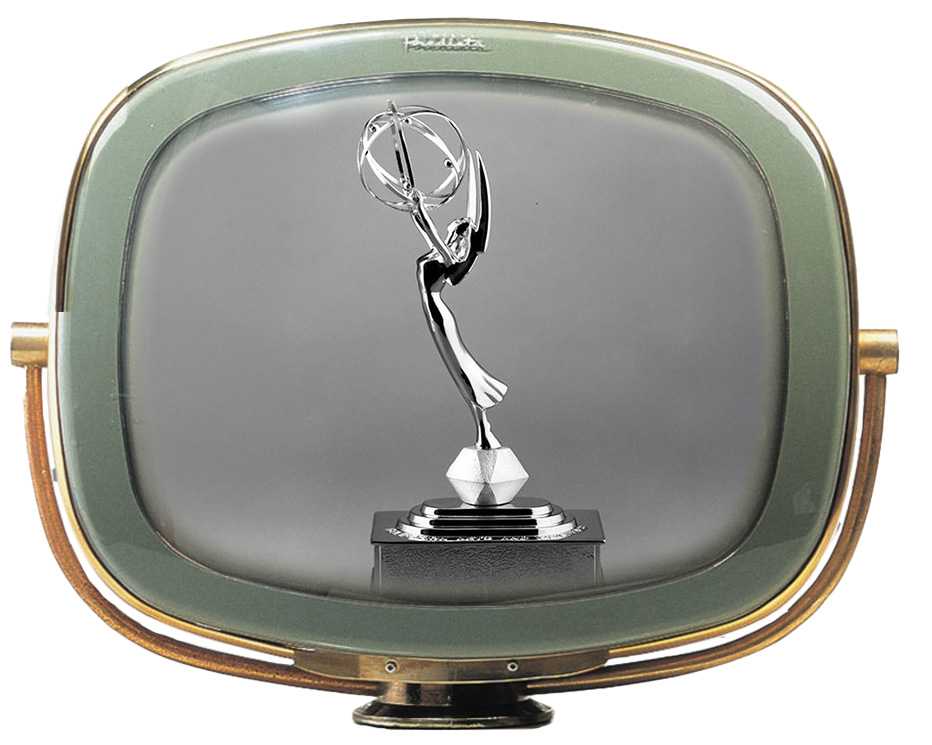
From 47 submissions, the winning design came from Louis McManus, a television engineer and art director who had worked on early broadcast graphics. McManus submitted a sketch of a winged woman holding aloft an atom. The wings represented the muse of art; the atom symbolized the electron and the scientific breakthroughs that made television possible.

McManus used his wife, Dorothy, as the model for his design, which stood out for its elegant reflection of the Academy’s mission to promote both creative excellence and technical innovation.
Once the design for the trophy was settled on, all that remained was to decide what to call it.
The first idea was to call the new award “Ike” after the Iconoscope – the camera tube that RCA introduced in the 1930s. There’s no direct evidence that RCA or David Sarnoff advocated for the name, but RCA still had a huge influence on the technical vocabulary of the industry, so maybe the reference seemed a natural fit for some Academy engineers.
The idea was quickly rejected, though, if for no other reason than because “Ike” was already widely associated with General Dwight D. Eisenhower, a national icon even before seeking the presidency in 1952. Nor did it seem like a good idea to burden the statuette of a winged female with an ostensibly male-sounding name.
The gentle push for a less masculine but still technically grounded name came a source within the Academy’s membership whose roots go back to the earliest days of the medium.
In 1929, Harry Lubcke was an electrical engineering student at U.C. Berkeley. He wasn’t necessarily looking to be a pioneer in television, but he got a job at a small laboratory at 202 Green Street in San Francisco, where he found himself working on the most novel electrical project of the day alongside none other than Philo T. Farnsworth.
Under Farnsworth’s encouraging eye, Lubcke built scanning and synchronizing circuits for the first electronic television systems. In 1930 he co-authored a pioneering technical paper with Farnsworth, The Transmission of Television Images, which was published in the February issue of San Francisco Engineers.

Harry Lubcke was intimately involved in the technology that brought television to the point where, in 1948, the industry he’d helped create was ready to hand out awards. So it comes as no surprise that it was Harry Lubcke who first suggested that, rather than the outdated Iconoscope, the trophy be named for the dominant camera tube of the day, the Image Orthicon.
And the Image Orthicon, you’ll recall, was named in part for Philo Farnsworth’s original camera tube – the Image Dissector – the breakthrough device he first he conceived as a teenager in 1921 and delivered on his workbench in 1927. And, the Image Orthicon was, in fact, based on a 1935 Farnsworth patent disclosed notable improvements to the Image Dissector.
Lubcke’s first suggestion was to call the TV Academy’s new trophy “Immy,” and that was easily feminized to “Emmy.”

The first Emmy Awards were presented on January 25, 1949 at the Hollywood Athletic Club. The ceremony was largely a local affair, recognizing achievement only in the Los Angeles area. It was hosted by Walter O’Keefe, tickets cost just $5, and a total of six categories were awarded.
Among the honorees were Shirley Dinsdale, a ventriloquist, who won for Outstanding Personality; the game show Pantomime Quiz Time won Most Popular Program; and KTLA, recognized for overall TV station performance.1 A special award was given to Louis McManus for designing the Emmy statuette.

Ironically, the first Emmy Awards ceremony was not telecast anywhere. Televising the event did not begin until 1953. By then, there were two Television Academies – the original ATAS in Los Angeles and the sister National Academy of Television Arts And Sciences (NATAS) in New York.
On January 23, 1953 Los Angeles station KTTV was the first to carry any Emmy ceremony on the air, though it was still a local affair.

On March 7, 1955, the two branches joined forces for the 7th annual Emmy Awards, the first to be televised nationally, on NBC. That broadcast ceremony marked the Emmys’ transition to a national, primetime-focused event, aligning with the explosion of coast-to-coast network broadcasting in the early 1950s.
Assuming the tradition continues, the Television Academy will present its 79th Emmy Awards in the fall of 2027, just as (OK, “electronic”) television itself observes its Centennial.
In 2003, the Academy finally recognized Farnsworth himself with the creation of the Philo T. Farnsworth Award for Corporate Achievement in Science and Technology. That year, the first Farnsworth award was presented to the Sony Corporation in recognition of its long history of novel contributions to television technology, including advances in broadcast equipment, cameras, recording formats, and consumer video technologies.
In the meantime, it seems important to remember that every one of the thousands of local and national Emmy statuettes that have been awarded for every aspect of the art and science of television since 1949 bears, however faintly, the imprint of its true inventor.
_
at ~9:30 into this interview for the Television Academy Archives, Pem Farnsworth shares her recollections of Harry Lubcke, the Image Orthicon Tube, and Harry’s role in naming the Emmy Awards.
_____________________
1 There were other experimental TV stations in the Los Angeles area starting in the 1930s – most notably Don Lee Broadcasting’s W6XAO – but these broadcasts were non-commercial, irregular, and reached only a handful of receivers. KTLA is generally recognized as the first commercial television station in Los Angeles. Owned by the Los Angeles Times, the station conducted experimental broadcasts in the early 1940s with the call sign W6XYZ, and began regularly scheduled programming on July 22, 1947. The call sign was changed to KTLA when the FCC granted its commercial license later that year. The “K” was designated for stations west of the Mississippi; the “TLA” stood for “Television Los Angeles.”
________________________