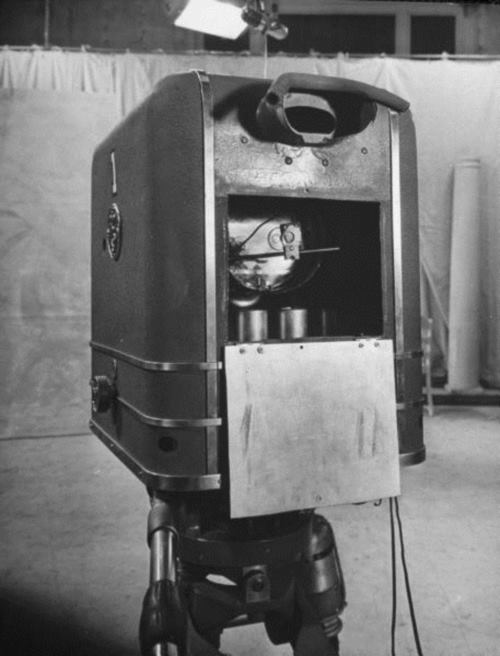
On the back side, things are a little crude on the outside, but inside…state of the art. That pitiful looking viewfinder allows the operator to see an optical image on a ground glass screen. Like the image on the Iconoscope tube (right), it is also inverted and backward meaning panning left with the camera would make the image center move to the right, tilting up would make the image center move down, and so on. On the left, you can see the rear of the Iconoscope tube but the image shown on the right could not be seen from there as the receiving surface faced the lens on the front of the camera.
Related Posts
1951: CBS Television At 20
- September 15, 2016
CBS looks back on 20 years of television innovation in this 18 page review from July 1951…smack dab in the middle of the Color War with RCA/NBC.
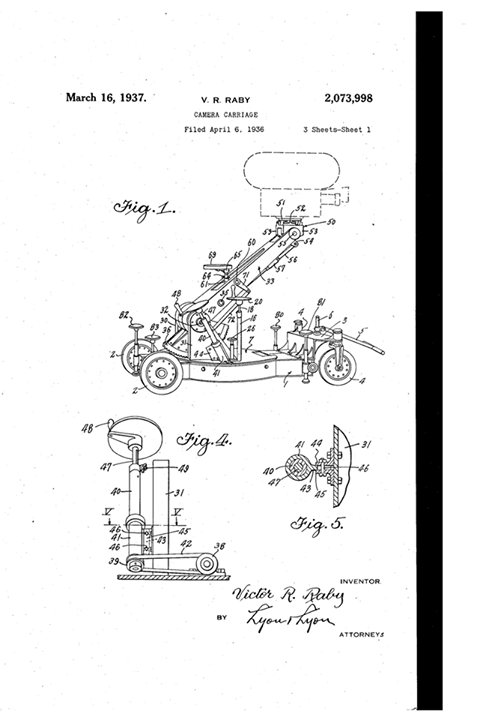
The First Camera Dolly, 1936
- January 20, 2014
The First Camera Dolly, 1936 In the patent application, this is referred to as a “camera carriage” and as you can see, it has only three wheels. Designed by Victor Raby and made by Studio Equipment Company, these are now rare items and only a couple of these are still around. One of the survivors […]
1946: Mechanical Color Wheels or Electronic Color?
- May 1, 2016
The question of the day: the choice between the CBS color wheel (sequential field system) or the RCA electronic dot matrix.
NBC Facilities Rate Book, 1959
- April 14, 2016
Want to do a program at one of NBC’s facilities? Here’s how much it would have cost you back then.