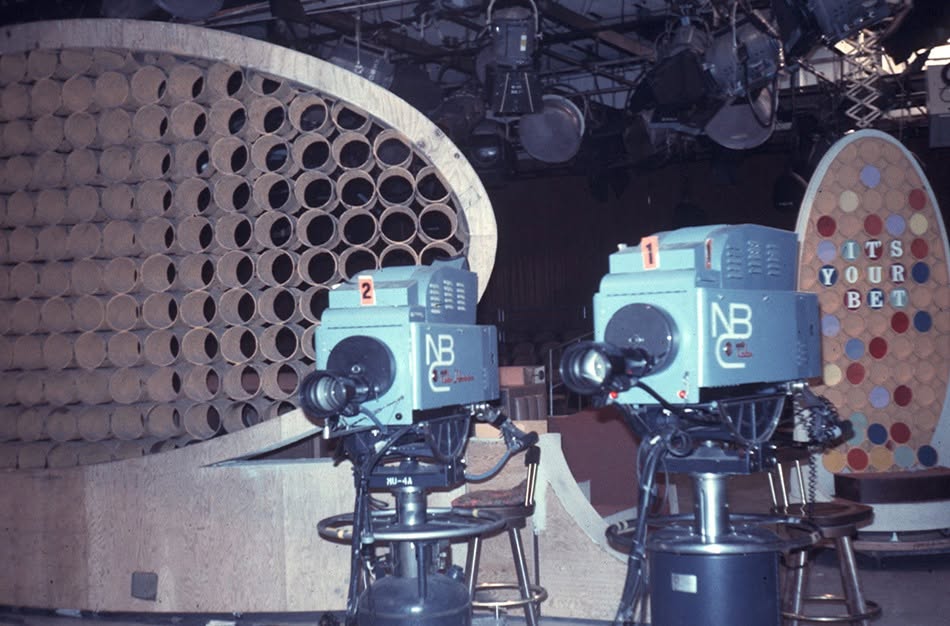
EDITOR’S NOTE: With the receipt of the exceptional new image above, I am updating this story that I finished researching and writing just a couple of months ago. MANY THANKS to our Washington D.C. friend and photo sleuth, Tom Buckley for finding the only known color image of the Blue TK41s at NBC Burbank. Now, that is NOT the surprise here, but as I reevaluate the elements of this story, I realize that I, as the historian writing this, have known of these not so well-known elements for a long time and have not presented the uniqueness of some things here with as much emphasis as I should, SO… here we go, again! THIS time with more emphasis on the four unique points to be laid out here. -Bobby Ellerbee
I would hope that if back in the 1970s, NBC knew what I am about to reveal, they would have made every effort to save these cameras because they are truly special. As I tell this story, it seems that perhaps the first generation of color employees knew about this marvelous act of NBC’s historical pride, but as time passed it seems the story of the blue cameras slipped away, like a faded memory. It seems the blue cameras were not a secret from 1955 till about 1967-68, but by then, they became one. And seem to be as forgotten about, as the modified TK41 viewfinders we saw on the 1968 Elvis Presley “come back” show.
Which blue cameras? What are you talking about? Well, the five or six cameras that look like the two above IN THE JUST DISCOVERD PHOTO of them in NBC Burbank Studio 2! The image, which is the only known color photo of the blue RCA TK41s inside Burbank, was recently discovered in a box of slides from a late 1960s high school class tour of LA area TV and Radio properties. Prior to this update, the image below was the photo at the top of this story, but because I wanted you to see what color the cameras were out in the light of day, here is that striking image again, and this RCA TK41 is most definitely BLUE! SURPRISE #1
It is not RCA “New Look” blue, because these RCA TK41s were painted this baby blue shade in early 1955 and the first new look came in 1960. Could this color scheme have had anything to do with RCA finding blue as a new color for their equipment? This is a question that for now, will remain unanswered, BUT the answers that are coming up are real surprises!
I had thought about writing this in a question-and-answer style, but the stories complexity makes that too hard to follow, as does dropping clues for you to try and guess the historical significance of these cameras before I reveal it to you. All I can say is, from here on, you are in for the Granddaddy of all Color Camera Stories in Surprise #3!
To start, the main characters here are the very first TK branded RCA color cameras, the TK40s and 41s, and among the early surprises here, compared to their later kin is…1. their chassis color and 2. the right-side focus control. Below is one of the 5 TK40 prototypes in its original RCA Umber Gray. SURPRISE #2!

If you remember, the RCA Coffin Camera prototypes were being field tested at Palisades Park in New Jersey when the similar dark colored camera there overheated in the sun, so after that RCA decided all their new color cameras must be silver to reflect the heat. In Camden, the 5 new RCA TK40 prototypes (per the RCA Redbook of 1953) were almost ready to ship to the Colonial Theater, but at least 1 of them was RCA Umber Gray and perhaps it was the TK40 held at Camden to replicate updates made in the field. It would serve as the template camera for the first commercial build out of the new line. You see that template camera below with its creators gathered around.
 Below are two of the four, TK40 prototypes at the RCA/NBC color test facility, The Colonial Theater in NYC. There will be a test so please notice the left rear panel of the near camera, and you can see where the factory installed focus control has been removed. The cameramen liked the new focus control built into the right pan handle. The Coffin Cameras prototypes, that preceded the TK40 prototypes had this focus handle and the cameramen preferred it on this big camera too.
Now comes the interesting part for us camera sleuths. The blue camera below is in pretty rough shape, but that’s because it sat outside under a house trailer for a dozen or more years in California. It was discovered and rescued by my mentor (and yours) Chuck Pharis. Notice the hole on the rear panel (where the focus control knob had been) is just where the hole on the Colonial Theater camera is in the photo above! Hmmmm?! That is interesting you say, but what does the blue mean? TK40s and 41s were silver, except for that template camera in Camden.

Here comes SURPRISE #3 It just so happens, that when the first studio ever built specifically for color broadcasting was being completed, which was NBC Burbank Studio 2 in March of 1955, NBC New York sent at least 4 cameras designated for use in Studio 2. The story I know is that they were not new and were the oldest on hand. THE OLDEST? (Hmmmmmmmmmmmm?!)
Except for always using the three cables of the TK40s, all had been totally refurbished and upgraded which meant they were the latest and most UpToDate TK41 color instruments NBC had…and now, the kicker! These were the first TK series cameras ever built for color broadcasting! Are you getting the picture yet?
THESE CAMERAS WERE THE COLONIAL THEATER CAMERAS!!! Like this surviving beauty, from the estate of or friend Phil Savenick, which has the same empty hole for the side focus knob. There are more photos at this link https://photos.app.goo.gl/7wizasapJc5dUEkj9

So, you may be asking who painted them blue? Well, I’m still on that trail but I’m pretty sure it was Camden given that many of the internal electronics and prism elements were being moved around and upgraded. On the updating, let me just say this…all of the Colonial prototype cameras were RCA TK40s. By the time they earned a new coat of blue paint and arrived in California, they were all RCA TK41A models.

The ELVIS Special was shot in Studios 2 and 4 and the Elvis photo above is in Studio 4, because that is where NBC Maintenance began replacing TK41 viewfinders with Conrac monitors and building custom covers in their machine shop. They give a whole different look to the TK41 profile, but at least they suggest the beautiful John Vasos inspired curve on the original viewfinder covers. Here are some close ups below and believe it or not…the one pictured here is blue. How do I know? Keep reading!


Below are two of the 3 blue RCA TK41s bought from NBC Burbank. These were Studio 4 cameras, but this photo shows them at their new home at KGET TV in Bakersfield, California around 1970. The third camera bought by KGET is one you have already seen on this page. It is the blue camera Chuck Pharis rescued from under a trailer in Bakersfield and came from Studio 2 in Burbank. SURPRISE #4

So here is what we know: the RCA TK41s in both Studios 2 and 4 were all blue at one time. Studio 4 debuted a year after Studio 2 and their cameras may have been silver before the Conrac additions began (they were scheduled for the Studio 2 cameras also), but for one reason or another, they never got past the Studio 4 cameras which may have been painted blue to match the RCA New Look scheme, with their new viewfinders. FYI, one of the hottest tubes ever made was in that original RCA viewfinder.
Not all of the blue cameras at NBC Burbank were original Colonial Theater TK40 prototypes, but I believe at least 4 were and this camera that Chuck Pharis has IS ONE OF THEM! That is what gives us the belief that when Studio 2 debuted in 1955 as the first TV studio built for color broadcasting, its cameras were the first TK series instruments built for color broadcasting… from the Colonial Theater in NYC.
I’ve not mentioned this yet, but notice on these two blue cameras above, there is an added feature on top of the forward most fan door…it is a 30 Rock designed sound damp for hiding the fan noise when the camera is under a sound boom. I’m not sure where this started but my best guess is that the need arose first in studios that did soap operas. This would not have been added in Burbank as they had other tricks up their sleeves there, but if you see it on a camera, you know it was added in NY.

Long before this blue camera belonging to Phil Savenick appeared, Chuck had shown me his blue TK40 (below at the parade) and had told me about blue TK41s at NBC…he offered this photo below as “evidence”. I have a silver TK41 at my home and know how different it can look in different lighting conditions and I just thought this looked like a silver camera in the deep shade. Now, as of late watching old LAUGH IN shows, I can see blue TK41s and although the show “originated” from Studio 4, like many productions, they used both studios, so my money is on Studio 2 when you see the blue TK41s on LAUGH IN.

In closing, I want to thank Jim Smith, longtime video chief at NBC Burbank and Jay Ballard, longtime video chief at NBC New York and later ABC. They’ve answered a lot of my questions, but thankfully, they could not answer my main question, which is why I did this research and wrote this story.
In 1955, when most of this story began, RCA was a magnificent example of American ingenuity and development. So was NBC! Their people (in Burbank, NYC and Camden) would know this event as a sincere good luck gesture. The very same cameras that had brought color television to the world just a few short years before from The Colonial Theater, were now being sent to Burbank to the first television studio built specifically for color. They even painted the cameras “a new color” to commemorate the event.
As time goes by, companies are bought and sold, people move on, retire and pass away and leave…all their knowledge is lost. Almost. Sometime, the remnants of history remain to excite the curiosity of some, to search, to explore and to ask questions. It makes me sad to know that when NBC sold off these “used” cameras, they didn’t know the front end of the story. It was like they just “tuned into the middle of a show” and weren’t watching and didn’t know the plot or care about it. Had RCA not languished and imploded, I would like to think that they would have somehow made a move to protect these broadcast rarities, save them for their own museum. At least now we know what happened and why there were not only blue TK41s, but blue TK41s with weird viewfinders!
Below is the fully restored RCA TK40 Colonial Theater Prototype camera belonging to Chuck Pharis after he lovingly restored it to its original look and condition. The no vent viewfinder cover, a rebuilt inside and a total detail and paint job to bring her back to how she looked at The Colonial. (Yes, this is the beat-up blue cameras from above). Chuck and I knew a few years ago that this was a Colonial Theater TK40 but had no idea that it got to California via Burbank! It was only lately, after seeing some new pictures of the two blue cameras displayed on their console in Bakersfield that the pieces started to fit together.

This story is dedicated to our late friend, Phil Savenick who passed a couple of years ago and things haven’t been the same since. He was a very successful producer as you can see at this link. Phil Savenick – IMDb
Just so you know, the beautiful blue camera mounted on the pedestal was part of Phil’s collection and I’m happy to report that his blue camera is now part of a special multiyear display at The Nixon Presidential Library.
Phil did all he could to help the world remember Philo T. Farnsworth and would be happy to know that Eyes Of A Generation is celebrating the weekly countdown to September 7, 1927. That will be the 100th anniversary of the first transmission of an all-electronic television signal! It occurred at Mr. Farnsworth’s lab in San Francisco that day!