_______________________
September 7, 2027, will mark 100 years from the day when electronic television was invented. To celebrate the Centennial, this website and accompanying podcast are going to countdown the Top 100 Milestones from the First 100 Years of Television.
________________________
________________________
By the fall of 1963, Ed Sullivan had been one of the most popular figures on American television for more than fifteen years. The 30-40 million viewers who tuned in every week for his Sunday night variety show made Sullivan a cultural icon and one of the most influential gatekeepers of mid-20th century show business.
Sullivan regularly booked British and European talent on his show, and in October, 1963, he flew to London to scout future bookings.
Sullivan and his wife Sylvia landed at London’s Heathrow Airport on October 31 – just in time to witness a crowd of crazed teenagers screaming uncontrollably as a quartet of curiously coifed young men emerged from another airplane on the tarmac.
Startled by the chaos, Sullivan turned to a colleague and asked, “Who are those boys?”1
They were, of course, The Beatles.

When their paths first crossed with Ed Sullivan, John, Paul, George, and Ringo were already the most popular pop stars in Britain. That day at Heathrow, they were returning from a short tour of Sweden to a country already caught in the throes of “Beatlemania” – and Ed Sullivan was about to play an instrumental role in the phenomenon’s global spread.
Though still largely unknown in the U.S., the Beatles had been a rising force in Britain since their first single, Love Me Do went to #17 on the pop charts in the fall of 1962. Their second single, Please Please Me, was their first to reach #1 in the winter of 1963, followed in the spring by their second chart topper, From Me to You.
By the time She Loves You (“yeah, yeah, yeah!”) reached the top of the charts that summer, the Fab Four were firmly perched at the pinnacle of Britain’s pop music scene, and crowds of screaming teenagers drowned them out wherever they performed.
But in America, the phenomenon didn’t sow its first seeds until two months after Ed Sullivan asked the fateful question at Heathrow.
The Reluctant Label
Despite their juggernaut up the British charts, Capitol Records – EMI’s affiliate label in the U.S. – was slow to recognize the potential. The band’s first three releases – Love Me Do, Please Please Me, and She Loves You, were released in the U.S. on the minor Vee-Jay and Swan labels. All three received scattered airplay but none charted. There was no buzz, and Capitol considered the whole proposition – a British act on American airwaves? – as rather risky.
Meanwhile, in England, another Beatles single – I Want To Hold Your Hand – was released on November 29, 1963 and likewise sped to the top of the charts.2

Sometime in mid-December, Carroll James – a DJ at WWDC in Washington, D.C. – got his hands on an imported copy of The Beatles new single, weeks before Capitol planned to release it in the U.S. Accounts vary, but legend has it that a teenager whose friend had just returned from England brought the single to the station and urged James to play it.
Carroll James started playing I Want to Hold Your Hand on WWDC on December 17, 1963. This was not the first time The Beatles were played on American radio, but this time the reaction was explosive. Phone lines lit up and WWDC put the song on near constant rotation. Within days, other stations began scrambling to find copies and Capitol Records – which planned to release the single after the holidays – rethought the schedule.
I Want To Hold Your Hand was just starting its climb up the U.S charts, but The Beatles journey from England to New York was already in the works.
The Clock Starts Ticking
As soon as he got back to New York, Ed Sullivan told his staff about the frenzy he’d seen at Heathrow and instructed his long time producer (and son-in-law) Bob Precht to contact Brian Epstein, The Beatles’ manager. On November 11, a deal was struck: The Beatles would make three appearances on The Ed Sullivan Show in early 1964 for a total of $10,000 (roughly $100,000 in 2026 dollars).3 The band’s first appearance on The Ed Sullivan show was scheduled for Sunday, February 9, 1964.
There was just one catch.
The Beatles had famously said among themselves that they didn’t want to come to America until they scored a #1 hit on the American charts.
As soon as the deal was signed, the clock started ticking.
That first “bootlegged” European import of I Want To Hold Your Hand didn’t air on WWDC until a month after the deal was signed. But after the phones lit up, Capitol rushed the release to the day after Christmas – December 26, 1963.
This time Capitol pulled out all the stops on a nationwide blitz. The label reportedly spent $50,000 to promote the release through radio, press, and teen fan magazines. By mid-January, I Want to Hold Your Hand was racing up the charts. Advance orders from retail record shops ran in the millions.

Number One in the U.S.
At the end of January, 1964, The Beatles were in Paris completing a residency at the Olympic Theater. They were relaxing between shows at the Hotel George V on February 1st when Brian Epstein received a telegram with the news: I Want To Hold Your Hand had reached #1 on both the Billboard and Cashbox charts in the United States.
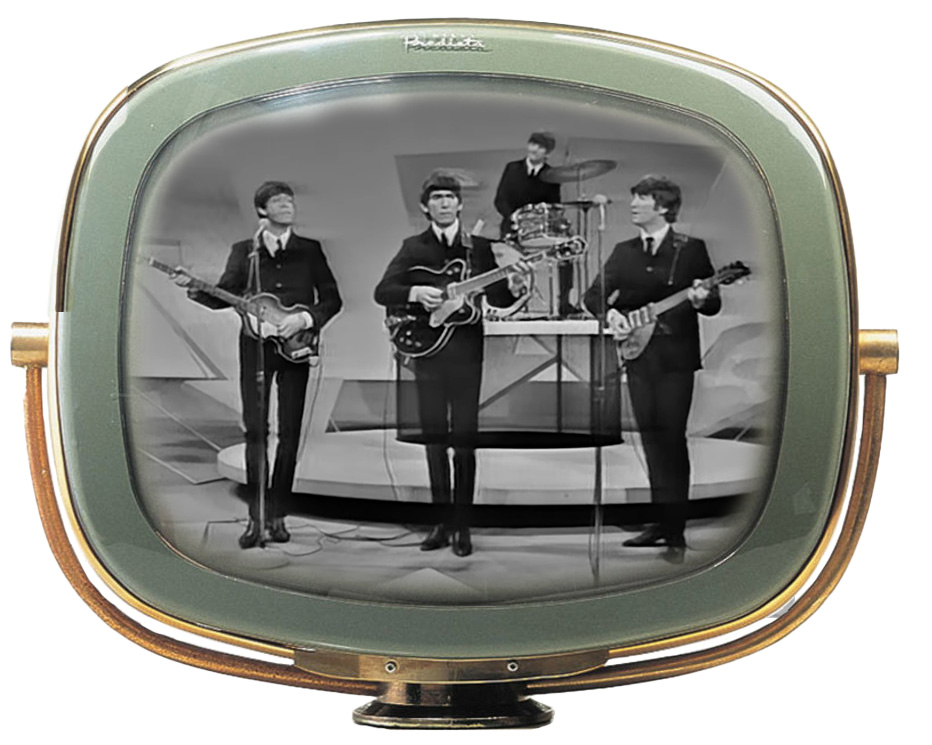
One week later, on February 9, 1964 more than 70 million people in America sat down in front of their cathode ray tubes to see what all the fuss was about.
As that Sunday’s show opened, Ed Sullivan acknowledged what was going to happen. He even mentioned a telegram he’d received “from Elvis Presley and Colonel Tom Parker” wishing the newcomers “tremendous success in our country.”
After a commercial, Sullivan reappears, all buttoned-down-and-Brylcreamed to tell the audience:
Yesterday and today our theater has been jammed with newspapermen and hundreds of photographers from all over the nation. These veterans agree with me that the city has never witnessed the excitement stirred by these youngsters from Liverpool, who call themselves The Beatles. Tonight, you are going be entertained twice by them – right now and again on the second half show.
And then, to the sound of screams that still ring down through the ages:
Ladies and gentlemen… The Beatles!
Near the center of an array of large white arrows converging around the band, Paul McCartney called out:
“1-2-3-4!”
The guitars shimmered and the drums crackled. Paul sang:
“Close your eyes and I’ll kiss you, tomorrow I’ll miss you…”
… and the world shifted on its axis.
Sorry Girls…
The Beatles performed two sets that night. During the second song, the classic ballad Till There Was You, the camera zoomed in for close-ups, with the name of each Beatle: Paul… Ringo… George… and John, with a parenthetical note: “Sorry girls, he’s married.”

The first set ended with the crowd pleasing She Loves You – the girls going wild when all four Beatles shook their scandalously long hair on the chorus of ooohs.
And what a fuss it was: The total audience for The Beatles’ U.S. debut on The Ed Sullivan Show has been estimated at 73 million, accounting for nearly 40% of the entire U.S. population of ~190 million.4 The number also represents an astonishing 60% of all television sets that were turned on that night. That number means that well over half the households in America were tuned in to see a theater full of teenagers screaming at four boys from Liverpool with floppy haircuts.
Aside from the screaming, modern mixes show how much jubilant sound these four “boys” could make with just two guitars, a bass, and drums. There’s John’s jangling rhythms, Paul’s throbbing bass, Ringo’s steady drums, and George’s deft guitar solos. As they play and sing they are conscious of which camera has the red light, and smile with confident joy at every harmonious note.
Sighs and Screams
And throughout, the cameras cut to shots of teen girls, one moment sighing in disbelief, screaming with abandon in the next.
At the end of the show’s final segment, the band returned with I Saw Her Standing There and the chart topper that made their appearance a reality, I Want to Hold Your Hand.

Something changed that night, and once again the catalyst was television – a machine that barely existed twenty years before. The Beatles’ appearance on Ed Sullivan was a defining moment for the postwar generation that had been raised in front of the tube.
At the very least, a whole generation of new musicians and rock stars was born that night. Bruce Springsteen, Billy Joel, Tom Petty, Nancy Wilson (of Heart), and Gene Simmons and Paul Stanley (of KISS) are just a few of the notables from the decades that followed who recalled February 9, 1964, as the defining moments of their lives.
The World Changed
Steven Van Zandt – Springsteen’s longtime bandmate – has described what a lot of young people experienced that night: “The world changed that day. February 9, 1964 there were no bands. February 10, everyone had a band. Everybody’s hair suddenly looked very short. Everybody’s clothes looked very boring. Everybody needed to have a band.”5
For the less musically inclined among the 70-plus million – the students who had been sent home from school to watch a weekend-long national funeral just a few months earlier – The Beatles on Ed Sullivan offered something of a respite from their collective trauma.
Their parents, on the other hand, looked at the novel haircuts and unfamiliar sounds and surely wondered what God had wrought.
JFK and The Beatles were back-to-back events that signaled the passing of one era and the arrival of something entirely new and – as the coming years would prove – tumultuous.
Those years would also deliver some of the most profound and memorable music and art ever written or produced, and much would find its roots in the night four boys from Liverpool beamed out from a TV screen singing “yeah, yeah, yeah.”
There was no way to predict then what was coming: Vietnam, campus protests, the continuing Civil Rights struggle, psychedelia, more assassinations, Woodstock, Watergate.
But in that innocent moment, amid ringing guitars and sparkling harmonies, the world was finally getting a clear look at the role that television could play – both in formulating what had arrived, and in shaping what would come.
______________________________
Now that you’ve read all about it… watch it.
___________________________
1 The line “Who are these boys?” appears in later accounts of this event. It may be paraphrased rather than verbatim, but the reaction itself is well documented: Sullivan immediately recognized this as something new.
2 As was the common practice at the time, the Beatles’ singles were not released on an LP. The Beatles second LP, With The Beatles (with the iconic black-and-white cover) was released a week before I Want To Hold Your Hand – on Friday, November 22, 1963.
3 In addition to the groundbreaking February 9 appearance, The Beatles appeared the following week live from Miami Beach, Florida. On February 23, the final appearance was one taped during rehearsals for the February 9 show.
4 For comparison’s sake: In modern terms, the 73 million that watched The Beatles on Ed Sullivan in 1964 would be like 125–130 million Americans today watching a single broadcast simultaneously – something that just doesn’t happen in the 21st century’s atomized digital media environment.
The only event that comes close in absolute numbers is Apollo 11 Moon Landing on July 20, 1969, with 125–150 million Americans tuning in for at least part of that epic broadcast. In more contemporary terms, a typical Super Bowl is the only thing that comes close.
5 Quoted from the Without The Beatles podcast December 7, 2024 episode.
________________________