_______________________
September 7, 2027, will mark 100 years from the day when electronic television was invented. To celebrate the Centennial, this website and accompanying podcast are going to Count Down the Top 100 Milestones from the First 100 Years of Television.
________________________
________________________
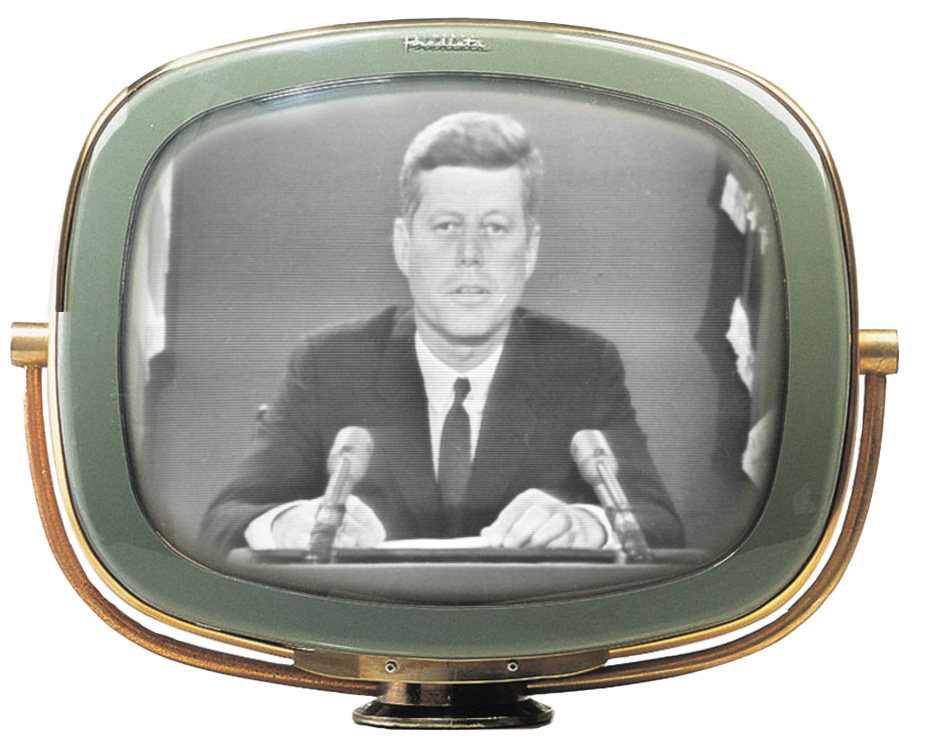
If the Cuban Missile Crisis did anything, it fulfilled television’s promise to put viewers in the middle of history as it unfolded, in a way that print readers or radio listeners could scarcely imagine.
From Herbert Morrison’s radio account of the Hindenburg disaster (“Oh, the humanity!”) in 1937 to Edward R. Murrow’s rooftop broadcasts during the Battle of Britain (“This… is London”) in 1940, radio made urgency audible for the listener.
But for viewers around the world, television made the impending doom of the Cuban Missile Crisis truly visceral. The maps and photos of missile silos displayed in living rooms from coast to coast engaged viewers’ central nervous system in a way that sound alone never could.
They they didn’t just hear the firmness in President Kennedy’s voice. His determined gaze beaming through the fixed frame of the screen made the tension between an existential peril and the president’s grace under pressure truly palpable.
Once the crisis had passed and the world went on about its business, what television audiences wanted was some kind of release. One way that television responded to the absurd prospect of nuclear annihilation was the time-tested tradition of satire. It is fitting that the first response would start in Britain – the first country to launch regular television service in 1936. 1
From Punch to Goons
From the caricatures printed in Georgian tabloids to the Victorian irreverence of Punch, the roots of British satire reached well back into the print era, fostering a tradition that assumed public life was fair game.

But in the age of electronic media, the BBC was the epitome of British decorum. This restraint was first dictated by John Reith, the founding Director-General of the British Broadcasting Company from 1927 until 1938. Reith’s guiding maxim was “inform, educate, and entertain” – in that precise order of diminishing priorities.
Public affairs were to be covered with impartiality, authority, and what came to be known as “Reithian restraint.” Sharp opinions were permissible, but critique stopped at the point of ad hominem attacks or maliciously mocking those in public office.
John Reith retired from the BBC in 1938, but his shadow loomed over the organization well into the 1940s.
So it might have come as a bit of a surprise to radio audiences in 1951 when the BBC launched The Goon Show, a surreal, anarchic comedy that challenged many of the conventions of traditional broadcasting.

Created by Spike Milligan and featuring rising comics like Peter Sellers, The Goon Show treated authority and bureaucracy as raw material for all manner of nonsense for nearly a decade. The airing of its final episode in the winter of 1960 left something of a hole in the British cultural landscape.
From Silly to Ridiculous
But if radio could make authority sound silly, then television could make it look downright ridiculous – and two years later the BBC rose to the task.
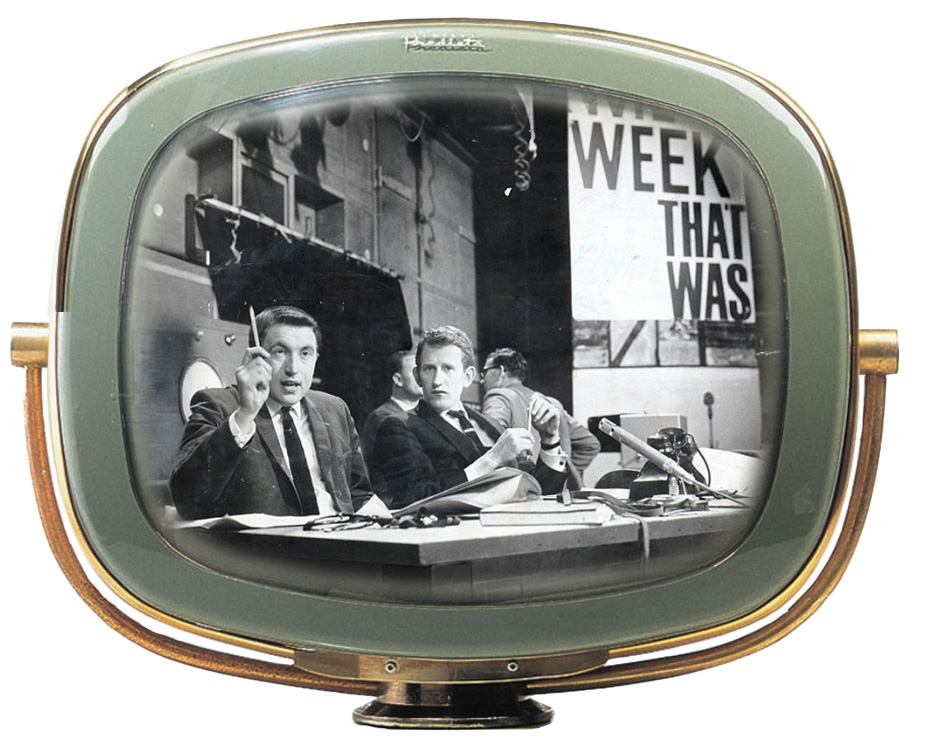
On November 24, 1962 – just a few week after the Cuban Missile Crisis – the BBC began airing a program that treated the week’s news not as sacred text, but as grist for large scale mockery.
That Was the Week That Was – or TW3 as it was quickly branded – wasn’t the first time politics was the butt of British humor, but it is fondly recalled as the first time television made topical satire the premise for a nationwide weekly comedy catharsis.
TW3 was created, produced, and directed by Ned Sherrin and Jack Duncan.
The host was an aspiring 23-year-old Briton named David Frost. Frost was neither a comic nor a journalist, but was earning a reputation as a clever, articulate champion of the postwar intellectual culture that produced Beyond the Fringe and other satirical revues.2

Frost had studied English at Cambridge, edited the university magazine Granta, and was coming up through the ranks of the BBC from the Talk department – a division that placed him in proximity to news discussion and analysis, rather than either straight news reporting or sketch comedy. He was smart, clean-cut, and spoke with the kind of precise British diction that lent an air of gravitas to his on-screen persona – even as he delivered devastating punch lines.
That Was the Week That Was was more than a variety show with topical jokes; it was a weekly act of cultural sabotage.
Putting a traditional comedian at the front might have framed the show as frivolous or irresponsible. Instead, David Frost, looked like someone who might just as plausibly be hosting the BBC’s flagship current affairs program, Panorama. 3Young as he was, Frost’s presence provided reassurance that the show’s incendiary material was being presented by somebody who bore some semblance to an adult. 4
From the first fade-in, TW3 offered a departure from anything that had preceded it. More than a “comedy about politics,” it was a kinetic collage that borrowed the familiar constructs of current affairs and journalism – headlines, quotes, summaries and debates were delivered with a serious tone – and then subverted them with sketches, monologues, and music.
The show vaporized whatever remained of John Reith’s long shadow of restraint and turned the venerable Beeb’s mantle of seriousness inside-out.
Satire to Sing Along To
Every week, TW3 opened with a musical number performed by Millicent Martin, a young actress and singer who warbled outrageous political observations with the calm demeanor of a BBC newsreader.

Martin’s phrasing delivered an absurdist counterpoint to the biting lyrical content, declaring in the opening minutes of each episode the show’s subversive tension between decorum and dissent.
The lyrics of the opening number changed with the headlines, but the show was careful to use the same melody every week – effectively turning the news into a chorus that the whole country could sing along to.
And, fittingly, the opening song of that first show in November 1962 offered a cutting recap of the recent, narrowly survived Cuban Missile Crisis – and the strange anticlimax that followed.
TW3 honed its satirical edge by putting public figures and institutions – the Prime Minister, the Parliament, establishment manners, and the hypocrisies of class and society – into a stark comic relief that seemed disruptive under the solemn mantle of the BBC. What was pioneering in its time seems obvious now, but it was startling amid a postwar BBC culture where convention and respectability were part of the brand.
That Was The Week That Was ran for only two seasons over 13 months, airing its last episode in Great Britain on December 28, 1963.
But that was not the end of the weeks that were.
Jumping the Pond
Even as the last episode aired in Britain, TW3 was setting up its second act across the pond.
After NBC secured the rights to replicate the program in the U.S., a pilot episode aired on November 10, 1963, under the direction of producer Leland Heyward.
David Frost remained the on-air face of the U.S. version – effectively importing the show’s tone along with its title. Between Heyward and Frost, the American version of TW3 leaned hard into its predecessor’s DNA.
Frost remained central, but American folk singer and actress Nancy Ames assumed Millicent Martin’s role as the resident vocalist. More of a trained singer than a comic, Ames helped translate the British program’s satirical format into the American idiom.
When it crossed the Atlantic, TW3 landed in an environment that was primed for its kind of humor. The trail had been blazed in print and radio, from editorial cartoons to Will Rogers’s folksy monologues. Early television variety shows routinely included topical jokes, but TW3 was the first program to make political satire the sustained focus of an entire broadcast.
That Was The Week That Was was by no means the first program on television— in either the U.K. or the U.S. — to make fun of politicians or joke about current affairs.
But TV historians routinely cite TW3 as a prototype: ground zero for a through-line that continued in the 1960s with The Smothers Brothers Comedy Hour, expanded in the 1970s through Saturday Night Live’s “Weekend Update,” and sharpened in the 1980s and 1990s with programs like Spitting Image and Politically Incorrect. Today, staples of late-night cable like Comedy Central’s The Daily Show and The Colbert Report all carry the DNA of That Was The Week That Was.
Millicent Martin opens an episode the British version of TW3
_________________________
1 Countdown #95: Mystic, Magic Rays
2 Beyond the Fringe was a landmark British satirical stage revue that premiered at the Edinburgh Fringe Festival in 1960 before transferring to London and Broadway. Written and performed by Peter Cook, Dudley Moore, Alan Bennett, and Jonathan Miller, it marked a decisive break from deferential, class-bound comedy, openly mocking politics, religion, and the British establishment. Its success helped usher satire from the margins of revue and radio into the cultural mainstream, clearing the ground for programs like That Was the Week That Was.
3 To this day a fixture on BBC-TV, Panorama began airing on November 11, 1953, making it the world’s longest-running TV news magazine program (NBC’s Meet The Press is both the longest running program of any genre and longest-running news interview show; Countdown #86).
Panorama specializes in sober, authoritative reporting: foreign affairs, domestic politics, investigative exposés, and long-form interviews, all delivered in a tone of institutional seriousness and editorial restraint. It was emphatically not “entertainment.”
4 Frost’s later reputation as a serious television journalist – most famously through his interviews with disgraced former U.S. President Richard Nixon in 1977 – grew directly out his tenure on TW3.
________________________