_______________________
September 7, 2027, will mark 100 years from the day when electronic television was invented. To generate interest in the Centennial, this website and accompanying podcast are going to Count Down the Top 100 Milestones from the First 100 Years of Television over 100 weeks until September 7, 2027.
________________________
________________________
By the end of the 1950s, American households were about as likely to have a television set as they were to have hot and cold running water – the difference being that TV viewers spent a lot more time gazing into the phosphor-lit vacuum than they spent cooking, dishwashing, bathing or flushing their toilets.
Nielsen and other industry sources estimated that by 1958, American households were watching roughly 4-5 hours of television every day – the equivalent of more than one day per week.
Around the world, the numbers were smaller but growing exponentially. Britain, Canada, France, West Germany, Japan, and the Soviet Union had all moved beyond their cautious postwar experiments. In many countries, TV penetration exceeded the 10% that some considered the threshold between a luxury and a necessity.

The medium that had spent the 1930s in laboratories and the 1940s in limbo was, by the end of the 1950s, the command center of a new kind of mass culture. The growth statistics describe a planet rapidly adapting to a collective consciousness – and billions of individual brains being quietly rewired to absorb a relentless bombardment of visual stimuli.
In this context, the years 1958 and 1959 produced several milestones that, taken together, recall a two-year stretch when television – now a fixture in the world’s living rooms – began to find its own bearings and blaze new trails. And, as much of the world was just beginning to tune in, American producers were forging the template for what television would look and sound like.
Television Discovers “Cool”
One way to understand 1958 is to see it as the year when prime-time television began to both reflect and dictate the style of the period
Three programs in particular—The Rifleman, 77 Sunset Strip, and Peter Gunn—premiered within months of each other. Each represented a different facet of television finding its own forms, learning to look and sound like the postwar world rather than an extension of pre-war radio.
The Rifleman brought textured narrative layers to the well-worn Western. The father-son dynamic between Lucas and Mark McCain added emotional shading to a genre that had grown stale with cookie-cutter archetypes.
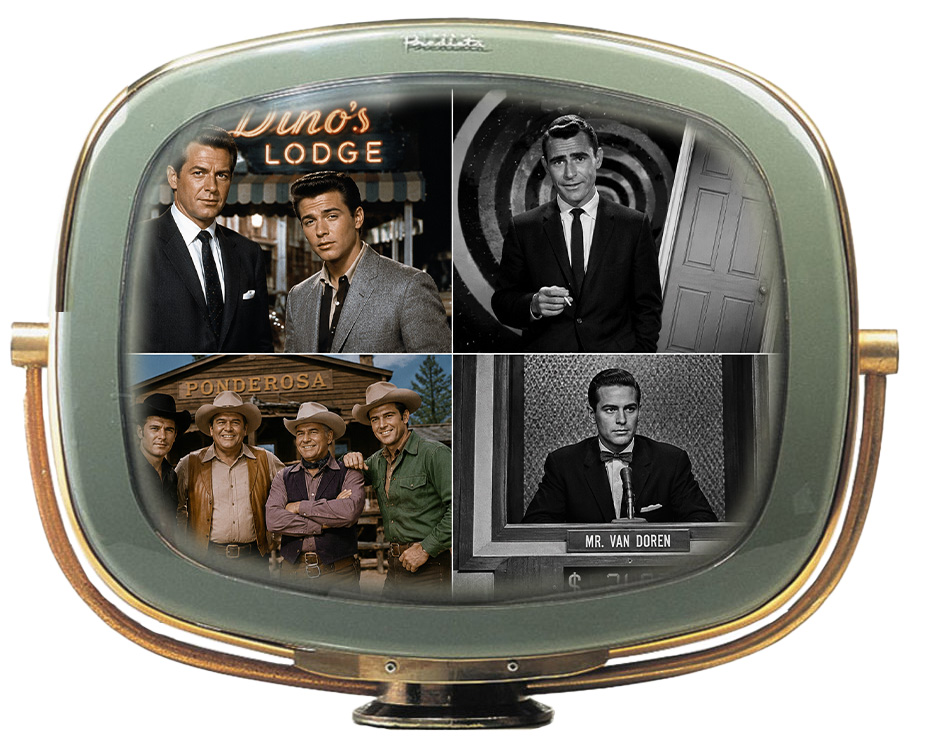
77 Sunset Strip embraced the glamorous contradictions of late 50s chrome-tail-fins Los Angeles, giving primetime its first weekly taste of Hollywood noir. Efrem Zimbalist Jr. anchored the series as Stuart Bailey, the cool, unflappable private detective. Edd Byrnes, playing Gerald “Kookie” Kookson III, the comb-waving parking lot attendant at Dino’s Lodge, became the show’s breakout youth icon.
___________________________________
The cold open and titles from the first season of Peter Gunn
________________________________________
And then there was Peter Gunn, which may be the purest expression of television’s mid-century awakening. Created by Blake Edwards and scored by Henry Mancini, Peter Gunn brought a new level of polish to the small screen. Mancini’s jazz themes announced something different: the series that didn’t simply borrow atmosphere from the movies—it imported a cinematic sensibility into a television format still dominated by stage-bound sets and radio-style blocking.
In shows like these, television revealed a fresh capacity for sophistication. After a decade of conventional Westerns, sitcoms, and live-play adaptations, here was something sleek and modern.
You Have Entered The Twilight Zone
If 1958 was the year television found its style, then 1959 was the year it discovered its twentieth-century imagination by slipping into Rod Serling’s Twilight Zone.

Rod Serling was a disaffected veteran of the TV trenches. Before The Twilight Zone, he had earned the dubious distinction of being the most honored – and the most censored – writer of television drama in the 1950s.
He established his bona fides as the author of some of the most memorable episodes of television’s “Golden Age” of live drama. His Requiem for a Heavyweight on CBS’s Playhouse 90 is still regarded as one of the greatest live television dramas ever aired, and earned Serling the first of his six Emmy Awards. He wrote dozens of episodes for shows like Studio One, Lux Video Theatre, and Kraft Television Theatre, often dealing with controversial subjects like race, corruption, war, and abuses of power – which themes often triggered objections from both networks and sponsors.
By 1958, Serling was at the top of his game, but had grown frustrated with broadcast television. His biggest clashes weren’t with networks, but with advertisers. For Requiem for a Heavyweight he was required to remove brand names so as not to offend cigarette, beer, and pharmaceutical sponsors. He had to rewrite No Time at All – a labor union story – after a sponsor objected to the depiction of a strike. And a script he wrote about Emmett Till – the Black teenager murdered in Mississippi in 1955 – was vetoed unless he removed all racial references.
“The sponsors censor everything,” Serling complained, “but the commercials.”
Seeking a forum that would let him explore controversial ideas, Serling pitched CBS with a fantasy/sci-fi anthology series. It was a hard sell. Anthologies that didn’t reuse the same sets or locations were expensive. Fantasy was dismissed as “kids’ stuff.” And Serling’s reputation for stirring up controversies made sponsors wary.
To entice the network, in 1958 Serling wrote The Time Element for Westinghouse Desilu Playhouse as a backdoor pilot. When it tested extremely well, CBS ordered a limited trial run, knowing they could market a new series “from the Emmy-winning writer of Requiem For A Heavyweight.”
The network watched nervously when The Twilight Zone premiered on October 2, 1959. The audience response and critical acclaim were so strong that the series was quickly extended.
______________________________________
The opening titles of The Twilight Zone – and its unforgettable theme music.
______________________________________
The series ran a total of 156 episodes on CBS from 1959 to 1964, with Serling himself writing or co-writing more than 90 of them.
With its anthology format cloaked in speculative fiction, The Twilight Zone did not merely entertain; it startled, provoked, and lingered in the viewers’ imagination. It gave television permission to be philosophical. It gave writers permission to think in original ways. The result was one of the most enduring programs in the history of the medium, and paved the way for similar series: The Outer Limits, Night Gallery and more recently The X-Files and Black Mirror.
With Rod Serling himself – cigarette in hand – introducing every episode, The Twilight Zone gave a literary quality to a medium often dismissed as mindless and trivial.1 His presence encouraged layers of fantasy, parable, and science fiction in a weekly exercise of nuance far deeper than anyone expected of the small screen.
After its run on CBS, the show immediately found continued success in syndication, and continues to run on the CBS-affiliated streaming service Paramount+. The Twilight Zone is routinely ranked among the most-watched classic series, and remains far more famous now than it ever was during it original run.
To this day, the opening notes of the show’s theme music are mimicked when conversation turns to the weird or inexplicable – even among generations born long after the show ended its initial run.
The Peacock Spreads Its Feathers
While the writers and producers stretched the medium in studios and on stages, the scientists and engineers in television’s laboratories and factories were quietly preparing the medium’s next big technical transformation: the all-out pursuit of color.
In the first years after the NTSC standard was updated, broadcasting in color remained a rarity. When RCA/NBC and Ampex introduced the first practical color-compatible videotape recorder in 1959, the ability to record color electronically set the stage for a full scale push into color TV.
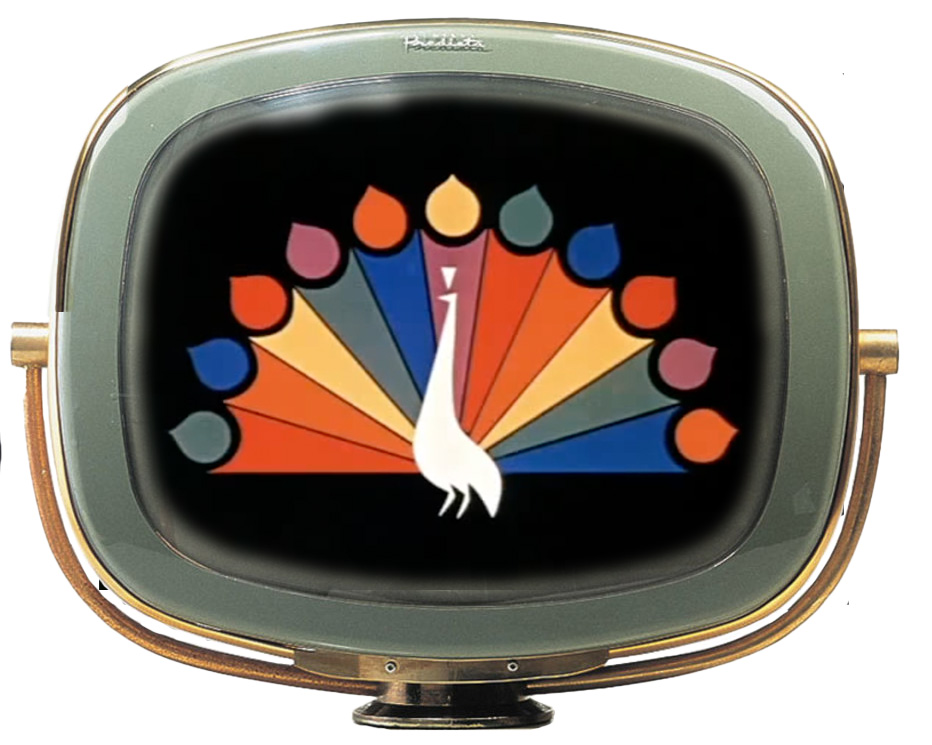
NBC started using the slogan, “brought to you in living color” in the mid 1950s. In 1956 the network added an animated peacock spreading its tail feathers. A handful of shows like The Cisco Kid, My Friend Flicka and Sergeant Preston of the Yukon were filmed in color or offered color episodes, but remained the exception. Most regularly scheduled programs continued to be broadcast in black-and-white.
Anthologies, specials and one-offs didn’t give viewers enough justification to make the costly leap into color. What RCA needed was a spectacle: a program that looked better in color week after week that could entice consumers to invest in RCA color televisions that sold for as much $600 – the equivalent of $6,000 in 2026.
With no hint of irony, NBC reached for the prize with a Western series called Bonanza.
_______________________________________
The opening title sequence from Bonanza
_______________________________________
Bonanza followed the weekly tribulations of the Cartwrights — widowed patriarch Ben Cartwright, played by Lorne Greene, and his three adult sons, Adam, Hoss, and Little Joe – as they protected their vast Ponderosa ranch amid the moral thickets of the Old West.
NBC focused on Bonanza after producer David Dortort shot the pilot on 35mm color film. When NBC president Robert Sarnoff saw the saturated footage of wide-open landscapes, brightly lit Victorian interiors, and vivid costumes, he must have thought he was looking at a brochure for RCA color televisions.2
When it premiered on September 12, 1959, Bonanza was not only the first hour-long dramatic series broadcast in color, it was the flagship of a whole corporate strategy. The program rewarded households that had already invested in color TVs – and showed everyone else what they were missing.
When Bonanza went on the air in 1959, there were fewer than 200,000 color receivers in American homes, but annual sales doubled and tripled through the early 1960s as RCA poured millions into marketing and manufacturing. By 1966 – when NBC became the first network to broadcast its entire prime-time lineup in color – RCA’s color-set division was generating more than half of the company’s profits.
Though they were initially reluctant to shoulder the added costs of color, CBS and ABC were compelled to follow NBC’s lead, and converted their prime-time lineups to color as well. By the late 1960s, most television programming was offered in color.
The combination of falling set prices and a full color schedule on all three networks generated hundreds of millions in annual revenue for RCA – and transformed Robert Sarnoff’s big gamble on color into… well, a true bonanza.
How About… A Little Scandal?
By the end of its first full decade, television had become the nation’s nightly ritual, the glowing electronic hearth around which families gathered not only after dinner, but often during.3 And nothing on the schedule drew larger, more devoted followings than the prime-time quiz shows.
Programs like The $64,000 Question, Tic-Tac-Dough, and Twenty-One turned seemingly ordinary Americans into instant celebrities possessed of superhuman memory and composure.

The game shows were popular with sponsors, too. For household names like Revlon and Geritol, the relatively low production cost made quiz shows the most profitable programming on television. They offered suspense, aspiration, and the reassuring fiction that success awaited any one off the street who could come up with the right answer before the other guy with a buzzer.
Behind the scenes, the economics of “authenticity” presented unique challenges. Real competition produced unpredictable results that produced nervous sponsors. If a charismatic champion lost too soon, ratings fell. If a new contestant froze on camera, tension evaporated. The pressures of live, sponsor-driven programming created an environment in which the line between contest and performance blurred quickly—and, ultimately, fatally.
The most egregious example was Twenty-One, produced by the seasoned but ethically elastic team of Barry & Enright.
The show’s signature device was a pair of “isolation booths” – fortresses of integrity that shielded contestants from outside cues. Behind the scenes was a very different story. Contestants were advised on topics, given answers, and even coached on facial expressions. The drama looked spontaneous, but it was engineered to maximize suspense.
In 1956 the show found its breakout star: Herbert Stempel, a Queens postal clerk whose encyclopedic memory made him an unlikely champion. Though obviously bright, Stempel came through the screen as clumsy and awkward – not the sort of character that sponsors wanted at the top of the ratings.

Instead, the producers groomed a new contender: Charles Van Doren, a handsome, soft-spoken Columbia University instructor who seemed tailor-made for magazine covers. Stempel was explicitly instructed to lose on a question he knew cold. Van Doren’s rise became a national phenomenon, and Twenty-One garnered its highest ratings.
The deception might have endured had Stempel remained silent. But after his forced exit, he began telling reporters that the show was rigged. At first he was dismissed as a sore loser. But as other contestants quietly confirmed patterns of coaching and manipulation, the claims gained traction. By 1958 the whispers had become headlines and in 1959 they became the subject of a Congressional investigation.
The decisive moment arrived in November 1959, when Charles Van Doren – after months of public denials and private pressure – appeared before a House subcommittee and admitted that Twenty-One had been rigged throughout his celebrated run. The confession was stunning: the handsome young scholar who had embodied the promise of television now embodied its deceit. NBC cut ties with Van Doren immediately. Columbia University accepted his resignation the same day.
____________________________________
This short YouTube documentary tells the whole story.
____________________________________
The collapse of the quiz shows was swift. Sponsors fled and networks purged their schedules. Several states passed laws prohibiting the fixing of contests, and the Federal Communications Commission expanded its oversight. Within eighteen months, the prime-time quiz show had virtually disappeared from the airwaves4.
Faking Authenticity
The quiz show scandals marked the first moment when Americans realized that television could fabricate reality as easily as it projected it. The medium that had promised transparency and immediacy had instead demonstrated how convincingly it could fake authenticity.
By the end of the 1950s, television had clearly entered a new era: confident enough to stretch its storytelling muscles in filmed Westerns and sleek urban dramas, imaginative enough to explore moral riddles in The Twilight Zone, and technologically ambitious enough to gamble its future on color.
But the quiz show scandals made plain that in addition to reflected and illuminated American life, television could just as easily manipulate it.
Reality and artifice were never more than a camera angle apart, and the world of “fake news” that would emerge decades later was not a break with the past but a continuation of conventions woven into the medium from its earliest, flickering days.
_______________________________
1 Rod Serling was an extremely heavy smoker, often burning through four or five packs a day. He frequently appeared with a cigarette in hand during his on-camera introductions for The Twilight Zone, especially in the early seasons. In some episodes he’s holding it, lighting it, or gesturing with it; in others the cigarette is off-camera but the smoke is visible curling up beside him. Serling died in 1975 after a string of heart attacks at age 50.
2 Robert W. Sarnoff (1918–1997) was David Sarnoff’s eldest son. He rose through the ranks of RCA after World War II, starting in advertising and corporate planning before being appointed president of NBC Television in 1953. Groomed as his father’s successor, he championed aggressive programming growth, early color promotion, and the integration of RCA’s hardware and NBC’s content strategy. By 1965 he had succeeded his father as president (and later chairman) of RCA, presiding over the company during the peak years of its color-television expansion.
3 “Frozen TV dinners” were actually a thing. After Thanksgiving 1952, C. A. Swanson & Sons food company found itself stuck with 260 tons of surplus frozen turkey. A salesman, Gerry Thomas, proposed packaging the turkey with sides in a three-compartment, aluminum, oven-ready tray modeled after airline meals. Swanson test-marketed it in 1953 as a “TV Dinner”—complete with a box designed to look like a television set—and sold more than 10 million units the first year.
4 The quiz show scandals of the 1950s did not kill the format permanently but it did change the rules under which they operated. During the early 1960s, networks largely abandoned high-stakes, sponsor-controlled, prime-time quiz programs in favor of games produced under stricter network supervision. By the mid-1960s, shows such as Jeopardy! (1964), Let’s Make a Deal (1963), and The Dating Game (1965) helped restore the genre’s credibility. Congress reinforced public confidence by passing amendments to the Communications Act of 1934 in 1960 making it a federal crime to rig or predetermine the outcome of a purported contest of knowledge or skill for broadcast, establishing legal safeguards that remain in force today.
________________________