_______________________
September 7, 2027 will mark 100 years from the day when electronic television made its first appearance on Earth. To generate interest in the Centennial, this website and accompanying podcast is going to Count Down the Top 100 Milestones from the First 100 Years of Television over 100 weeks until September 7, 2027.
________________________
________________________
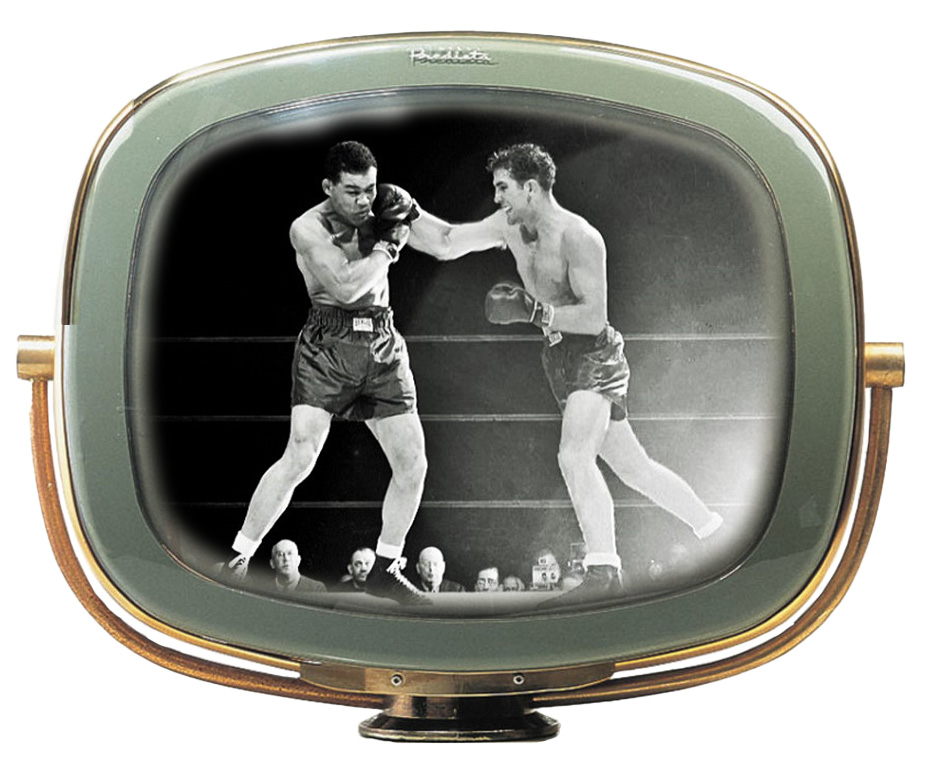
After the ‘false dawn’ of 1939-1941, one of television’s first steps out of its postwar crib was the telecast of a heavyweight title fight between Joe Louis and Billy Conn on June 19, 1946.
What makes the event noteworthy is not the fight itself (Louis knocked Conn out in the 8th round to retain his title) but the camera tube that NBC used for the first time for this particular broadcast: the Image Orthicon.
Despite the race to bring it to market, television was barely viable before the war. The camera tubes of the 1930s were hardly up to the task. RCA’s Iconoscope delivered a usable signal, but that signal came with a lot of noise, poor contrast, and required either bright daylight or unbearably bright studio lights. The images from Farnsworth’s Image Dissector were cleaner and more stable than those of the Iconoscope, but the tube was far less sensitive and also required a veritable flood of interior lighting.
Between 1937 and 1939, RCA arrived at a breakthrough when engineers at the Camden, NJ laboratory – primarily Albert Rose, E.G. Ramberg, and Harold Law – developed a camera tube that offered both improved sensitivity and image fidelity.*
RCA’s new tube bore little resemblance to Zworykin’s Iconoscope, but RCA insisted on calling it the “Orthiconosope” – adding the Greek prefix meaning “straight” to the older tube’s name for the sake of marketing continuity. The name was eventually shortened to “Orthicon” but, like everything else, development ceased at the start of the war.
The Image Orthicon was a further improvement, and arguably the video camera tube that changed everything in the mid 1940s.
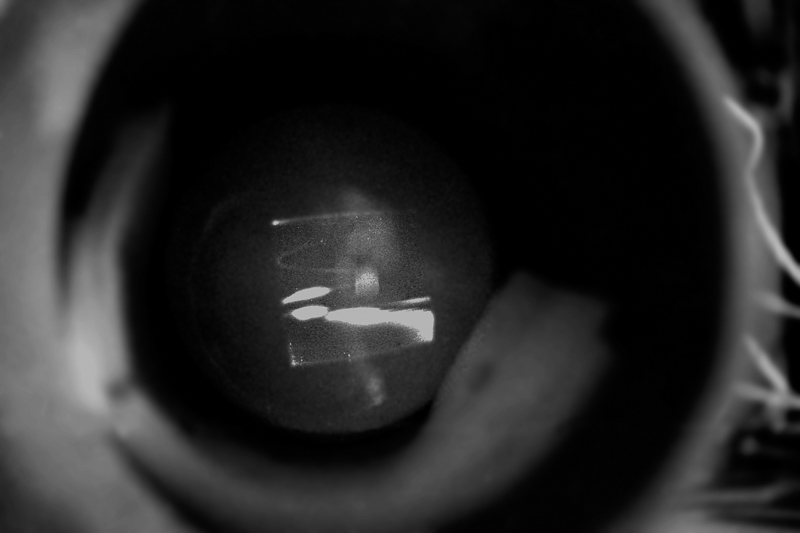
To understand why the Image Orthicon succeeded where its predecessors struggled, it helps to break down its internal architecture, which consists of four major elements:
– an electrical image
– a charge-storage target
– a low-velocity scanning beam
– a secondary-emission electron multiplier

Of those four elements, three derive largely from Philo Farnsworth’s work.
First, the scene to be televised begins its journey from light to electricity by landing on a light-sensitive surface that forms an “electrical image” – the breakthrough concept defined in Farnsworth’s first 1927-30 patents.
After being momentarily stored in a second element (about which more in a moment), the charge pattern is scanned by a “low-velocity electron beam,” something Farnsworth introduced in patents related to the Image Dissector in the 1930s.
Next, the signal from the low-velocity scan is amplified in an “electron multiplier,” a configuration that uses the physics of secondary electron emission that Farnsworth also began experimenting with in the early 1930s.
The only major component of the Image Orthicon’s architecture not derived from Farnsworth’s work is a target plate capable of momentarily storing the charge pattern – a principle adapted in both RCA’s Iconoscope and Orthicon tubes, but first developed independently in the 1920s by the Hungarian physicist Kálmán Tihanyi.1
So the Image Orthicon – the camera tube that delivered so many of the iconic television images of the 1940s and 50s – is based largely on Farnsworth’s innovations, albeit with crucial development and refinement by RCA engineers.

Even the name of the new camera tube was derived from its two predecessors: The “Image” part of the name is derived from the “Image Dissector” because the first element of the tube converts light into electrons in precisely the manner described in Farnsworth’s first patent. The “Orthicon” part of the name derives from RCA’s lexicon.
The sequence of events during these years is fuzzy, but this much seems certain: By 1939 RCA was existentially invested in the launch of television. But even as David Sarnoff added “sight to sound” at the New York World’s Fair, the company still refused to acknowledge or license the Farnsworth patents that made the new medium possible, starting with #1,773,980 from 1927-30.
Farnsworth’s improved “Image Dissector” patent dated back to 1933. RCA’s work on the Orthicons began between 1937 and 1939. We can only imagine the consternation facing RCA’s patent attorneys when they discovered that one of the critical elements of both new tubes – the low velocity electron scanning beam – was previously covered by a Farnsworth patent. So it comes as no surprise that a few months after the World’s Fair, RCA finally capitulated to Farnsworth and accepted a license for the use of his patents.
But wait, there’s more: By the time RCA accepted a license with Farnsworth, the patent office had been dealing for the better part of a decade with the company’s aggressive “pay no royalties” strategy. One patent officer was so fed up that he told Farnsworth’s attorneys that in addition to the patent rights to the Image Orthicon, “we’d have given you the name, too” – but that was covered by separate trademark provisions.

So we come to July, 1946. The war has been over for nearly a year. The nation is converting its military production to civilian uses once again. Thousands of highly trained engineers, technicians, and radio operators returned home with cutting-edge knowledge in electronics, optics, and signal processing. These veterans found work with companies like RCA, CBS, DuMont, General Electric, and dozens of other companies that were staking out claims on the new territory of television.
With the Image Orthicon, television finally had a reliable “eye” that could see clearly in the real world. The technical barriers were cleared. The legal impediments were settled.
And from that summer night in 1946, television antennas began appearing on rooftops all over the world.
___________________
If you really want to get into the weeds re: the inner workings of the Image Orthicon, here’s a detailed video that explains it all for you:
*The Orthiconoscope was first announced in Sept. 1939 with the publication of a paper by Rose and Iams in the Proceedings of the Institute of Radio Engineers (IRE). There also appears to have been work on a similar principle (low-velocity scanning) by Blumlein and McGee at EMI prior to the RCA initiative to develop a tube with low-velocity scanning.
1 RCA long credited this “storage principle” to Vladimir Zworykin, but the idea was first formulated by the Hungarian Kálmán Tihanyi, whose 1920s designs for an all-electronic camera introduced the “storage mosaic” that later defined the Iconoscope. RCA later absorbed Tihanyi’s patents and incorporated the storage principle into its own designs. For more, see the footnotes accompanying Countdown #94, “Now We Add Sight to Sound”
________________________