_______________________
September 7, 2027, will mark 100 years from the day when electronic television was invented. To celebrate the Centennial, this website and accompanying podcast are going to count down the Top 100 Milestones from the First 100 Years of Television.
________________________
________________________
As we have endeavored to do for you here, once you have peeled back the curtain of false narratives about television’s origins, you can begin to appreciate that its physics emerged from the same well of cosmic knowledge that gave the world nuclear energy — and atomic bombs.
The first paper that Albert Einstein published in 1905 was his articulation of the photoelectric effect – the process by which light becomes electricity. That is the essential principle that Farnsworth bottled in his Image Dissector tube1.

Later that year Einstein published his paper outlining the Theory of Special Relativity. Then in 1907, he added a coda that described the theory of energy/mass equivalence. That theory is more familiar in what is perhaps the most famous mathematical equation of all time: E=mc² – the theory that becomes fact in nuclear power plants and atomic bombs.
The thread of scientific logic that Einstein followed does not go straight from converting light into electricity to powering (or vaporizing) cities. The point is that all of these ideas emerged from a new understanding of the physical universe. The wholly electronic form of television that first appeared on Farnsworth’s workbench in 1927 emerged from the same intellectual paradigm as the advances in physics that powers nuclear submarines – and flattened Hiroshima and Nagasaki.
The two ends of Einstein’s seminal work came full circle in the autumn of 1962.
We Interrupt This Program
If you were planted before a TV at 7:00 PM eastern time on October 22, 1962, you would have most likely been watching one of three programs: On CBS, you were tuned into To Tell The Truth; on NBC, you were watching The Alfred Hitchcock Hour; ABC was broadcasting the wartime drama Combat!
But within minutes of the hour, instead of Hitchcock, NBC viewers saw an image of the Seal of The President of The United States, accompanied by announcement that:
NBC News brings to you from the White House in Washington an address by President Kennedy, declared to be officially of the highest national urgency. Mr. Kennedy met today with the National Security Council and conferred with leaders of Congress rushed back to Washington by Air Force jet.
And then…
The president of the United States….
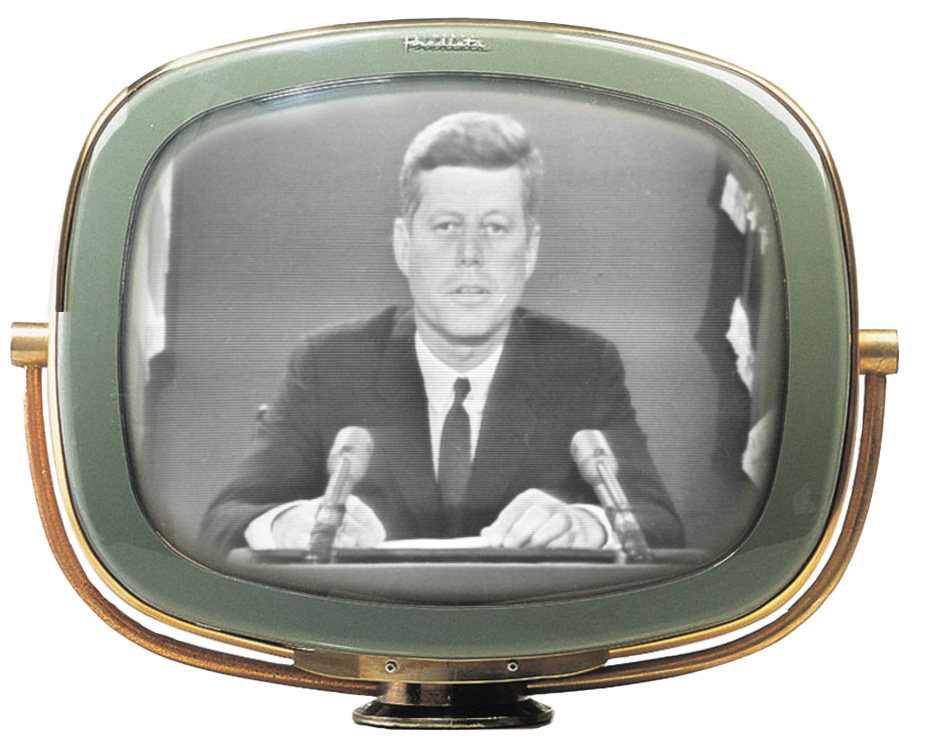
John F. Kennedy’s image appeared on the screen, from a hastily rigged broadcast facility in the Cabinet Room.2 Seated behind an uncluttered desk, against a neutral grey background with the America flag on one side and the presidential flag the other, Kennedy addressed the camera as some 85-90 million people watched anxiously from the other side of the lens.3
“Good evening, my fellow citizens.
This government has promised to maintain the closest surveillance of the Soviet military buildup on the island of Cuba. Within the past week, unmistakable evidence has established that a series of offensive missile sites is now in preparation on that imprisoned island. The purpose of these bases can be none other and to provide a nuclear strike capability against the western hemisphere.”
Prior to that Monday night, there had been reports of a Soviet military buildup in Cuba. Most of the coverage took the form of rumor and speculation about surveillance flights and missiles. By October 18, several journalists – like the New York Times James Reston and David Halberstam, and Washington insiders like Charles Bartlett and Walter Lippmann – sensed that something major was unfolding.

What nobody but Kennedy’s inner circle knew before the president addressed the nation was that the U.S. had photographic proof that the Soviet Union was setting up offensive nuclear missiles in Cuba – and that the prospects for a nuclear confrontation were being openly discussed at the highest levels of the administration.
Once Kennedy appeared on television and spoke of “nuclear weapons capable of striking most of the Western Hemisphere,” the national mood shifted dramatically from worrisome to downright apocalyptic.
Ashes In Our Mouth
Before charting a course of action, Kennedy clearly stated the stakes:
“We will not prematurely or unnecessarily risk the costs of worldwide nuclear war in which even the fruits of victory would be ashes in our mouth – but neither will we shrink from that risk if at any time it must be faced.”
Suddenly, the collective immediacy of television dramatically shifted the consciousness of the nation. This was the first time a sitting U.S. president used live television to announce a confrontation that could plausibly witness the end of the world.
For 18 minutes, the President of the United States detailed the deceptions that the Soviet Union had committed in violation of international laws and treaties, and how the “transformation of Cuba” with “weapons of sudden mass destruction constitutes an explicit threat to the peace and security of all the Americas.”
The president’s calm but grave tone turned global statecraft into a fact of daily life. For families gathered in their living rooms, the rhetorical abstraction of the “Cold War” suddenly mutated into an immediate and personal peril.
In measured terms, Kennedy announced several actions that the United States would take in the days ahead.
The centerpiece of the American response was an immediate naval “quarantine” of Cuba – carefully avoiding the use of the more bellicose word “blockade.” That meant that any Russian ships approaching Cuba carrying offensive military equipment would be turned back before reaching the island.
Next, Kennedy assured the nation that the U.S. would continue intense aerial surveillance of Cuba, and directed the U.S. Armed Forces “to prepare for any eventualities.”
Kennedy then made it clear that “any nuclear missile launched from Cuba against any nation in the Western Hemisphere” would be regarded as “an attack by the Soviet Union on the United States, requiring a full retaliatory response upon the Soviet Union.”

Kennedy’s address was both explicit and cautionary. In his closing remarks he reiterated the stakes and – to the extent he could without inciting panic – the potential consequences.
“It is difficult to settle or even discuss these problems,” Kennedy said, but insisting that any Soviet threat “must and will be met with determination.”
After addressing “the captive people of Cuba,” Kennedy set a sober tone for “the difficult and dangerous effort” ahead. “No one can see precisely what course it will take or what costs or casualties will be incurred. But the greatest danger of all would be to do nothing.”
It didn’t take a scholar of international diplomacy to read between the lines: “attack by the Soviet Union on the United States ” meant World War III and “full retaliatory response” meant nuclear annihilation.
Hard Truth, Real Consequences
After Kennedy’s address, the networks did not return to their regularly scheduled programming. Contrived Truth or Consequences were going to have to wait until the journalists and commentators had their chance to weigh in on the real thing.

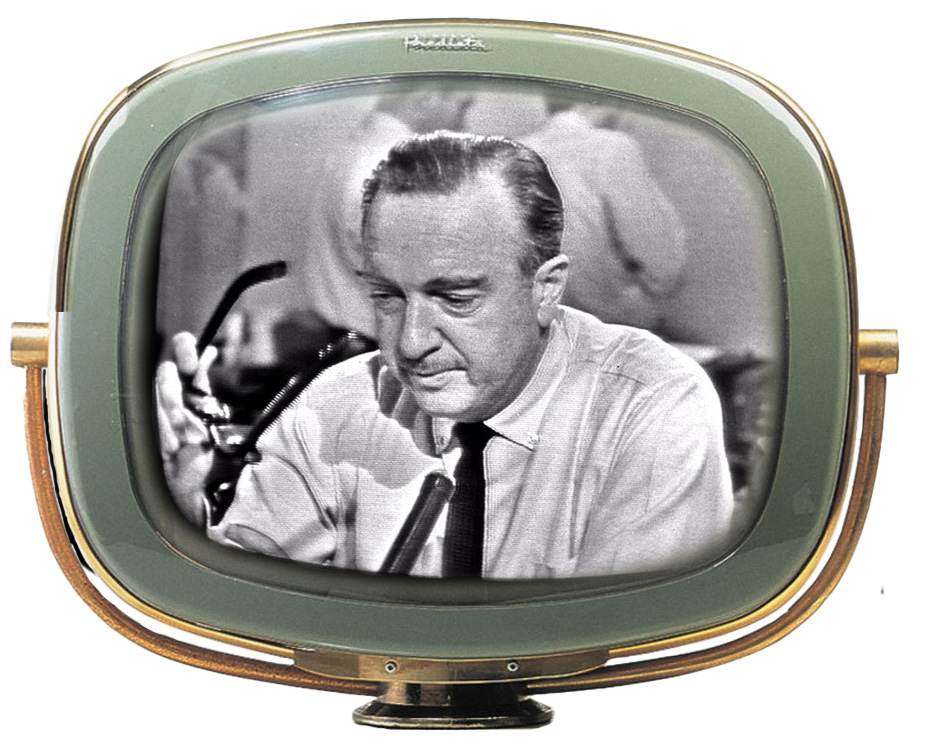
In the days that followed, the major networks suspended normal programming for extended periods. Anchors like Walter Cronkite became a steady presence, translating nuggets of hard information into measured narratives. Cronkite, in particular, embodied television’s evolving authority: trusted, restrained, and conscious of the medium’s influence on both public opinion and emotion.
The Cuban Missile Crisis was resolved not by a single dramatic act, but through a nerve-wracking de-escalation that unfolded over thirteen days. Though the world was not aware of the extent of the danger until Kennedy’s address on October 22, the tension had in fact started some days earlier, when aerial surveillance confirmed the confirmation of the build up in Cuba. It effectively ended on October 28, when Soviet Premier Nikita Khrushchev announced that the Soviet Union would dismantle and remove its nuclear missiles from Cuba in exchange for a U.S. pledge not to invade the island. 4
From Kennedy’s October 22 address until Khrushchev’s announcement six days later, television was almost continuously tuned in to the crisis, turning America’s living rooms into windows on the White House Situation Room. 5
Like armchair military commanders, television viewers could follow the drama not only through words, but through images: maps of the Caribbean, photographs of missile sites, grainy footage of ships approaching the quarantine line, and the extraordinary spectacle of a Cold War confrontation playing in the United Nations.
More than any moment in his brief tenure, the Cuban Missile Crisis sealed John F. Kennedy’s legacy as the first true television president. Youthful and telegenic, the screen framed him simultaneously as both Commander-In-Chief and even-handed father figure, keeping his head while others around him were losing theirs.
It’s hard to say that television played a direct role in the resolution of the Cuban Missile Crisis. But it’s equally misleading to say that it did not. Television galvanized the nation’s consciousness in the face of existential risk. It is arguable that the nation’s leaders knew they could stand firm because they also knew that a well-informed citizenry understood the risks and shared their determination.
In that sense, it seems fair to say that Einstein’s first discovery in 1905 did indeed have a hand in staving off the apocalyptic consequences his further work eventually ushered into the world.
___________________________________
John F. Kennedy addresses the nation from the White House on October 22, 1962.
________________________
1 Most people think Albert Einstein won his Nobel Prize for Relativity or E=mc². But Einstein was awarded the 1921 Nobel Prize for his work on the Photoelectric Effect, in part because of its role in establishing the foundations of quantum mechanics.
2 Unlike later Presidential addresses, Kennedy’s 1962 address was staged from the Cabinet Room because the Oval Office was too small and poorly lit for the camera equipment of the time. The Cabinet Room offered better depth, lighting, and camera placement.
3 The size of the audience for Kennedy’s address vary from 80 to 100 million, with historians and scholars settling on ~85-90 million. (Television penetration is estimated at ~90% of the population of ~190 million.) The number is difficult to pin down because Nielsen did not meter such interruptions of entertainment programming, and the audience surged during the address. Several contemporary sources described it as the largest television audience in American history to that date.
4 The resolution also included a secret American agreement to withdraw U.S. Jupiter missiles from Turkey, a concession deliberately withheld from the public at the time to preserve NATO unity and avoid the appearance of a quid pro quo.
5 The White House Situation Room was created early in John F. Kennedy’s presidency, in direct response to the communication failures exposed by the Bay of Pigs invasion. Kennedy ordered the conversion of a basement conference space in the West Wing into a dedicated, around-the-clock intelligence and crisis-monitoring center, staffed by military officers and intelligence analysts. By the time of the Cuban Missile Crisis in October 1962, the Situation Room was fully operational and served as a central hub for receiving U-2 reconnaissance imagery, diplomatic cables, and military updates.
________________________