_______________________
September 7, 2027, will mark 100 years from the day when electronic television was invented. To celebrate the Centennial, this website and accompanying podcast are going to countdown the Top 100 Milestones from the First 100 Years of Television.
________________________
________________________
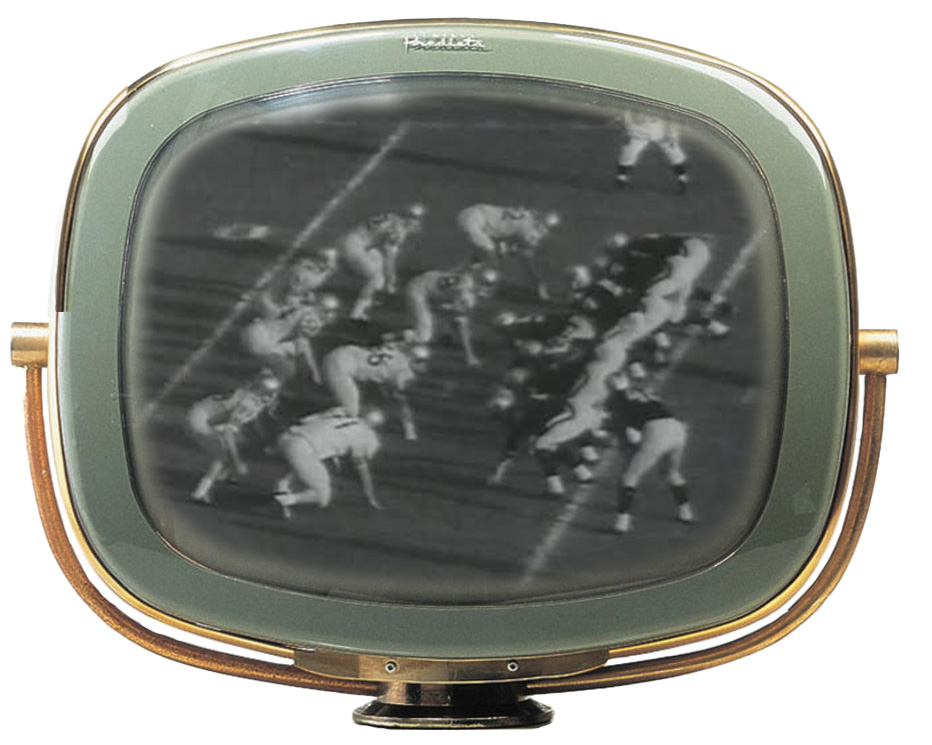
In the years before the first Super Bowl (in 1966), the annual face-off between the Army and Navy’s military academies – West Point and Annapolis – was as close as the U.S. came to an annual football game that generated as much interest as baseball’s World Series1.
During his tenure as the Commander-in-Chief, John F. Kennedy – a veteran of the Navy whose exploits in the Pacific had been deeply woven into the mythology of his presidential campaign – had embraced the pageantry of the game. Kennedy attended the Army-Navy games in 1961 and 1962, bringing a unifying and glamorous presence in the stands with his youthful countenance and dark glasses.
Kennedy was scheduled to attend the game again on November 30, 1963. The events in Dallas the previous weekend precluded that from happening.
With the country still recovering from the shock of the assassination, the 1963 Army-Navy game was postponed until December 7 – the 22nd anniversary of the attack on Pearl Harbor that drew the U.S. into World War II.
Where Were We?
That Army-Navy game was one of the first events in a country that was only beginning to find its footing after the trauma that the nation had experienced – mostly through the medium of television.
So, it is fitting that this 1963 Army Navy game is remembered for another pivotal milestone in television history.
At Philadelphia’s Municipal Stadium, both academies dedicated the game to Kennedy’s memory.2 There were moments of silence and military ceremony, already central to the event, carried additional emotional weight.
And the game was broadcast on CBS, a week after the network’s continuous coverage of the assassination and funeral had etched the face of Walter Cronkite into the national consciousness.
The featured players in that day’s game were the two quarterbacks, Navy’s Roger Staubach and Army’s Rollie Stichweh.
And, in the broadcast booth, a third star, a young TV sports director named Tony Verna, waited for his chance in the spotlight.

Navy was leading 7-0 in the second quarter when Roger Staubach took the snap from center and backed away from the line of scrimmage. After a few seconds dodging defenders, Staubach threw a pass that found receiver Ron Beagle in the end zone to put Navy up 13-0.3 Navy kicked for the extra point to make the score 14-0.
Wait… what?
And then an estimated 30 million viewers watched the most astounding thing: There was Staubach, taking the snap… again. There he was, dodging defenders… again. And then throwing the pass to Ron Beagle in the end zone and scoring… again!
And that’s why director Tony Verna was the third star of the 1963 Army-Navy game. He had just demonstrated television’s latest invention: the instant replay.4
Just 29 years old, Tony Verna was a rising star among CBS sports directors, and part of a new generation that had started in television rather than migrating from radio. Verna cut his teeth directing boxing and football telecasts for CBS Sports, earning a reputation for a steady hand in the control room and a willingness to experiment with new technology.
By 1963, CBS thought enough of Tony Verna to entrust him with one of its most prestigious sports telecasts.

Verna had long been pondering one of the challenges of live sports broadcasting: television viewers could only see what the cameras chose to focus on. And as soon as a play was over, it was time to huddle up for the next one. Viewers could see what happened, but Verna’s narrative instinct wanted to show the audience why things had happened.
For the Army-Navy game, CBS lined up a pair of Ampex videotape recorders5. The first of the two machines was used to record the game for a tape-delayed broadcast to the West Coast.
Record… and Play Back!
Verna’s masterstroke was realizing that in addition to recording, the second Ampex machine could be rewound to play back.
The moment was not without its risks.
“The machines were the size of Frigidaires,” Verna recalled later, “and the tape came with an episode of I Love Lucy previously recorded on it. If the tape didn’t record properly, you would get Lucy in the middle of the football game. And if you fool with the Army Navy game and mess that up, that was the end of your career.”

Accounts vary, but it appears that replays were shown several times during the broadcast. The final replay came late in the fourth quarter: a dramatic one-yard touchdown dash by Rollie Stichweh brought Army within one point of tying the score – before losing the game 21-20 after failing to score a two-point conversion.
Each attempt at the instant replay required close coordination between director and tape operator, who had to manually stop and rewind the tape.
Each replay was its own unique experiment, or, as Verna recounted later, each attempt was like “jumping off a cliff.”
The first instant replay in 1963 was just one in a long string of innovations that started with Philo Farnsworth’s first electronic video transmission back in 1927.
Invention is Messy
Although separated by decades, the two moments had one aspect that is common to all invention: both were crude to the point of showing how much more would have to be done to make it truly practical.
Farnsworth’s 1927 demonstration was a simple straight line rendered in low resolution on an unstable display. But it proved for the first time that electrons could be scanned to convey an image over the air.
That was enough to propel a decade of innovation that refined the pictures that cathode ray tubes could display.

Even in 1963 – after decades of signal refinement and engineering, coaxial cables, microwave relays and countless other improvements – invention was still messy, and the challenges of instant replay were immediately obvious: It was difficult to manually rewind to the point where you wanted the replay to begin, and you could rejoin the live action after having missed some important development on the field.
But, as in 1927, once the principle was proven, further innovation quickly followed.
The first thing that Tony Verna and his engineers came up with was the addition of an inaudible “cue tone” recorded on to the tape.
At the start of a play, the operator pressed a button that added the tone to the tape; When the director called for a replay, the operator could easily return to the moment by isolating the cue tone.
As the technology matured, more advances added to the viewing experience. Slow motion replays were added in the late 1960s. In the 1970s, more cameras meant more replay options from multiple angles; in the 1980s, graphic overlays expanded the visual vocabulary.
A Part of The Game
And then in the 1990s, the replay itself became part of the game with the addition of the coach’s challenge, where each team was given a limited number of opportunities to demand that a play on the field be reviewed and often overturned.6
The evolution of the replay has continued into the 21st century as television has gone high-definition and digital. Now plays are reviewed frame-by-frame in ultra slow-motion, and the practice has expanded to include nearly every sporting event that is televised.
The experience of the instant replay has become as much a part of the culture as the games themselves, demonstrating that television not only conquers space, it can also manipulate time.
______________________________
___________________
1 The first baseball games broadcast on television are covered in Milestone #93. The first World Series broadcast on television was 1947, between the New York Yankees and the Brooklyn Dodgers. The Yankees won in seven games (4–3).
2 Philadephia’s Municipal Stadium was renamed John F. Kennedy Stadium in 1964.
3 Contemporary accounts identify this as a second-quarter Navy touchdown pass but do not consistently preserve the exact yard line or game clock time. This play has been recreated from contemporary accounts for the sake of the narrative here.
4 Although videotape machines had been used to record sporting events, no network had successfully integrated immediate replay into live coverage before the 1963 Army–Navy game.
5 The invention of the video tape recorder is covered Milestone #60.
6 The replay challenge was first tried briefly in 1986, but did not become a formal part of the game until 1999.
________________________