_______________________
September 7, 2027, will mark 100 years from the day when electronic television was invented. To celebrate the Centennial, this website and accompanying podcast are going to Count Down the Top 100 Milestones from the First 100 Years of Television.
________________________
________________________
Throughout the 1950s, ABC was the perpetual also-ran network, running a distant third to its older, larger rivals.
With their pedigrees stretching back to the 1920s, NBC and CBS were the twin tentpoles of American broadcasting. ABC, on the other hand, was the orphan child of the industry, with fewer affiliates and less capital to invest in infrastructure or prestige programming.
ABC started as part of NBC. Until 1943, parent company RCA operated two radio networks. NBC Red was the commercially driven flagship, built around big-budget entertainment and major sponsors. NBC Blue was somewhat less overtly commercial, offering more news, public-service, and lower-revenue offerings.
With two national networks at its command, RCA had a hammer-lock on America’s airwaves. But in 1941, the FCC adopted new “Chain Broadcasting Rules” designed to put limits on the networks’ growing monopoly power. Under the new rules, the Commission ordered NBC to divest one of its two networks.
Mr. Life Saver
RCA complied with the ruling by selling NBC Blue to Edward J. Noble, who made his fortune turning the peppermint white “Life Saver” into one of America’s most popular confections.

By the early 1940s Noble commanded broad interests in advertising and consumer marketing. In NBC Blue, he saw a singular opportunity to acquire a national radio footprint and establish a much needed third network.
In 1943 Edward Noble bankrolled the acquisition of NBC Blue for $8 million (about 150 million in 2026 dollars) and in 1944 he rebranded the network as the American Broadcasting Company.
Between 1944 and 1946, ABC expanded its radio network but had none of the resources that its larger, older rivals were already pouring into television.
As the FCC began lifting the wartime restrictions, ABC applied for broadcast TV licenses, starting with a TV-version of its flagship WJZ radio station in New York. Applications were filed in Chicago and Los Angeles as well to match NBC and CBS’s reach in the nation’s largest markets.
ABC started its network TV service in April 1948 to a relatively tiny number of affiliates and with a thin slate of offerings. The few stations the network did have often had weaker signals than their rivals, which, when combined with the weaker program slate, kept the network chronically third in the national ratings throughout the 1950s. 1
Another Decision
ABC’s fortunes began to improve in the wake of another pivotal legal ruling.
In May, 1948, the United States Supreme Court issued its landmark decision in United States v. Paramount Pictures. Finding that Hollywood’s control of the production, distribution, and theatrical exhibition of motion pictures constituted a vertically integrated monopoly, the Court ordered the studios to divest their nationwide movie theater chains.
It took nearly two years of contentious negotiations between the studios and the Justice Department to iron out the details. In 1950, in a series of agreements known as the Paramount Consent Decrees, Paramount was formally split into two separate companies: Paramount Pictures Corporation stayed in the motion picture production and distribution business. A new company, United Paramount Theatres – or UPT– assumed ownership and control of the theater chain formerly held by Paramount.
At the time of the Consent Decrees, Paramount’s theatrical division was run by Leonard Goldenson, a Harvard-educated lawyer and businessman who had rescued the studio’s theaters from the worst of the Great Depression. When UPT was spun off in 1950, Goldenson was named president, putting him in command of more than 1,400 theaters and their consistent, reliable cash flow.

Goldenson wanted to expand but couldn’t go into the motion picture business because of the court ruling that had put him where he was in the first place. But Goldenson was savvy enough to realize that there was “a new screen in town” – and turned his aspirations toward the weakest of the three television networks.
Still Third of Three
ABC was third-of-three in everything that mattered: the number of affiliates, quality programming, and ad revenue. But Goldenson believed that with adequate financing and Hollywood production expertise, ABC could compete with NBC and CBS. Goldenson figured he could forge a whole new kind of integration by merging UPT’s capital with ABC’s broadcast platform.
United Paramount Theatres merged with ABC in 1953, taking on the name of the acquired network. The influx of fresh capital transformed the chronically underfunded network into a competitive force.2
The merger also gave ABC sufficient financing to form a pioneering production alliance with Lew Wasserman’s MCA/Revue Productions, and ABC finally had the content pipeline it needed to compete with NBC and CBS.3
The impact of the merger was almost immediate. The capital infusion enabled ABC to form its alliance with the Walt Disney Company, which was instrumental in in the creation of Disneyland – as covered in Countdown #74, Money Isn’t Everything. After the merger, ABC started building more owned-and-operated stations as well as signing on more affiliates around the country.
By the late 1950s, ABC was noticeably more competitive, but there was one critical area where it was still well behind its older, larger rivals: Sports.
NBC had baseball and big college football. CBS had the NFL, SEC football, and heavyweight boxing.
ABC had… almost nothing.
Another Acquisition
In 1959, ABC acquired a company called Sports Programs, Inc. from Edgar Sherick, a veteran of MCA/Revue – the company that Leonard Goldenson had engaged fill ABC’s thin programming lineup.
Sherick operated around one of MCA’s core philosophies: if you didn’t have the money, you compensated with packaging ingenuity and clever deal-making. When he left MCA to form Sports Programs in 1956, the company started supplying ABC with the kind of low-cost, ready-to-air sports programming that ABC was increasingly relying on. After the acquisition of Sherick’s company, he was named ABC’s vice president of programming.
One of Sherick’s first tasks in his new post was to fill the gap in ABC’s sports coverage. Well aware that ABC could ill-afford the rights to big American sports, he turned instead to the idea of a weekly international sports anthology, surmising that he could fabricate “must-see TV” out of lower-cost international events, tape-delayed competitions, and visually striking athletic events.

To develop this Wide World of Sports, Sherick turned to a 27 year-old producer he had recently hired away from NBC: Roone Arledge.
A native of Queens, Arledge was still a student in Columbia University’s journalism program when he started experimenting with live broadcasting setups. He started working at NBC as a production assistant in the early 1950s before becoming an assistant producer for The Today Show’s occasional sports remotes. At NBC, Arledge quickly distinguished himself for his visual imagination and for arguing that sports television should cultivate the underlying human drama, not just the play-by-play of televised sports.
Big Swings
Arledge’s ideas for coverage included slow motion cameras, multiple isolation angles, handheld cameras on the sidelines, and pre-produced features. Executives at NBC routinely dismissed his suggestions as too expensive, too complicated, and just unnecessary for sports broadcasting.
But in Ed Sherick at ABC, Roone Arledge found not only a receptive ear, but an executive willing to take some big swings.
When Sherick described his idea for a weekly sports anthology, Arledge started spinning off ideas of his own: The show had to have a host with narrative authority; It should use pre-produced profiles and filmed inserts; Camera placement had to show the athletes’ emotions, not just the action; And editing should shape each episode as a narrative arc, not just an assorted variety of unrelated events.
Most importantly, Arledge felt the show should have a defining philosophy.
To create a mission statement, Arledge turned to ABC staff writer George Meister, who crafted the iconic opening of every episode:4
“Spanning the globe to bring you the constant variety of sport…the thrill of victory, and the agony of defeat…”
____________________________________
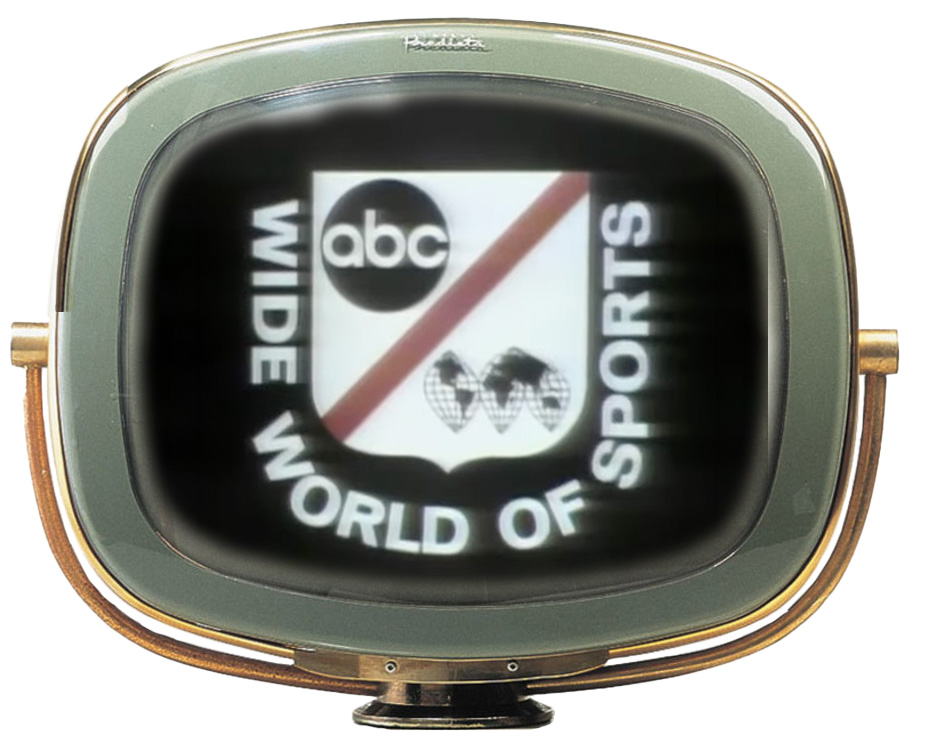
The opening sequence from ABC’s Wide World of Sports ca. 1974
____________________________________

That intro was delivered by veteran sportscaster Jim McKay who became the face and voice of the show starting with its second episode, assuming the role of host and storyteller rather than play-by-play announcer.
After a pilot episode of the new show aired late in 1960, ABC’s Wide World of Sports made its official premiere on April 29, 1961 featuring two venerable track-and-field events, the Penn Relays – broadcast live from Philadelphia, Pennsylvania and the Drake Relays – tape-delayed from Des Moines, Iowa.
Innovations
Over the years that followed, Roone Arledge used Wide World of Sports as a proving ground for countless innovations, among them:
• Up-close camera work to capture emotion and detail;
• Slow motion replays with frame-by-frame analysis (the advent of tape replay will be covered in Countdown #51);
• Split-screen comparisons;
• Pre-produced athlete profiles integrated directly into live coverage;
• Wireless miniature mics with unconventional placements;
• Dramatic editing and storytelling structure emphasizing the human drama of competition;
• International remote production on an unprecedented scale.
In addition to Jim McKay, Wide World of Sports introduced many hosts and commentators now familiar in the pantheon of sportscasters: Among them Howard Cosell, Keith Jackson, Bud Palmer, Frank Gifford, Al Michaels, and Becky Dixon, who was the first female cohost with McKay starting in 1987.
Among the international events that were popularized by Wide World of Sports were the Indianapolis 500, Wimbledon, The British Open, various Olympic trials and figure skating championships, boxing events like the first Muhammad Ali fights via tape delay, numerous Alpine skiing events, and world gymnastics championships.
In addition to such marquee events, Wide World of Sports frequently featured the unique and the unusual: Cliff diving from Acapulco; barrel jumping; jai alai; demolition derbies, log rolling and lumberjack competitions; surfing championships; rodeos; table tennis; mountain climbing; camel races, elephant polo, and other global oddities.
These events were often filmed in locations in Europe, Central America, Africa, and Asia that Americans had never seen before.
By the time its 37-year run ended in 1998, Wide World of Sports had aired more than 600 episodes and presented over 1,000 different sporting events from roughly 100 countries around the globe.
From Sports to News
Wide World of Sports, made Roone Arledge one of the giants of American broadcasting.

In 1977, Arledge was appointed president of ABC News, a move widely considered radical at the time: no network had ever turned its news division over to a sports producer.
But Arledge brought with him the same instincts that had transformed sports broadcasting – dramatic pacing, tight storytelling, bold graphics, muscular field reporting, and an insistence on treating every story as both journalism and human interest story.
Under his leadership ABC News launched 20/20, reinvented World News Tonight with a three-anchor structure, expanded Nightline out of the Iran hostage crisis in 1979, and infused the entire division with a sense of urgency and visual intelligence that reshaped American newscasting.
Roone Arledge remained at ABC for nearly forty years, guiding first sports and then news until ill health forced his retirement from day-to-day duties in the late 1990s. He died in 2002 at the age of 71, leaving behind a half-century of work that altered the grammar of television itself — from the way the country watches football games to the way it understands world news.
In the span of a decade, the once-struggling ABC network acquired a sports identity so strong it became a cornerstone of its brand.
Wide World of Sports didn’t single-handedly lift ABC out of the basement, but it provided the foothold – undeniable proof that the smallest of the three networks could originate programming that could attract the kind of audience that advertisers coveted.
_________________________
1 Another factor in ABC’s slow entry into television was the FCC’s freeze on new licenses between 1948 and 1952. This moratorium probably deserves its own entry in the Countdown, as it also contributed to the demise of the DuMont Network (Countdown #64 – Have You No Sense of Decency?) For now it is noted for possible future reference.
2 UPT acquired ABC. Realizing the longer-term potential of the new medium, Goldenson opted to rebrand the company as ABC.
3 Lew Wasserman was the driving force behind Music Corporation of America (MCA) the most powerful talent agency in Hollywood. MCA also owned Revue Productions, a rapidly expanding TV production company that had important Hollywood talent under contract and owned the old Republic lot in Burbank (now Universal City). MCA/Revue’s specialty – filmed TV series produced cheaply and quickly was perfect for ABC’s budget.
4 This opening was not part of the premiere of Wide World of Sports in 1961; it was added sometime in 1962 and remained part of the program for the remainder of its run.
________________________