- Home
- TV History
- Network Studios History
- Cameras
- Archives
- Viewseum
- About
Meet ‘I Love Lucy’s’ Summer Replacement! ‘My Little Margie’
Remember this show’s theme song? I do, and you can hear it again and see a full episode of ‘My Little Margie’ here, starring Gail Storm and Charles Farrell. This is episode six of season two and first aired on 10/25/52.
‘My Little Margie’ premiered on CBS as the summer replacement for I Love Lucy on June 16, 1952, under the sponsorship of Philip Morris cigarettes (when the series moved to NBC for its third season in the fall of 1953, Scott Paper Company became its sponsor). In an unusual move, the series—with the same leads—aired original episodes on CBS Radio, concurrently with the TV broadcasts, from December 1952 through August 1955. As usual, this episode ends with the same line her dad, Vern Albright used at the end of each show…”Well, that’s my little Margie”.
http://www.youtube.com/watch?v=uP3NpF_p3rI
Because that’s when the syndicated edition of the series was prepared; as previously mentioned, the original closing credits were seen with a Philip Morris pack in the background…they had to be refilmed, along with the credits seen during the 1953-’55 Scott Paper sponsorship {a box of Scotties on…
You Mean There Were Art Departments?
Yes! Once upon a time, local stations and networks had real artists on staff. Before electronic and computer graphics came along, art departments made flip cards for promos, made title and closing credit cards, illustrated ticker crawls like the one in this photo and more. This picture is from 1960 and shows a CBC Marconi Mark II camera shooting a side to side crawl on what may be a Grey Ticker Table. Anyone know more about the machine?
Fascinating Photo! The Iconoscope Tube In Action…
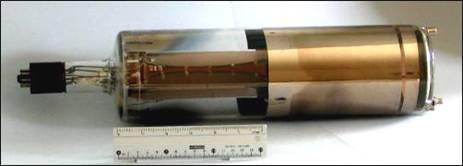
Here is the heart of early electronic television cameras. This photo, taken by Andreas Fininger, shows an image bring projected into the lens, and then displayed on the plate of the Iconoscope tube. You can actually see the scanning beam in process. Thanks to J P Auger in Canada for sending this!
Ever Seen A Marconi Mark IV In Color?
Having just posted the story below of the Mark IVs at Television City, I thought I would add this color photo of my Mark IV. Although CBS painted many of their cameras Navy Grey, I think the one in that photo is still it’s original color. This is the original Champagne color of these great cameras. This is the first Marconi model with handles and they were the same color as the camera, but on later models like the Mark VII color cameras, the handles had a brushed aluminum look.
Live Eye…First Of The Live TV Vans
WTVJ in Miami purchased its first “Live-Eye” Truck in 1975. Built by the O.J. Ferrell Company, and modified by the engineering staff, the truck was considered to be “State-of-the-Art,” and once boasted doing 11 news stories in one day. WAGA in Atlanta also bought Live Eye trucks in 1975. Although the RCA TK76, the first true self contained ENG camera was still a year away, Ikegami and Ampex had hand held video cameras. There were a few small Ampex and RCA portable tape machines, but with no editing ability. I’m sure there were a few station built live vans starting to appear, but I think the Ferrell company’s vans were the first to be specially modified for live TV.
A Rose By Many Names…Norelco, Philips, Pye, Peto Scott
In this very good video, notice that the Norelco PC70 has a Pye logo on the side instead of a Norelco (as we knew the brand in the US), or Phillips logo (as the camera was branded in the rest of the world). You may have also seen these cameras with a Peto Scott logo. Here is the story of the branding…
(A) Norelco: In a nut shell, Philco, in a 1940s court ruling forced Phillips to use another name for their products in the US. That brand name became Norelco and was cobbled from Phillips North American Electronics Company. Over 95% of all the Norelco cameras in the US were made at Mt. Vernon NY.
(B) Phillips: This is the parent company in the Netherlands. Their Plumbicon color cameras in the US were Norelco PC (for Plumbicon Color) models, while in the rest of the world, they were LDK models…our Norelco PC60 was their LDK 1. Our PC70 was their LDK 2, etc. I think LDK comes from the Dutch term for the Lead Oxide Camera…in Europe, Plumbicons are often referred to as ‘lead oxide valves’ (valves = tubes).
(C) Pye: In 1966, Phillips tried to buy Pye but was allowed only 60% ownership under anti monopoly rules in the UK. Demand for their plumbicon cameras was so great, and the Dutch plant so overwhelmed that many Phillips LDK cameras were made at their Pye plant in England under the Pye and Phillips name.
(D) Petto Scott: Needing even more production capacity, Phillips/Pye took over the small UK based camera maker, Peto Scott around 1968. Most of their camera output was Phillips branded, but in a few regions in the UK, they were allowed to brand the cameras as Peto Scott for marketing and anti trust reasons.
Very Nice! The EMI 2001 Model
This is nice 5 minute tour of the EMI 2001 that debuted in 1966, complete with a built in shot box. The demonstration is by veteran BBC cameraman Malcon Carr. Thanks to Steven Davis for sharing this video. Enjoy!
While I’m At It…
Since I just posted the 1948 color photo below of a WGN TK10, I thought I would follow it it up with a shot of the only known surviving camera from the original 8 that WGN bought in 1948. This camera came to me about 2 years ago and I am very glad it is still in such good cosmetic condition. Unfortunately, most of the insides are missing, but I’m quite happy to have such an iconic camera from such a pioneering station. It’s a great piece of history!
Something You Rarely See…
This is a rare color photo of an RCA TK10 at WGN in Chicago. This is one of 8 the station bought when they went on the air in 1948 and it could be the camera I own. The reason I wanted to post this was to show the original factory look. For some reason, many people think the red stripes were added at the stations…probably due to the fact few color photos exist of these great cameras. By the way, the first TK10s were made in December of 1946 and were the second Image Orthicon cameras on the market…the first was the RCA TK30 that came out a few months before the TK10. The reason the TK30 was released first is because the military wanted a field camera, which the TK30 was, but it was also widely used in studios too.
Rare 1948 color photo of TK10 and “Hi Ladies” host Tommy Bartlett
You MUST SEE THE VIDEO of a small part of her collection! You’ll see SO MUCH HISTORY! A pair of Ruby Slippers worn by Judy Garland, the famous white Marilyn Monroe dress from The Seven-Year Itch, THE CURTAN DRESS from Gone with the Wind, the ACTUAL Maltase Falcon and SO MUCH MORE!
A year or so ago, Debbie sold about half of this collection at auction for several million dollars. I think this video was done before that as I see some pieces that were sold, but this is a wonderful look at a one-of-a-kind collection. Thanks to Debbie Reynolds, much of this great treasure has been saved. I wish they showed all the Cleopatra wardrobes in this piece. Enjoy!
This Is FASCINATING!
The Story Of The Ruby Slippers, Part 1
In this great 4 part documentary, we learn the incredible story of the most famous slippers ever made. Who made them, how many pair were made, how they were lost, how they were found, who found them and where they are now. Each pair is now valued at over a million dollars each. In this part, you’ll see some great behind the scenes shots of ‘The Wizard Of Oz’ in production. Enjoy!
http://www.youtube.com/watch?v=1lHrgBbr6PY PART 1
The story behind the most famous pair of slippers ever made.
The Story Of The Ruby Slippers, Part 2
In this great 4 part documentary, we learn the incredible story of the most famous slippers ever made. In this part, we discover how they were found and who found them! Enjoy!
http://www.youtube.com/watch?v=0tk8neCC3go
The story behind the most famous pair of slippers ever made.
The Story Of The Ruby Slippers, Part 3 & 4
The discovery came in the spring of 1970…here is the story!
http://www.youtube.com/watch?v=K8TrN-RGLOg PART 3
http://www.youtube.com/watch?v=mKebFys0Vt0 PART 4
The Story behind the most famous pair of slippers ever made.
Network Notes…
On October 4, 1950, Atlanta was finally able to bring live network shows to Georgia via the new coaxial cable. Before the AT&T connection, network shows came in the mail as kinescopes and films.
CBS Television City…Circa 1988
This clip takes a look back as CBS prepares for it’s 60th Anniversary. Since the company became CBS in 1928, I’m guessing this was shot in 87 or 88. Enjoy!
New Video Tour – Ellerbee Camera Collection
It’s been a couple of years since the last video tour, so here’s a new version. Last time, there were only 12 cameras on display…now there are 16 on display and that’s about all that my space can handle. To you pros, this may look a little crude, but I’m using a little Sony photo camera while walking and narrating which is no easy trick. This is take 52,456. :>)
Totally Television!
This is an illustration Ampex commissioned for one of the NAB shows. The art is by Jack Davis who you may remember from your MAD Magazine reading days.
When Was The Last Time You Saw This?
The NAB’s Code Of Good Practice started around 1952 and lasted till the early 80s. I read a lot of it this morning and frankly, I would love to have parts of it back! Specifically the part that limited commercials! The best part of that section limits advertising to 6 minutes per hour in A and AA time. During Christmas and election times, you could go to 8 minutes per hour. With the Code back in place, most of the 800-Sue-Someone spots, the Viagra and big pharma spots and the, ‘but wait, there’s more’ spots we see would be long gone. Ahhh…the good old days!
Ted…How The Character Is Done
Before you go to the video of how Ted is animated, a word about Ted’s Oscar appearance.
The segment you saw that night was actually taped in mid-January. People in the Dolby Theater just saw Wahlberg standing next to an empty stool as Ted and Wahlberg presented an Oscar.
Incorporating 3D character animation into a pre-recorded movie or television show is one challenge, but integrating an animated character into a live-broadcast in front of a global audience is quite another.
Behind the shenanigans of the world’s favorite crass teddy bear were the same visual effects and character animation artists responsible for his creation in the film. Blair Clark of Tippett Studio perfected the illusion alongside Seth MacFarlane, telecast director Don Mischer and the Awards broadcast team.
For the filming of the segment, a duplicate of the Academy Awards stage was constructed at CBS Studios, with lighting and cameras situated to match the Dolby Theater set up. The feat involved planning exact camera positions so that the animation, rendered using Dell Precision workstations, would integrate seamlessly on Oscar Night with Wahlberg and the show audience. With five nominees in each category, Tippett artists created 10 different outcomes in just a four-week production schedule. As the winners were unknown before the envelope was opened, Mischer and his team sat at the ready to push the button for the correct winner during the live broadcast. Thanks to Don Langford for the story idea.