- Home
- TV History
- Network Studios History
- Cameras
- Archives
- Viewseum
- About
NBC Burbank Studio 1: If These Wall Could Talk
I would venture to say, that between 1952 and 2013, every major personality in America has been on this stage at one time or another. Between Bob Hope and Johnny Carson’s shows here…well, the list of guests boggles the mind. Enjoy and share! -Bobby Ellerbee
NBC Burbank Studio 1: The Start of Something Big
As NBC’s new Color City was coming to completion, CBS was in the final stages of completing Television City. In September, David Sarnoff announced that Burbank would go on the air earlier than planned. He said the new start date would be October 4, 1952 and that on November 8, NBC would open their first full color studio at the Colonial Theater in New York.
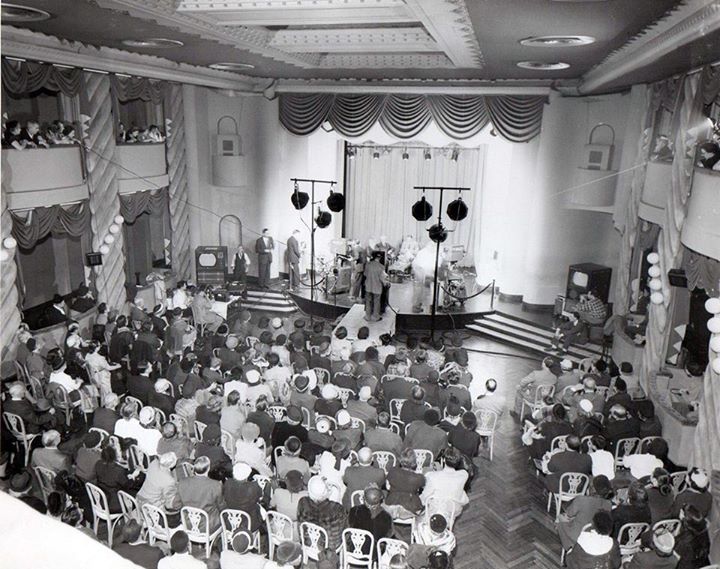
As you can see here in this photo taken shortly after it opened, Studio 1 was originally equipped as a black and white studio and was pressed into service early as KNBH’s studios at Radio City West were very overcrowded.
CBS didn’t want NBC to beat them by going on the air from Burbank first, so they rushed an episode of “My Friend Irma” into production and televised their first program from an unfinished Television City on the evening of October 3rd of 1952, one day before the first telecast from NBC. Enjoy and share! -Bobby Ellerbee
NBC Burbank Studio 1: A Star Is Born
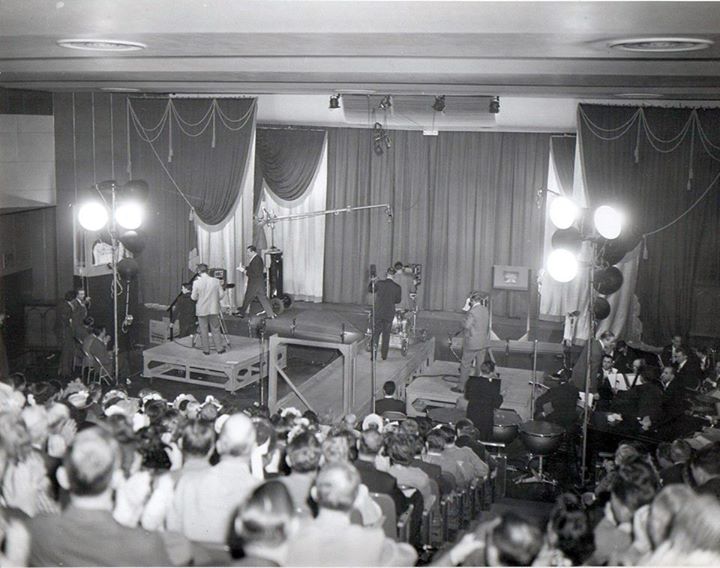
Here’s the studio under construction in 1952. The legend is, Bob Hope helped design this studio and may have been responsible for the massive audience area and it’s steep incline so that no seat had an obstructed view of the stage. Enjoy and share! -Bobby Ellerbee
NBC Burbank Drive By, 1958
It looks like today is Burbank day, so let’s take it all in! Enjoy and share! -Bobby Ellerbee
#t=11″ target=”_blank”>https://www.youtube.com/watch?v=Us2flcoPut0 #t=11
This is a 1958 videotape of NBC Burbank as recorded on 2″ Quad in a mobile unit. The show opens as the camera travels down California Street, takes a right t…
ULTRA RARE 2! NBC Burbank, Studio 1…360 Degree Video
This is where Johnny Carson’s “Tonight” show came from. Now, it is the “Access Hollywood” stage, but this is not that set which has four sides. This has only three and you can see the audience seating on the open wall. By the way, you can use your mouse to stop and go back and view this manually by dragging the mouse. Be sure to enlarge the screen to see this at it’s best. Enjoy and share! -Bobby Ellerbee
ULTRA RARE 1! Inside NBC Burbank Studio 3…360 Degree Video
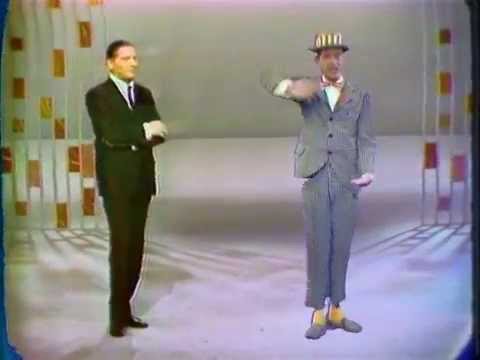
Just the other day, someone asked about the seating in Studio 3, wondering if it was like the huge Studio 1 audience area. Well, here’s your answer. There’s a lot of history here as this was home to “The Dean Martin Show”, “The Jerry Lewis Show” and countless others, including much of ‘Tonight’ with Jay Leno. By the way, you can use your mouse to stop and go back and view this manually by dragging the mouse. Be sure to enlarge the screen to see this at it’s best. Enjoy and share! -Bobby Ellerbee
A HUGE Beatles SURPRISE!
CBS sent one of their prototypes handheld video cameras from Cape Kennedy to Miami to get shots for the February 16, 1964, Beatles appearance on Ed Sullivan.
The man responsible for their creation, Dr. Joe Flaherty, who’s still Senior VP of Technology at CBS, told me a few years back that CBS had teamed up with Ikegami to come up with these cameras.
Their effort had started just the year before in 1963 and this is one of three prototypes Ikegami sent to CBS for use on space mission coverage.
This is the first time one of these cameras was used on anything other than space shots. This photo was taken at the morning sound check which was followed by a dress rehearsal and finally that night’s show.
By late 1964, I think about a dozen had been built and sent out for field tests. Two were sent to CBS O&Os KMOX in St. Louis, two to WBBM in Chicago, two to KNXT in LA, three to WCBS and three were on the CBS mobile units assigned to Cape Kennedy.
Unlike the RCA/NBC portables, I think this has an Image Orthicon tube and not a Vidicon. Enjoy and share! -Bobby Ellerbee
From last year’s big 50th Anniversary coverage, here is my story on how to tell which scenes are from which shows, which were all taped the same day. Enjoy and share! -Bobby Ellerbee
Beatles 50th Sullivan Anniversary Count Down…15 Days
Today, A Primer In: How to tell which performance is which.
With the anniversary approaching, you’ll see a lot of photos and clips and with this guide, you can tell which performance is which. The Beatles first appeared on Ed Sullivan these three consecutive Sunday nights…February 9, 16 and 23 1964. The February 16th show was done live from Miami, but all four of their other performances were done at CBS Studio 50 on February 9, with the first performances of the day taped for air on the 23rd. The Beatles appeared twice in each show and each time, the song set and stage set was different. From left to right, here are the Studio 50 stage sets in order of air dates. The first live performance set featured big arrows and the second live performance set featured hanging stripes. The first appearance of the taped February 23 show was the only use of a flat wall set with a wedge facade, which was widely used on many Sullivan shows and matched his hosting corner backdrop. The final set of the February 23 show featured the free standing art nouveau columns. Now you know!
The Art Of Shooting Live Drama
Before videotape, there were only kinescopes, so shows had to be done live. Just take a moment and study the photo below from Television City…that’s tight in every way. The floor camera is shooting the actor on top (Edmond O’Brien), the crane is shooting the other, the boom is there for sound and there’s even a handheld face light.
This takes choreography…a well laid plan and skilled crew. John Frankenheimer was one of the best ever live directors and did many of “Playhouse 90” presentations. Enjoy and share! -Bobby Ellerbee
NBC Chicago Class Picture
I wanted to share this picture from around 1950. There are a lot of familiar faces and names here that went on the New York. Among those that did, but are not seen here are Hugh Downs, Mrs. Francis from “Ding Dong School” and Jack Lescoulie. Enjoy and share! -Bobby Ellerbee
Speaking Of The EMI 2001 Cameras
Here is a follow-up on the BBC remote story from yesterday that showed us the EMI 2001 cameras in the field. Thanks to Andy Rose for the find. Enjoy and share! -Bobby Ellerbee
https://www.youtube.com/watch?v=uGvO29NQ8xs
EMI 2001 Broadcast Camera Training Video 1970’s (BBC)
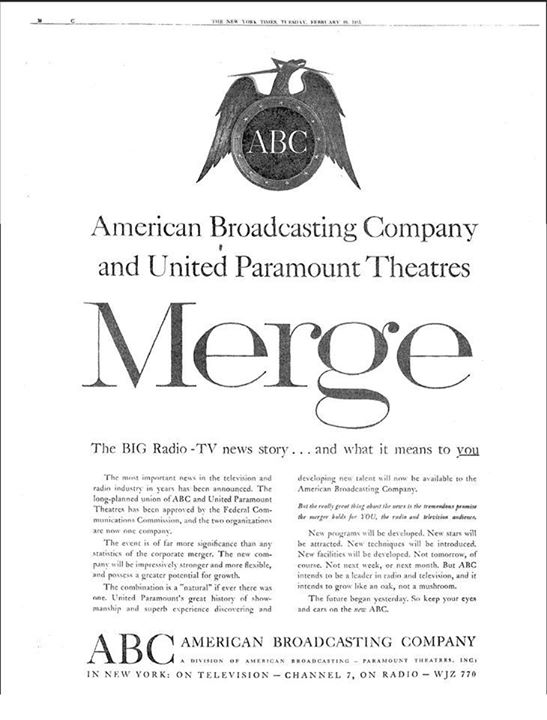
February 9, 1953…The REAL Beginning Of ABC!
That was the day United Paramount, led by Leonard Goldenson, came to the rescue and saved the company from bankruptcy.
On October 12, 1943, Edward John Noble, the owner of Life Savers candy, the Rexall drugstore chain, and the radio station WMCA in New York, bought NBC’s Blue Network for $8 million.
In much the same way NBC was forced to sell the Blue Network,
the movie theater operator United Paramount Theaters (UPT) was forced to become an independent entity, separating itself from the film studio Paramount Pictures in 1949.
For its part, ABC was on the verge of bankruptcy, with only five stations and nine full-time affiliates. Its revenues failed to compensate for its heavy investments in buying and building stations. In 1951, Noble held a 58% stake in ABC, giving him $5 million with which to prevent ABC from going bankrupt with a loan from the Prudential Insurance Company of America.
Leonard Goldenson, the president of UPT, approached Noble in 1951 and proposed that UPT purchase ABC. Noble received further offers, including one from Bill Paley of CBS, but that would have forced CBS to sell at least its New York and Los Angeles stations. Goldenson and Noble reached a tentative agreement in the late spring of 1951 that ABC would become a subsidiary of UPT, but would remain autonomous in its management.
On June 6, 1951, UPT’s board of directors validated their tentative agreement. However, the transaction had to be approved by the FCC. Insofar as the Paramount Pictures film studio was already a shareholder of the DuMont Television Network, the FCC conducted a series of hearings to ensure whether Paramount was truly separated from United Paramount Theaters, and whether it was violating antitrust laws.
In 1952, when the FCC ended its freeze on applications for new stations, among the issues to be addressed was the approval of the merger between UPT and ABC.
On February 9, 1953, the FCC authorized UPT’s purchase of ABC in exchange for $25 million in shares, and the company was renamed American Broadcasting-Paramount Theaters, Inc.
The new company was based in Paramount’s headquarters at 1501 Broadway in New York, and owned six AM radio stations and many FMs, as well as five TV stations and 644 cinemas in 300 cities throughout the United States.
In consideration of this merger, UPT sold its television station in Chicago, WBKB-TV, to CBS for $6 million. CBS changed the calls to WBBM-TV. They kept ABC’s existing Chicago station, WENR-TV but moved the WBKB call letters to channel 7, which would eventually become WLS-TV. Goldenson began to sell some of the old theaters to finance the new television network.
On May 1, 1953, ABC’s flagship stations – WJZ, WJZ-FM and WJZ-TV in New York – adopted the callsigns of WABC, WABC-FM and WABC-TV, and moved to 7 West 66th Street, one block from Central Park.
At the same time, Goldenson had been trying to convince his movie studio friends to provide content for the network. ABC’s merger with UPT led to the creation of relationships with Hollywood’s film production studios, breaking a long quarantine that had existed between film and television.
Goldenson’s efforts paid off, and on October 27, 1954, the network was able to launch a “New ABC” campaign with the productions of several studios, including Metro-Goldwyn-Mayer, Warner Bros., and 20th Century Fox.
However, the most iconic (and ironic) of ABC’s relationships with Hollywood producers was its agreement with Walt Disney. Walt and his brother Roy contacted Goldenson at the end of 1953 to ask ABC to finance part of the Disneyland project in exchange for Disney’s production of a television series.
Walt wanted ABC to invest $500,000 and a guarantee of $4.5 million in additional loans, a third of the budget intended for the park. Around 1954, ABC agreed to finance Disneyland in exchange for the broadcasting of a new Sunday television program, Disneyland, which debuted on the ABC network on October 27, 1954 as the first of many anthology TV programs that Disney would broadcast over the course of the next fifty years. We all know the rest of the story! Thanks to Maureen Carney for the image and reminding me of this anniversary! Enjoy and share! -Bobby Ellerbee
KHJ At The Beach, 1967
Thanks to Dave Miller, here’s a home movie shot at Santa Monica Beach in ’67 showing the taping of “Groovy” which was a local teen dance show. Notice the big silver connector on the side of the new Norlco PC60s…that is a converter box that takes the camera from it’s usual 2 cable configuration to a single TV 88 cable.
By the way, when you see The Standells perform, sing along with their hit “Dirty Water” and you’ll see they are in perfect sync. Enjoy and share! -Bobby Ellerbee
#t=35″ target=”_blank”>https://www.youtube.com/watch?v=hsEP8HE-aZc #t=35
Rare 8mm footage taken in 1967 in California during the filming of KHJ-TV’s Groovy. In addition to host Michael Blodgett, guest bands for the day included Th…
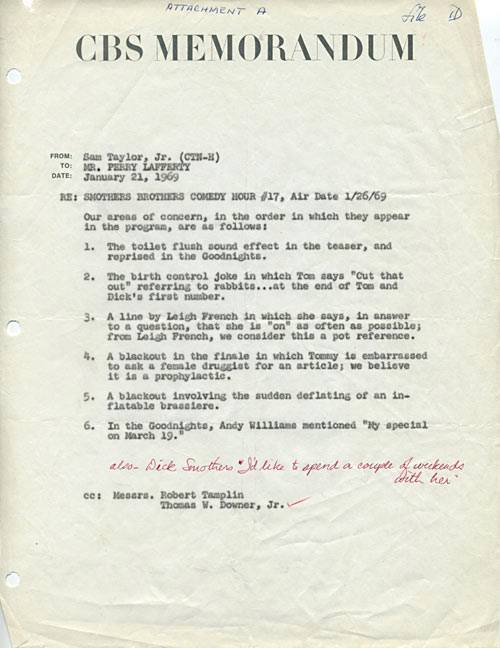
The CBS Censors And The Smothers Brothers
Thanks to Randy West, here is a perfect example of the kind of censorship and restraint CBS applied to Tom and Dick Smothers. Can you say petty?
The bigger issue was politics and Tom and Dick discuss that at the link above. The best discussion on this topic is from the 2002 documentary from Maureen Muldaur called “Smothered: The Censorship Struggles of the Smothers Brothers Comedy Hour”. It’s online, but you have to sign up to see it, but it’s worth it.
Enjoy and share. -Bobby Ellerbee
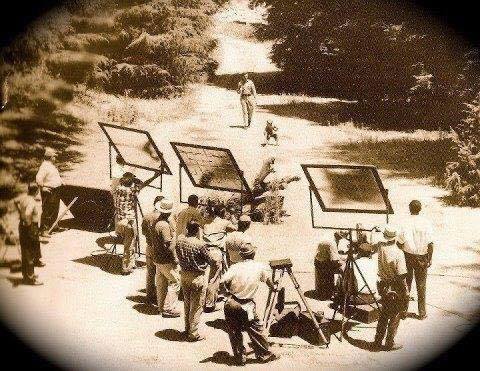
By Request, The Andy Griffith Opening
This rare photo is one of the most shared images ever posted here, and to answer the many requests to see it again, here it is. Enjoy and share! -Bobby Ellerbee
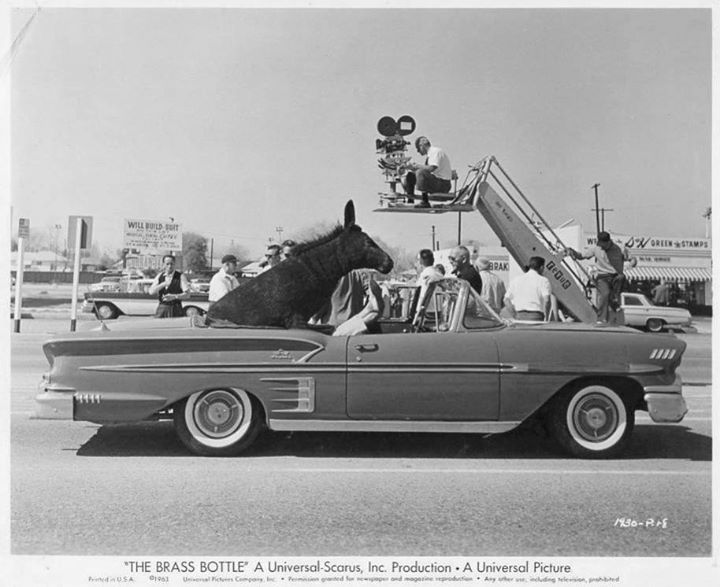
Hauling Ass Into History! A Dream Of Jeannie?
What does this picture of a donkey in the backseat have to do with television history? Actually, quite a lot.
This is a publicity shot for a 1964 movie called “The Brass Bottle” which costarred Barbara Eden. Although she did not play the genie that lived in the bottle, her appearance in the film led to her being cast in the television show that was a spin off of this movie…”I Dream Of Jeannie” which debuted in 1965. Please remember to visit the main page to see all of today’s stories…just click on the blue text at the top of this post! Enjoy and share! -Bobby Ellerbee
A Two Bird, One Stone Surprise
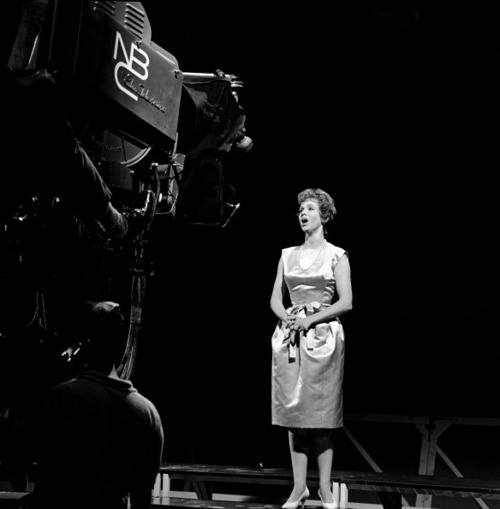
Below is a a video of a song that many people think was a Beatles original, but it’s not…it’s from “The Music Man”. The performance is by opera star Barbra Cook on “The Bell Telephone Hour” which began April 29, 1940, on NBC Radio and was heard there until June 30, 1958, when it moved to television for a nine-year run.
Above is nice shot of Barbara Cook from one of her many appearances on the Bell Hour which originated at NBC Brooklyn. The Bell hour was one of the first shows to be broadcast exclusively in color. “The Howdy Doody Show” was the first daily color broadcast starting September 12, 1955. -Bobby Ellerbee
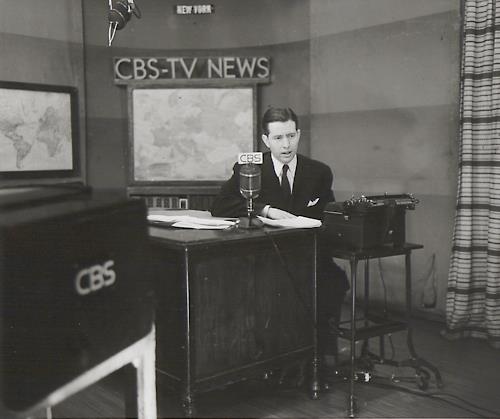
In 1947, CBS began experimenting with a news show which was broadcast on Saturday night, but soon afterward they added a Wednesday night edition too. As far as I know, this was newsreel show with no on camera talent, but there was a live announcer narrating.
On May 3, 1948, introduced “CBS Television News” with a live host…Douglas Edwards. I say host, because use of the word “anchor” did not come about till 1952, when Walter Cronkite was deemed anchorman of the 1952 political conventions.
This was television’s first live news show and ran weeknights from 7:30 till 7:45. I think the one camera show originally came from a small newsroom office at the CBS headquarters building at 485 Madison Avenue with the film being rolled from Studio 43 at Grand Central. It later moved to Liederkranz Hall and finally to Studio 42 at Grand Central. -Bobby Ellerbee
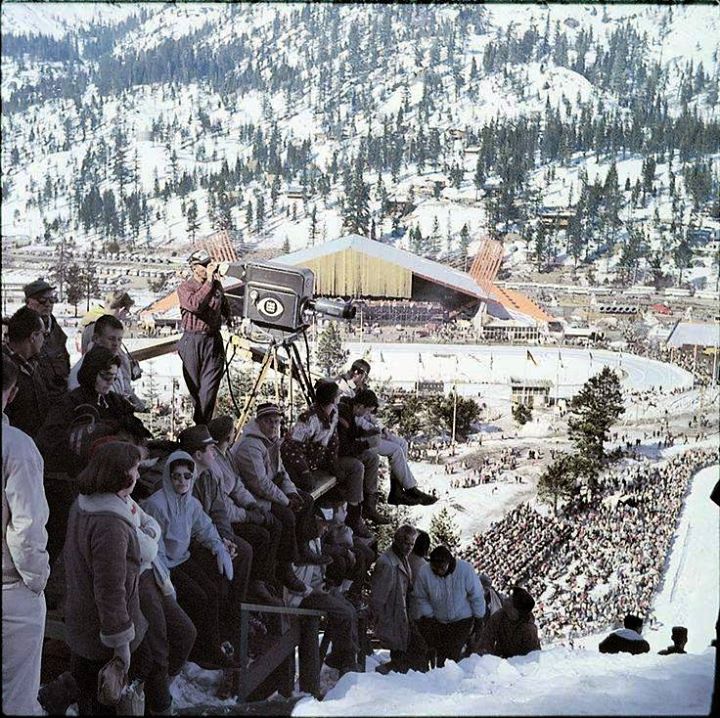
VIII Winter Olympics From Squaw Valley
In February of 1960, CBS televised the events live from California in glorious black and white, but at least by then, there was video tape. As a matter of fact, this is one of the first times videotape was used to help officials’ judge an event. There was a question if one of the skiers had touched a flag and the tape was used to help the judges see what had really happened. Thanks to Kevin Vahey for the great picture. -Bobby Ellerbee
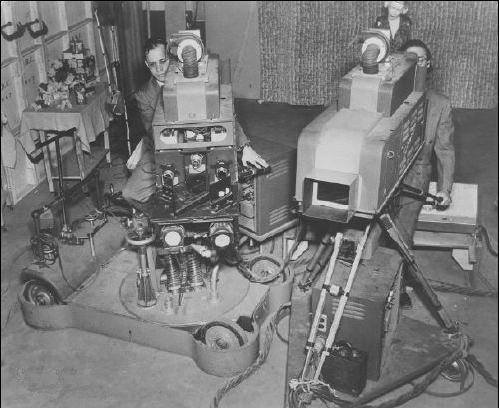
RCA’s First Experimental Color Television Cameras
By request, here is more on RCA’s first color efforts. Shown here are the first two RCA color cameras made. The photo was taken at NBC/RCA’s Wardman Park Studio in Washington DC around 1949. FYI, RCA/NBC people involved in the testing called these the “Princeton Cameras”, because that’s where they were created.
The camera on the left has the lens cowl removed and notice that the color splitting mirrors are mounted in front of the fixed lens. Although the b/w RCA TK10 and TK30 had come to market in 1946 with turret lenses, this camera was not quite ready for that yet and, as with the old Iconoscope cameras, had to dolly in and out to get close ups or long shots.
In late 1950, these cameras were basically abandoned when RCA moved color testing to NBC Studio 3H in New York. The Washington color veterans were sent there, but these cameras went back to Princeton. The new experimental color cameras in 3H were the black “coffin cameras” which had the first hint of the now famous rounded viewfinder. Color tests began in 3H in early 1951 and stayed there till early ’53 when the Colonial Theater came into service with the prototype RCA TK40s. Please remember to visti the main page…just click on the blue text at the top of this post! -Bobby Ellerbee