- Home
- TV History
- Network Studios History
- Cameras
- Archives
- Viewseum
- About
September 30, 1960…’The Flintstones’ Debuts On ABC
This short clip is what was used to sell the ‘The Flagstones’ to ABC and it’s sponsors. Before it came to air, the name had to be changed for legal reasons as Flagstone was a trademarked name.
This pilot was essentially a demo reel of what the show would look like. Note the grease pencil marks on the film, that depicts scenes from the pilot that would later be used in “The Swimming Pool” episode. It was shown to potential sponsors in the spring of 1960 with Miles Laboratories and R.J. Reynolds buying in as sponsors on the strength of this presentation. Daws Butler did both Fred and Barney’s voices; Jean Vander Pyl was Wilma and she continued as in that part in the series and June Foray was the voice of Betty.
In the series, Alan Reed was the voice of Fred, Mel Blanc was the voice of Barney, Jean Vander Pyl was Wilma and Bea Benaderet was Betty. The show was broadcast from September 30, 1960 till April 1, 1966. Although done in color, it did not air in color on ABC till 1962, after ‘The Jetsons’ debuted in color.
Exclusive New Photos From NBC Brooklyn…1 of 4
Thanks to Peter Katz, here is the first of four photos taken on the set of ‘Amahl And The Night Visitors’ at NBC Brooklyn.
If you remember from the article here a few weeks back, this was a one act light opera NBC had commissioned. It was first performed on December 24, 1951 in Studio 8H where it was broadcast live as the debut production of the ‘Hallmark Hall of Fame’. It was the first opera specifically composed for television in America and became a holiday staple at NBC.
For its first three telecasts, the program had been presented in black-and-white, but beginning in 1953, it was telecast in color. Because it was an opera, it later began to be scheduled as an afternoon television program, rather than shown in prime time as had been done in its first few telecasts. For years, Amahl was presented live annually, but in 1963 it was videotaped. This series of four photos were taken in 1954 during the rehearsals at NBC Brooklyn, shortly after it went into service on November 12, 1954.
Thanks to Peter Katz for sharing these with us. Enjoy and share! – Bobby Ellerbee
3 Fantastic Dick Van Dyke Set Shots…
We’ve seen the bedroom shot before but the other two living room shots are brand new. The large one here gives us an “Ah ha moment” as we finally see the kitchen set to the right of the living room, and if you look closely you can see the office set at the far end of the studio. See the bookcase behind Rob’s desk?
This probably means the bedroom set would be to the left of the living room, but at near a 90 degree angle.
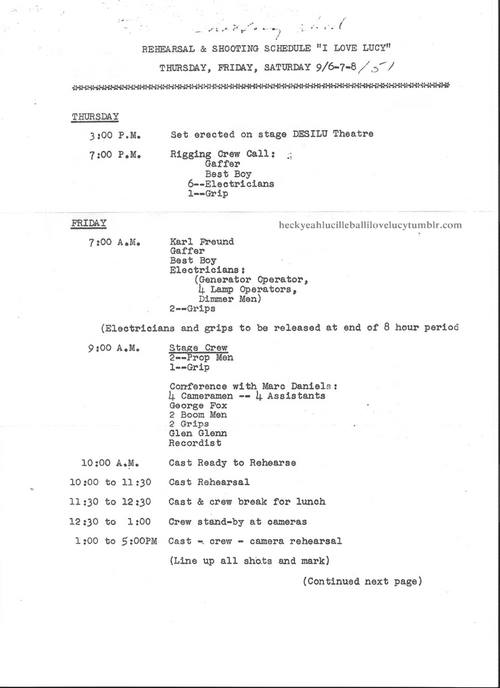
On ‘I Love Lucy’, the set up is almost the same…the living room was in the center and the kitchen and bedroom areas on either side with the bedroom and kitchen spaces the ones used for sets outside the apartment. To the far right of Lucy’s living room was the club set which was also used for non apartment scenes when there were no club shots. Enjoy and share! – Bobby Ellerbee
Anyone Know Who Made This Pedestal?
2021 UPDATE: It is a GE pedestal.
You don’t see many of these but there were a few around. This is built along the same lines as the old Dumont “milk wagon” pedestals used under their Iconoscope cameras. I’m pretty sure this is an electric ped with a small motor for raising and lowering the camera, but there are no manufacturing markings on any of the photos I have.
I suspect this may have been made by or for GE. The camera is an RCA TK30 and is band new. The photo is from WGN in Chicago and was taken during their first week of operations. The temporary number on the camera looks like that old cloth like medical tape used to hold bandages on. Remember that? Let us know if you know more! Enjoy and share! – Bobby Ellerbee
How’s This For A Flashback?
Here’s an ad for the first ever episode of ‘Saturday Night Live’ and goes a long way in clearing up some confusion in the comments section from last week.
As I wrote then, Tom Snyder did a special 90 minute Saturday version of ‘Tomorrow’ with Jerry Lewis to cover the one week pushback of the SNL debut. Some had posted that Billy Crystal was to host the first show and the pushback gave George Carlin the honor of being the first guest host, but that was never the case. It was always Carlin, BUT…Crystal was scheduled to appear. Unfortunately, the show went long and Billy’s segment had to be cut.
It would be interesting to know if Billy made it to the stage in the dress rehearsal or if the cut came that afternoon. Anyone know? Thanks to Doug Gerbino for this classic ad. Enjoy and share! -Bobby Ellerbee
Dumont was first with this video/film hybrid system which they called the Electronicam, and it debuted just before it was used on ‘The Honeymooners’ Classic 39 film episodes in 1954.
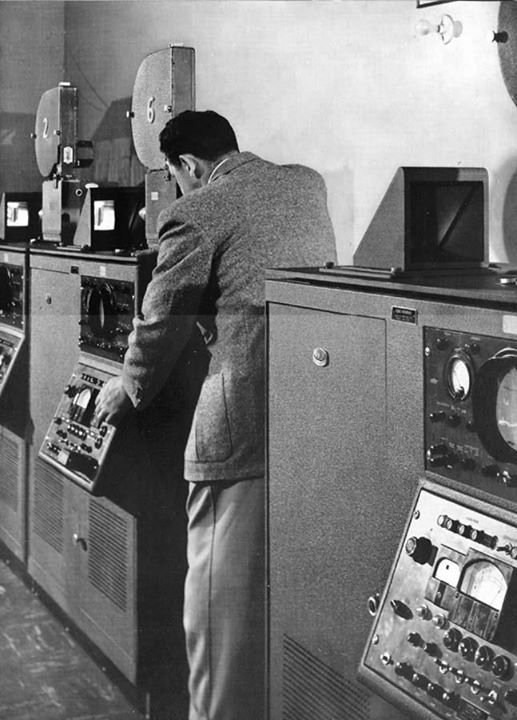
This Gemini System from UK optics company Rank (as in Rank, Taylor, Hobson) came out around 1957, and as the Broadcasting Magazine article states, would eliminate the need for Kinescopes. The problem for Rank was that videotape had just debuted too, but there was a need and use for this…especially when it came to commercial production.
Soon after videotape went into service at the networks, national sponsors began asking for their spots on tape. In order to avoid having to shoot the spots twice, once of film cameras and once for television cameras – or to avoid having a kine print, the Gemini came in handy for shooting both at the same time.
Even into the early 60s, many local stations only had one or two of the expensive video tape machines and still had to run spot from film via telecine chains. Thanks to John Schipp for the article. Enjoy and share! -Bobby Ellerbee
Ding, Dong The Witch Is Dead! GE Sign Finally Coming Down…
Most will be glad to know that work began a few days back to take down the GE sign at 30 Rock…soon NBC’s proud peacock will take it’s rightful place here. Thanks to Anthony Quintero for this shot of the work in progress. Enjoy and share! -Bobby Ellerbee
The Heart Of The Magnetic Field Problems For CBS Studio 50
In one of today’s earlier post about CBS ordering the Maconi Mark VII color cameras, I mentioned the the legendary magnetic field problems they had in Studio 50 and also, Studio 52.
Circled in red is the heart of the problem. That’s where the massive transformers for the subway were located. This is on 53rd Street with Broadway being just up at the corner on your right. The dark building to the right of the transformer building is the stage of The Ed Sullivan Theater (Studio 50) where David Letterman is done.
HERE IS WHAT IS INSIDE THE BUILIDING!
The building on the left (black fire escapes) is the rear of what was once CBS Studio 52, with the front entrance on 54th Street. After CBS sold it, it became the famous nightclub “Studio 54”.
Even in the Black and White days, cameras had to have special mumetal shielding inside to block the interference. Jackie Gleason once hired an RCA color truck with TK41s for a test of the show in color in the early 60s, but no matter what they did or where they parked the truck, they could not get a good picture. Enjoy and share! -Bobby Ellerbee
Geeky, But Interesting Camera History…CBS And Marconi Color
Being born on Halloween, things in history that happen on that day intrigue me and here are two biggies. On October 31, 1965, CBS Studio 50 made its debut color broadcast of ‘The Ed Sullivan Show’ with 5 Norelco PC60s.
The very next year, on October 31, 1966, this article appeared in Broadcasting Magazine. It announces the CBS purchase of 39 Marconi Mark VII color cameras, with the first 5 scheduled to arrive in the summer of 1967 at Studio 50.
It has always been my opinion that the Mark VIIs replaced the Norelcos there 18 months after they were first installed. Finally, we have the confirmation. The magnetic field problems at Studio 50 are legendary, and although Norelco modified the 5 cameras they installed to negate that interference, this makes it pretty obvious the CBS was never really happy with the Norelco picture quality from 50.
Somehow when CBS field tested the Mark VII at Studio 50 in 1966, with no modifications to the camera, it worked fine and the magnetic field problems had no effect on it. Enjoy and share! -Bobby Ellerbee
In Case You Missed It…Color Video Tape Comparison To Kinescope
Obviously color makes a big difference, but so does the quality of videotape over kine. This is the “laughing cameraman” sketch that I posted yesterday in a side by side comparison with some neat special effects inserts.
Thanks to Joao Antônio Franz dos Santos for sharing this, but most importantly, thanks to David Crosthwait at DC Video in Los Angeles for making this after transferring the show from a 2″ quad, low band videotape to a digital format for the Lewis family archives. Enjoy and share! -Bobby Ellerbee
‘Tonight’…Son Of ‘The Knickerbocker Beer Show’
When ‘Broadway Open House’ left the air in August of ’51, late night television got put on the back burner as NBC’s Pat Weaver was busy putting together ‘The Today Show’, which debuted in January of 1952. After a year or so of intense focus on the early mornings, Pat began to think about late nights again.
 Ted Cott, a successful radio executive who had recently moved into television at the NBC affiliate, suggested Steve Allen as host for the venture. and was interested in a west coaster that had recently shown up for some extended club dates and radio work in NYC. This was of course Steve Allen, and Weaver tested the water by giving Allen a half hour of late night air time on NBC’s local station, WNBT near the end of 1953.
At that time, WNBT and its late night movie program was getting clobbered by a better package of films being broadcast every night on the CBS affiliate, WCBS.
Knickerbocker Beer, which was then a major brand, decided it wanted to sponsor something other than late movies on WNBT…say, a variety show. Ted Cott, a successful radio executive who had recently moved into television at the NBC affiliate, suggested Steve Allen as host for the venture.
At the end of August of 1953, a 40 minute weeknight program called ‘The Knickerbocker Beer Show’ debuted. Steve Allen was the host and the legendary Dwight Hemion was directing one of his first shows which originated from Studio A of the WOR 67th Street Studios. At the time, the studio was still owned by WOR and NBC was leasing space, but that changed the next year when the ‘Home’ show with Arline Francis came to the air…NBC took over the whole complex then.
A few weeks after the debut, the show’s name was changed to ‘The Steve Allen Show’ but Knickerbocker was still the sponsor. In the comment section, I’ll show you ticket from the September 16th show.
Done at first without writers and always without much of a budget, Allen’s local show was an immediate success, garnering both critical acclaim and the desired higher ratings. On the show, Allen would play the piano, chat with audience members or guests, bring on Steve Lawrence and/or Eydie Gorme to sing a song (as in this clip) and have fun with the bandleader Bobby Byrne. Allen was basically laying the foundation for all TV talk shows to come. Less than a year later, most of the operation would be moving over to do a network show called ‘Tonight’ which debuted September 27, 1954! Below is a clip from that first night. Enjoy and Share! -Bobby Ellerbee
September 27, 1954…’Tonight’ Debuts From The Hudson Theater
Happy 60th Birthday To ‘Tonight’! May you have 60 more!
At the link are the opening minutes of the very first ‘Tonight’ show with Steve Allen. I’m not going to go into great detail on this as we have spotlighted this show’s history many times here, BUT…in the next post, I will give you something Ultra Rare!
As Steve jokes in the last few seconds on this debut video, “if ‘Tonight’ is successful, NBC will have a new show called Son Of Tonight”…actually, this show is the “son of” NBC’s local New York show which we will look at in today’s next post. The original name of that show was ‘The Knickerbocker Beer Show With Steve Allen’.
More on the way. Enjoy and Share! -Bobby Ellerbee
https://www.youtube.com/watch?v=n8AYUfBt1dE
Taken from the documentary series “Television”, this is a clip from the first episode of the Tonight show with Steve Allen.
Speaking Of Jerry Lewis…Here’s The Laughing Cameraman Sketch
In the last post about the delayed SNL debut, I mentioned that Tom Snyder and his guest Jerry Lewis filled the hole left by the one week push back. Lewis and NBC have a long history going back to ‘The Colgate Comedy Hour’ days of the early 50s, and here is a clip from his show from Burbank in 1960.
The laughing cameraman is comedian Joey Faye who was in a lot of Sinatra and Lewis movies. We get to see the RCA TK41s around 2:33 but the intro to “Witchcraft” include a typical Lewis bit about the time delay of this live show.
By the way, he did this bit again in 1967 and I’ll post that clip in Comments. Enjoy and Share! -Bobby Ellerbee
The Television Debut Of The SNL Original Cast…Rare & Surprising!
As it turns out, “The Not Ready For Prime Time Players” were not even ready for late night television! Really! Here’s the story…
NBC’s new 90 minute, live comedy show ‘Saturday Night Live’ was scheduled to debut at 11:30 on October 4, 1975. The plane truth is, they just could not get the show ready in time for a number of reasons, with timing and blocking among the biggest hurdles to overcome.
Although Tom Snyder’s ‘Tomorrow’ show was a one hour, Monday – Friday production, NBC called on him at the last minute to do special 90 minute Saturday show to cover the SNL hole in their schedule. Fortunately, Jerry Lewis was in town and agreed to do the show. For the first 85 minutes, he was the single guest. The last five minutes were reserved for the introduction of the SNL cast and it’s producer Lorne Michaels.
In this clip, you will see the first ever network appearance of the original cast of ‘Saturday Night Live’. Break a leg tonight SNL and happy 40th Anniversary! Enjoy and SHARE! -Bobby Ellerbee
I Wonder What Mel Allen Would Have Said About Jeter Last Night?
In one of the most surreal and remarkable farewells in Yankee history, leave it to Derek Jeter to deliver the dramatic game-winning hit in the Yankees’ 6-5 triumph over the Baltimore Orioles, just minutes after the Yankees had blown a 3-run lead.
As the longtime voice of the Yankees, it would be interesting to know what Mel Allen would have had to say, but here is a little known story about a conversation he once had with Lou Gehrig that may give us some insight. This will put a lump in your throat.
Allen once recounted an event that occurred during his first full season as the announcer of the Yankees. Lou Gehrig had been forced to retire the previous year due to what would be a fatal illness. Speaking with Allen in the team’s dugout, Gehrig told him “Mel, I never got a chance to listen to your games before, because I was playing every day. But I want you to know they’re the only thing that keeps me going.” Allen waited until Gehrig left, then broke into tears. Enjoy and share! -Bobby Ellerbee
Here’s Red Scare monger Sen. Joseph McCarthy in his favorite position…in front of a camera. Thank God for real newsmen and journalists like Edward R. Murrow who took him on and took him out.
Thank God for Dick Clark and American Bandstand! Boy, how this show changed things in music and for teenagers. Did you watch? Got a story?
Shades Of SNL…On The Set Wardrobe Changes
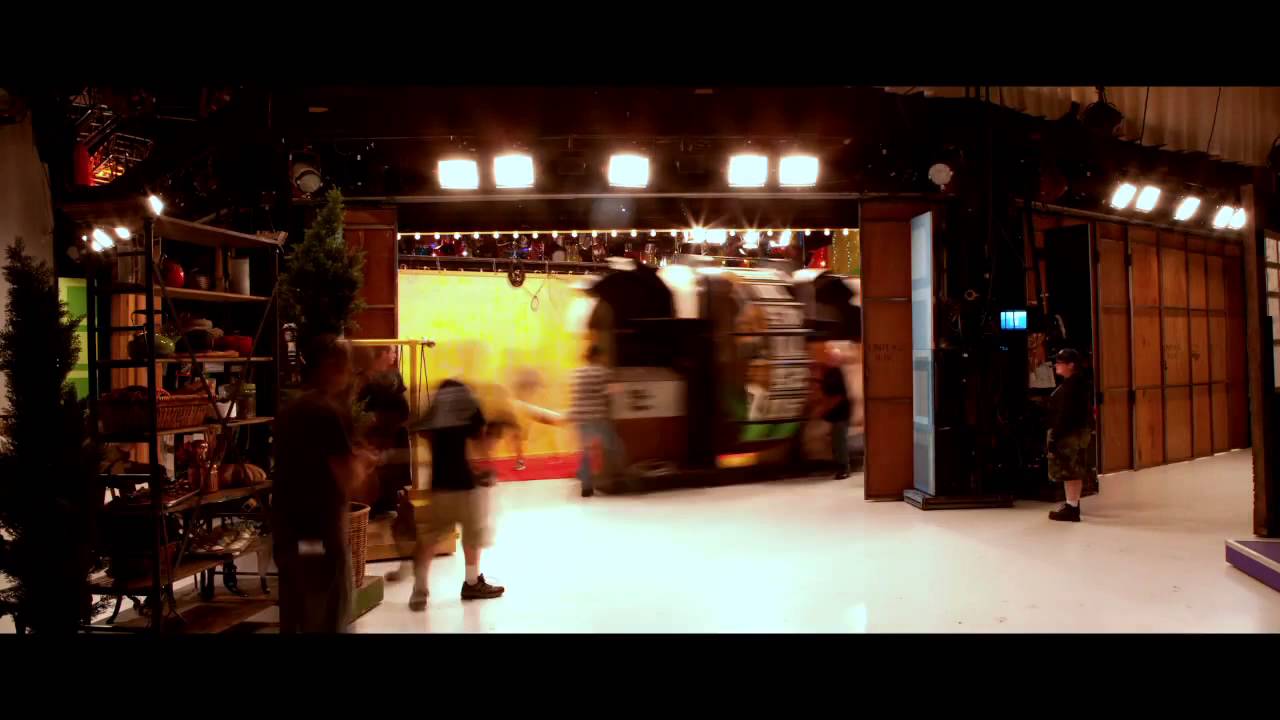
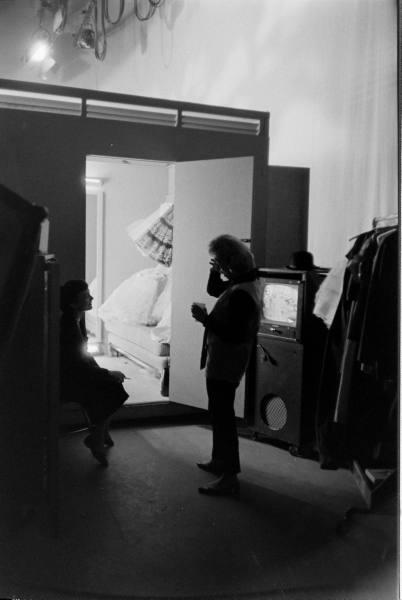
In live television, a lot of things happened just on the other side of the set walls. Here at Television City, a door opens to a quick change space where actors could make a change on the set. More often than not, there was no time to make it to a dressing room and back before they had to hit their marks.
This photo is from a ‘Playhouse 90’ production…one of television’s most cherished and respected anthology series. Enjoy and share! -Bobby Ellerbee
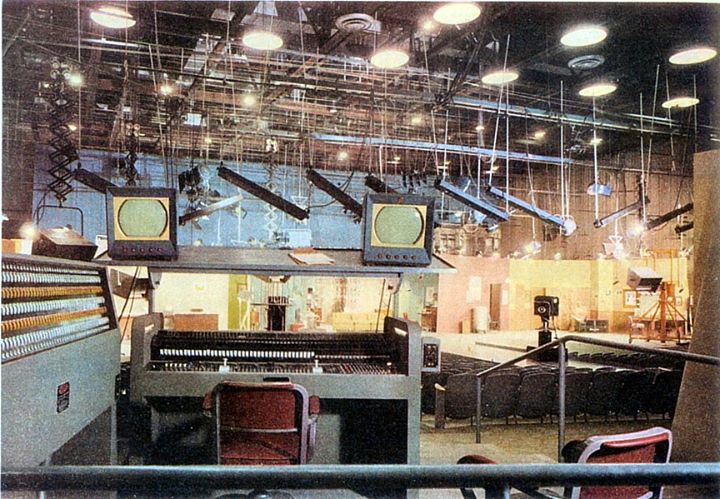
A Rare Color Photo of CBS Television City Studio 33
Perhaps the most famous of the TVC studios is 33. This is the only one left that has the side wings and the built in theater seating. Here is a shot from behind the lighting directors console from around 1953.
As mentioned in the post just before this, the dynamics of production changed as with this much space, you could have horizontal production with the cameras and crew moving from side to side on stage instead of operating in a maze of set walls as was necessary in most NYC productions. I think this set is either ‘My Friend Irma’ or ‘My Favorite Husband’.
You can’t see the wings, but you can see how far the center ramp comes out into the audience. Studio 31 was originally a mirror image of 33…the only difference was that in 31, the lighting board was on the other side of the control room which we see the corner of at the far right in this photo. Enjoy and share! -Bobby Ellerbee
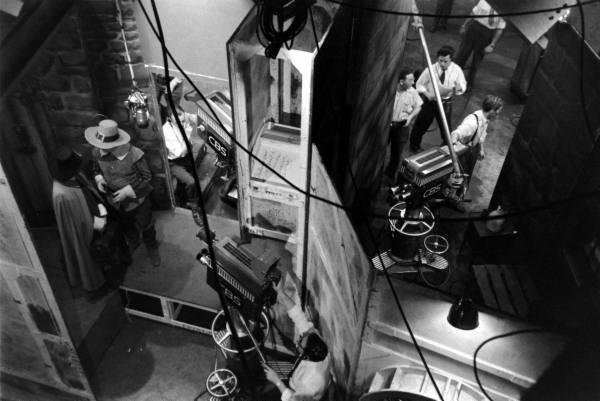
This NYC shot is a stark contrast to the way live production changed once bigger studios, like the ones at Television City, allowed horizontal staging…sets, all in a row that allowed crews and cameras to move side to side on the stage.
This photo could possibly be from the newly converted CBS Studio 50, which is now home to David Letterman. It was converted from radio to television in 1950 and this shot from the catwalk shows three RCA TK10s within 6 feet of each other ready to shoot three different scenes on this maze like set. The production is the 1950 “Studio One’ presentation of ‘The Scarlet Letter’. In 1950, ‘Studio One’ won an Emmy for Best Kinescope.
Notice the low camera in the top left is shooting into the rear of a fireplace opening and soon, will give us an image of one of the characters putting wood on the fire from inside the fireplace, but first the camera on the other side of the wall has to move. Enjoy and share! -Bobby Ellerbee