Posts in Category: TV History

The History Of Live Pool Splashdown Coverage…Part 1B

The History Of Live Pool Splashdown Coverage…Part 1B

Tampa’s CBS affiliate WTVT had a mobile unit that was so good, even NBC used it on their ‘Today’ show trips to Florida, but the unit’s usefulness did not stop at the water’s edge. Prior to being aboard for November 1965’s, first live splash down coverage via satellite, WTVT’s unit and crew had been aboard the recovery ship a couple of times before on Mercury and Gemini missions. On those earlier trips, they were there to videotape the recovery efforts to be broadcast once they got close enough to microwave the signal in. The photo on the left shows WTVT cameraman Jim Benedict with his TK11/31 on the deck of the USS Wasp during coverage of the Gemini 6 and 7 recovery missions. When CBS was chosen for pool coverage, the WTVT was often a first choice. There’s more on this at our friend Mike Clark’s Big 13 site.

http://www.big13.net/Jim_Benedict/jimbenedict9.htm


Source

The History Of Live Pool Splashdown Coverage…Part 2A

The History Of Live Pool Splashdown Coverage…Part 2A

Our friend Jodie Peeler has written a great three part story on this subject with lots of detail, linked video and photos that I am proud to present here. Unlike today, bringing live television pictures from a ship at sea was a whole new ballgame and in this series, we’ll learn how it was done. More details on the photos, so click on all included this this post. Thank You Jodie! Bobby Ellerbee

Live color transmission from the recovery ship finally became a reality in October 1968, with live pictures of the Apollo 7 recovery from the recovery carrier, USS Essex. A joint effort by General Electric and Western Union International resulted in a more portable earth station, with a deployable dish. Once unfolded, it was shielded from the elements by a 22-foot inflatable radome. The big white dome became a familiar sight on recovery ships throughout the days of Apollo.

Apollo 7’s splashdown in the Atlantic, where most Gemini flights had ended, gave the new system its first trial in familiar territory, but the recovery of Apollo 8 in December 1968 provided the challenge of getting pictures from far off in the Pacific Ocean, where all the lunar flights would come back. Some difficulties were encountered early in the Apollo 8 splashdown coverage – the ship’s powerful radar units didn’t get along with some radio and satellite equipment, and the signal was lost a few times – but on December 27, 1968 viewers were able to watch live as the Apollo 8 astronauts ended man’s first flight around the Moon as they emerged from the recovery helicopter aboard USS Yorktown.
Portable cameras allowed viewers a close-up look as the astronauts went from the flight deck to the hangar deck below.

With Apollo 8’s lessons learned, and further refinements during the Apollo 9 and Apollo 10 recovery efforts, all was in place for the historic Apollo 11 recovery by USS Hornet on July 24, 1969. Increased cooperation among the Navy, GE/WUI, and the networks meant coverage went better and with minimal technical glitches. Viewers were able to watch live pictures from Hornet: the recovery efforts, the astronauts landing aboard and going into their quarantine van, and the welcome-home ceremony in which President Nixon, aboard the ship to witness the historic moment, gave the astronauts an official welcome.

Although live coverage from the recovery ships continued through the remainder of the Apollo program, interest peaked with Apollo 11 and steadily dwindled, with the dramatic return of Apollo 13 (also carried live via satellite) the exception. Apollo became an old story, and the networks cut back on their coverage. By 1972 CBS News president Dick Salant was balking at the $200,000 or so it would cost to carry live coverage of the splashdown of Apollo 17, the final lunar mission (and in spite of his protest, CBS did carry the splashdown live). Still, the historic moments of Apollo had been carried from start to finish, and the world had been able to see its lunar explorers return home safely.

Here’s a Western Union International commercial, aired during the flight of Apollo 11, describing the terminal system and showing it being deployed:

http://www.youtube.com/watch?v=YjJKSpF10GM

There’s also a ton of Apollo coverage on YouTube, and it’s not hard to find – honestly, I wouldn’t know where to begin. (The Apollo 7 coverage doesn’t seem to exist, at least not on YouTube, alas – but the CBS coverage of the Apollo 8 splashdown exists pretty much in its entirety, and Apollo 11’s coverage may be found in both ABC and NBC formats.)


Source

The History Of Live Pool Splashdown Coverage…Part 2B

The History Of Live Pool Splashdown Coverage…Part 2B

30 year NBC Burbank veteran John Olson took the two color photos on the Apollo 10 recovery ship, the USS Princeton in May of 1969. On the left is one of NBC’s 35 Norelco PC 70s that were custom engineered by “Mr Tube”, Fred Himelfarb…NBC’s in house camera guru. They were bought in late ’66 for use in their sports and remote trucks. In late ’67 NBC also bought a half dozen Norelco PCP 70s, one of which is seen in the center photo being operated by Bobby Keys. On the right is an ABC RCA TK41 on the Hornet’s Apollo 11 recovery mission. At least one was mounted on the back of an aircraft tug to provide shots from various positions. FYI, RCA’s TK44A came out in ’68 and the first RCA color portable, the TKP45 came out in 1974…quite a bit of lag time. The TK76 ENG camera came out in 1976.


Source

The History Of Live Pool Splashdown Coverage…Part 3

The History Of Live Pool Splashdown Coverage…Part 3

Our friend Jodie Peeler has written a great three part story on this subject with lots of detail, linked video and photos that I am proud to present here. Unlike today, bringing live television pictures from a ship at sea was a whole new ballgame and in this series, we’ll learn how it was done. More details on the photos, so click on all included this this post. Thank You Jodie! Bobby Ellerbee

“So now that we’ve discussed the capabilities, what about all the support equipment? These diagrams from Hornet’s Apollo 11 and Apollo 12 Cruise Report shed some light on the equipment and where it was located.” Jodie Peeler


Source

The Eyes Of A Generation Camera Collection Video Tour


The Eyes Of A Generation Camera Collection Video Tour

It’s been a while since I posted this walking tour of my camera collection, and a few of you have asked me to post it again, so here it is. There are 16 cameras on display in my camera room and this was shot a year ago with a Sony camera made for still photos. Narrating, shooting and maneuvering at the same time was not as easy as many of you make it look, but I hope you enjoy it. Please share this.

Source

Last of the Mohicans?

Last of the Mohicans?

Neither I, Chuck Pharis or Jim Elyea at History For Hire know of any surviving Houston Fearless 30B stage cranes left in the US. This crane was recently rescued by Cinephonics Props Hire in the UK as it was almost scrapped, along with a lot of other equipment from the BBC Television Center in London when it closed last year (see link). Outside the US, this was called the Mole Richardson crane as they were the world wide distributor. In North America, the crane was distributed by RCA and Houston Fearless. If you know of any of these great beauties lurking in a warehouse, please let us know!
http://www.standard.co.uk/news/uk/bbc-television-centre-closes-its-doors-for-the-last-time-8555435.html


Source

It’s Howdy Doody Time…And Places

It’s Howdy Doody Time…And Places

When the show started in 1947, it originated from NBC’s first TV studio 3H. Up top is our old friend Frank Merklein with his trusty TK10 on the Doody set in 3H. Posing with Frank as the dolly man is the show’s director Sandy Howard. 8G came on line in 1948, but it wasn’t until that studio was equipped with the new TK11s in 1952 that the show moved there (center).

When 3H and 3F were combined to make a large color studio, the first inside NBC, it was renamed 3K (bottom) and Howdy moved there and became NBC’s first daily color show. As I said, 3K was the first in house color studio (Colonial Theater was the first NBC color facility) and next up for in house color was 8G followed by 8H. NBC Brooklyn debuted in September of ’54 at the same time 3K came online as a color studio.


Source

It’s Howdy Doody Time??? The X Rated, Ultimate Inside Story!

It’s Howdy Doody Time??? The X Rated, Ultimate Inside Story!

This is the only place you will ever read about of some of the backstage shenanigans on the world’s most famous kids show. Let me start by saying that these things only happened in rehearsals. When children were on the set, everything was squeaky clean and on the up and up, but…it was a different story when they weren’t.

What follows is a first hand account from our old friend Frank Merklien who started as an NBC cameraman in March of 1948. Till 1961, Frank worked almost every show and was one of the first to work at NBC’s first color studio at The Colonial Theater. He was on Camera 2 on the ‘Today’ show’s debut and shot Howdy Doody in black and white and color.

Both events took place long before anyone had ever even thought of sexual harassment, so with the stage set, here we go, and speaking of stages…that’s where part one takes place. Although the show started in Studio 3H, Howdy was done from 8G for a few weeks for some updates in 3H.

It seems that the puppet stage was put up in front of a window in 8G that tour guides liked to bring visitors to. For that week, it blocked the view of the studio as the raised stage, the puppet masters stood on, backed up almost to it and on their first day in 8G, everybody on the tour got a real eye full! The very tall Dayton Allen played Pierre The Chef and was the voice of Mr. Bluster. The very short Rhoda Mann was then the voice of Howdy. As they stood on the raised platform, the ever playful comedian that he was, Dayton Allen introduced Rhoda and Howdy to “Mr. Ding Dong”. Yes. He whipped it out. As fate would have it, naturally there was a tour group outside the window and as the story goes, the female page leading the very surprised group fainted. Both Mann and Allen were fired on the spot by Buffalo Bob.

Speaking of Buffalo Bob Smith, he had a playful streak too! Usually the straight arrow, Bob had one favorite target…the production secretary. Live spots were a fact of life and occasionally had to be done from a set behind the camera that faced away from the kids. It so happened that one of these had to be done with Bob seated to the left of a prop with the product in his left hand. The newly rewritten script was being held by the production secretary who was sitting to the left of Bob, and very close. As he read the script live into a tightly framed shot, he put his right hand on her leg and began moving it up, ever so slowly. It was a two page script and, since she was using both hands, could not stop the advancing hand, or so Bob thought. She managed to give him a good stomping with her left high heel and he let out a surprised yelp. Only the production secretary, the host and the cameraman, our buddy Frank, ever knew why.

Up top is Dayton Allen as Pierre The Chef, in the center Rhoda Mann and on the bottom, an Allan character colage from other shows.


Source

Inside CBS Studio 42…1940

Inside CBS Studio 42…1940

These rare photos from 1940 are some of the first ever of CBS television operations from their new studios, and were most likely taken in Studio 42, as it was 1,000 square feet bigger than Studio 41. In 1939, W2XAB (now WCBS) began broadcasting with an all electronic system it had bought from RCA. The new studio complex in Grand Central Station had it’s transmitter atop the Chrysler Building. Like RCA/NBC, CBS had started earlier, in the late 1920s, with mechanical systems and those crude broadcasts had come from the transmitter site. Some dates on the Grand Central studios put it in use as early as 1936 and makes sense as CBS could have used the space for experiments on it’s Field Sequential color system. W2XAB transmitted the first color broadcast in the United States on August 28, 1940.

On June 24, 1941, W2XAB received a commercial construction permit and program authorization as WCBW. The station went on the air at 2:30 p.m. on July 1, one hour after rival WNBT (channel 1, formerly W2XBS and now WNBC), making it the second authorized fully commercial television station in the United States. The Federal Communications Commission (FCC) issued permits to CBS and NBC at the same time and intended WNBT and WCBW to sign on simultaneously on July 1, so no one station could claim to be the “first”, but, there was a glitch. WCBW’s initial broadcast was the first local newscast aired on a commercial station in the country.


Source

Rare! CBS Studio 42 (Grand Central) Spec Sheets

Ultra Rare! CBS Studio 42 (Grand Central) Spec Sheets

Our thanks again to Gady Reinhold for these 1960 CBS information sheets. This, and Studio 41 were the only two live production studios on the third floor at 15 Vanderbilt Avenue. As noted yesterday, Studios 42 ad 43 were actually “Program Control” rooms where all of the video tape, graphics and telecine operations originated for the network and WCBS TV.


Source

The Nearly Lost Art Of Live Crane Work…


The Nearly Lost Art Of Live Crane Work…

I can’t write this without thinking of our friend John Pinto and his talented crew on the Chapman Electra at ‘Saturday Night Live’. In the US, that is the only show left that uses a stage crane. The BBC’s equivalent to John and his predecessor, the late Al Camoin, is the late Ron Green. In this great video, Ron shows us how it’s done. The first part is the performance and the second, an overhead view and split screen of Ron shooting the performance with amazing grace (no pun intended). Enjoy and share. Thanks to Bill Jenkin in the UK for sharing this.

http://www.youtube.com/watch?v=rteHG-m5BwE&feature=youtu.be

Ron Green shows how it was done.

Source

The Location Of NBC’s First Show With Steve Allen

Location, Location, Location #1

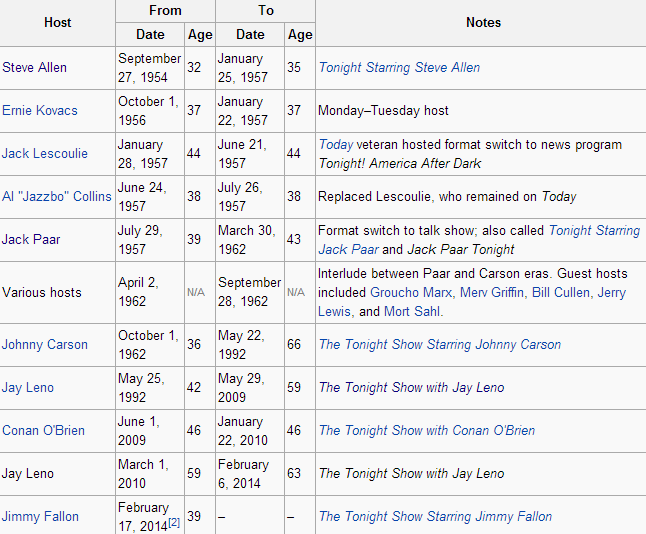
Finally, we know the location of the first ‘Steve Allen Show’ that debuted on NBC New York’s local station, WNBT. Before Allen became host of the first incarnation of ‘Tonight’, which began on September 24, 1954 at The Hudson Theater, his Knickerbocker Beer show had hit the air locally the year before from 101 West 67th Street. At the time, the property was the home of one of three independent stations in NYC…WOR TV, which they had built and occupied in the fall of 1949. Back then stations rented studio space to the big players all the time, like CBS renting studios at Dumont’s WABD for a couple of soap operas. WOR/Channel 9’s new building was known as “9 Television Square”. Shortly after WOR was sold to RKO, the studios moved back to Times Square at 1440 Broadway with WOR radio. NBC had produced the ‘Home’ show with Arline Francis from here starting in 1954 and when WOR moved, NBC took over the building. ‘Home’ continued here till 1957 and in ’58, ‘Concentration’ prime time editions came from here. NBC moved out in 1961 and The Video Tape Center moved in. Here is a point I need to clear up…I had thought that Video Tape Center started in 1961 and their first home was here at 67th Street…nope. No one has a firm date on when VTC went into business, but their first home was actually in the Century Theater. NBC had leased the Century from ’54 till ’58 and did ‘Caesar’s Hour’ with Sid Caesar (1954–1957) and ‘Treasure Hunt’ from there. Sometime after ’58, Video Tape Center moved in and stayed till the building was torn down in ’61, necessitating the move to 67th Street. Thanks to Dave Miller for help with the Steve Allen ticket and to Brett Henry for the personal photo of the property in ABC’s hands.


Source

Absolutely, Positively…The “Florida Showcase” Location

Absolutely, Positively…The “Florida Showcase” Location

It’s taken a month and a few false starts, but we finally have the exact location of the Florida Showcase space which was home of the ‘Today’ show from 1962-1965. Thanks to our own “NBC, on the scene, reporter” Dennis Degan, who took this photo on the left on Sunday afternoon, we are now positive that we have the exact location. The ‘Tonight’ show’s Kurt Decker gave us invaluable help with the photos he found that show the exterior (center) of the space. We thought we had it the location Sunday morning, but in the Google map photo we had, the second set of fire hydrants (that weren’t there) was hidden by a bus and when Dennis went there that afternoon, we discovered the space is a few doors up by careful photo matching. When all you are working from is memories from decades ago, projects like this are a challenge, but here, thankfully…we get by with a little help from our friends.


Source

New York-Boston Microwave Relay Inaugurated…February 1948

New York-Boston Microwave Relay Inaugurated…February 1948

On Monday, I posted a map of NBC’s television network from July 1, 1948 which for the first time included Boston. Thanks to Bill Neese, here an article on that link up from a February 1948 Bell Telephone publication. The map showed that aside from Boston, Baltimore, Washington and Richmond had been linked in was well. If you can’t read the included image, go to the link.

http://long-lines.net/places-routes/1st_transcon_mw/TelephoneNews-1948-02/017.html

Source

Rare! CBS Studio 43 And 44 (Grand Central) Spec Sheets

Ultra Rare! CBS Studio 43 And 44 (Grand Central) Spec Sheets

Yesterday, I showed you Studio 41 and tomorrow, we’ll see Studio 42. Today we are going to look at “Studio” 43 and 44 which are actually control rooms. This has caused some confusion over the years as the Grand Central location has always been listed as the location for Studios 41, 42, 43 and 44, but there are only two real live production stages there…41 and 42. Studios 43 and 44 were PC Studios or Program Control Studios where video tape and telecine operations were located. 43 was the main control room where all the network and WCBS shows were rolled from and where the live announcing for local and network shows came from. 44 was used to roll in sectional commercials when a sponsor wanted to sell two different products, or air different versions of spots to different parts of the country, like Ford airing Mustang spots in the south and Falcon spots in the west during their 30 seconds of air time within the same broadcast. When networks aired pre recorded shows, there was always an A and B version, a master and a backup, rolling in sync in case the film broke or the tape warbled and 43 was where most of that came from. Master control was also in Grand Central which was in use from 1936 till 1964 when the move was made to the Broadcast Center. As always, thanks to Gady Reinhold for the images as well as the explanations.


Source

First Ever Televised Academy Awards…March 19, 1953


First Ever Televised Academy Awards…March 19, 1953

The 25th Academy Awards ceremony was not only live on television for the first time, it was live from Los Angeles and New York for the first time too! In the west, Bob Hope hosted from the RKO Pantages Theater in Hollywood, and Frerdric March hosted in the east from NBC’s International Theater in New York. There were more AT&T people on hand than there were NBC people with some 70 of Ma Bell’s finest split between the two venues. The show was sponsored by RCA for $100,000. In New York, Shirley Booth accepted the best actress statuette for ‘Come Back, Little Sheba’. In LA, the best picture went not to the favored ‘High Noon’, but to Cecil B. DeMille’s “The Greatest Show On Earth”. Here is the opening of that show.

http://www.youtube.com/watch?v=iOtp4dli7-4

Bob Hope’s Oscars opening monologue at the first televised Academy Awards® on March 19, 1953. Introduced by Charles Brackett.

Source

Just For Fun…Network News Bloopers NBC, CBS, ABC, CNN


Just For Fun…Network News Bloopers

NBC, CBS, ABC, CNN, correspondents, cameramen and congressmen…Donaldson, Schieffer, Brinkley, Mitchel, Jennings, Brokaw, Koppel, Rather, Wallace, Hume and more of network news’ best in funny rare moments. First is the 1980s original “Tapes Of Wrath” followed by 1991’s “Tapes Of Wrath” parts 1,2 and 3. These were produced for the Washington press corps’ Annual Correspondents Dinner. Enjoy and share!

http://www.youtube.com/watch?v=AQXCCuBwZjE
http://www.youtube.com/watch?v=-fO3NixNX2A
http://www.youtube.com/watch?v=whZWFzevPsU
http://www.youtube.com/watch?v=LzORSArW0sE

From the collection of TV producer Peter Shaplen comes this segment of a blooper reel from various news programs and stations.

Source

The CBS Grand Central “Long Tongue” Boom Arm

The CBS Grand Central “Long Tongue” Boom Arm

In the late 40s, CBS customized a few of their Houston Fearless Panoram dollies by extending the boom arm by two feet. Above, you can see the added counter weight at the base of the boom and below, you can see the extension. They made the kit available to HF who sold them, but mostly only local stations bought them including WGBH in Boston.


Source

Rare! CBS Studio 41 (Grand Central) Spec Sheets…1960

Ultra Rare! CBS Studio 41 (Grand Central) Spec Sheets…1960

At 44′ X 60′, this is the smaller of the two studios at 15 Vanderbilt Avenue. The CBS Grand Central studios were on the third floor and the scenery door was on Depew Place at the building’s southeast entrance. CBS had been in this location since 1936 and stayed till 1964. I think 41 was Walter Cronkite’s home base before the move to the Broadcast Center. I will be posting the spec sheets from the other Grand Central studios in the coming days, but have more research to do in advance of that. Notice on the third page, it states that one of the four cameras was mounted on a “long tongue” Houston Fearless Panoram dolly that was shared with Studio 42. I will be posting photos of that rarity and some other shots from Grand Central just after this post. Many thanks to Gady Rienhold for this information.


Source

The Great Carsoni…


The Great Carsoni…

While were showing clips of great late night hijinx with cameras in the frame, here’s a look at a TK44, as Johnny chases down producer Fred De Cordova. Fred was a pro and knew when to run. He’d started in television in 1950 as the director of shows like ‘The Jack Benny Show’ ‘George Burns and Gracie Allen Show’, ‘The Bob Cummings Show’, ‘The George Gobel Show’, ‘December Bride’, ‘Leave It to Beaver’, ‘My Three Sons’ and ‘The Smothers Brothers’. Thanks to Albert McGilvray for the clip.

Source