Posts in Category: TV History

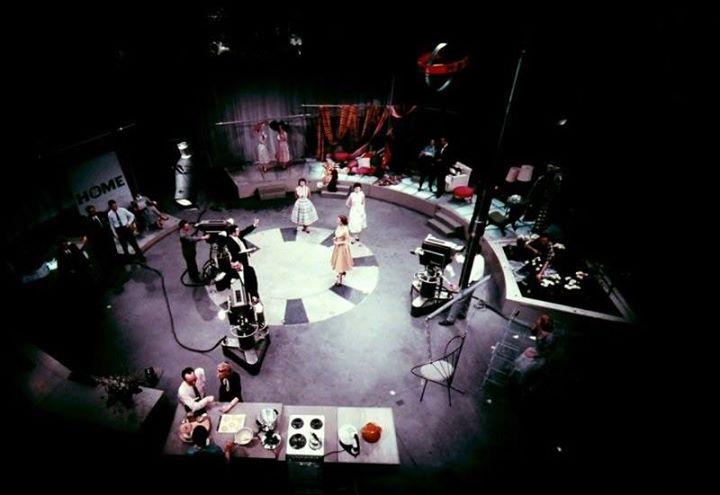
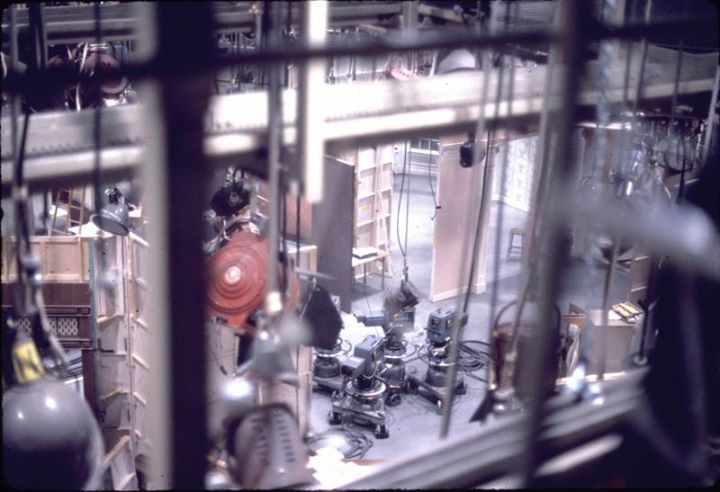
CBS Broadcast Center…Studio 41, 1975

CBS Broadcast Center…Studio 41, 1975

Remember ‘Beacon Hill’? I didn’t think so…it was a huge waste of time and money for CBS. This was basically “borrowed” version of ‘Upstairs, Downstairs’ about a wealthy 1920s Boston family and their Irish servants. The show lasted less than a season, but did leave behind some interesting photos that were taken by our friend Gady Reinhold.

Studio 41 is the largest of the Broadcast Center studios at over 8,100 square feet. In these shots we see four or five Norelco PC60, dual cabled cameras, at work with one on a Chapman Elektra crane. A couple of the PC60s have the plastic viewfinder hoods that were made in the BC prop shop.

I never knew that Robert Stigwood and RSO was involved in television but they are listed as the producers. Enjoy and share! – Bobby Ellerbee


Source

The Photo And The COLOR Video…’Hallmark Hall Of Fame’

Ultra Rare! The Photo And The COLOR Video…’Hallmark Hall Of Fame’


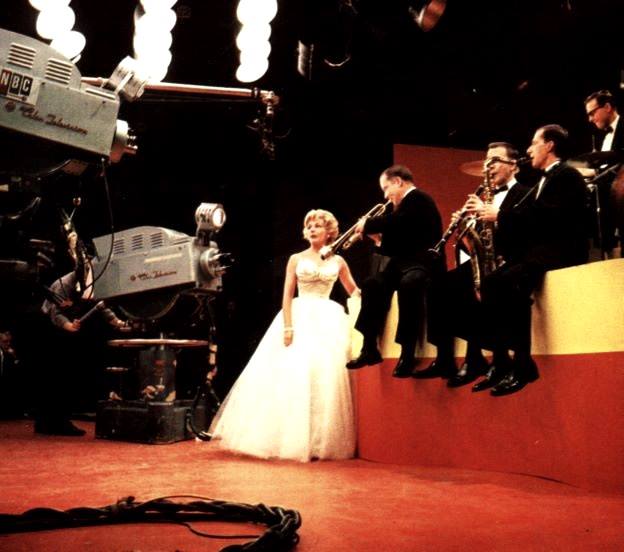
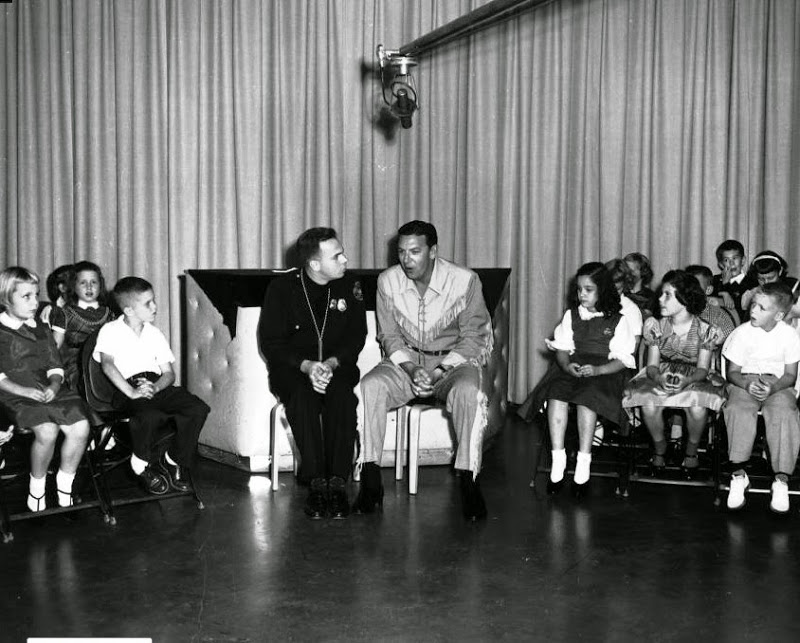
On October 18, 1964, Hallmark’s production of the popular Broadway musical “The Fantasticks” came to television. At the link above, the video is cued to start at the head of this scene in the photo that shows John Davidson speaking to his father, who is played by Bert Lahr.

This was done live to tape at NBC Brooklyn. Although videotape could be edited then, it was still done manually by splicing so the prefered method was still to go live in the east and tape for the west, just like in the kinescope days.

‘The Hallmark Hall of Fame’ debuted on Christmas Eve 1951, with the world premiere of “Amahl and the Night Visitors” on NBC TV. Until 1955, the production schedule was near frantic with an average of 40 new presentations a year. In 1954, the show began color broadcasts and in 1956, it went to a bi monthly format with six or seven shows a year.

The Hallmark anthology series was one of the highest rated and most awarded in television history. For nearly three decades the series was broadcast by NBC, but the network cancelled it in late 1978 due to declining ratings. Since then, the series has been televised by CBS from 1979 to 1989, then on ABC from 1989 to 1995, then CBS again from 1995 until 2011, when that network cancelled the series due to low ratings. As of 2014, the series has earned 80 Emmys, 9 Golden Globes, 11 Peabody Awards and many others.

Thanks to Paul Duca for finding the video. Enjoy and share!
– Bobby Ellerbee

Source

Wonder Where This Is Now? Try The Smithsonian…

Wonder Where This Is Now? Try The Smithsonian…


Here’s clip of the original Starship Enterprise model behind glass at it’s permanent home in Washington.The original filming model from the ‘Star Trek’ television series has resided at the Smithsonian National Air & Space Museum in Washington, D.C. since it was donated it in 1974.

NBC considered the fist pilot “The Cage”, too cerebral, but liked the space angle and ordered another pilot. “Where No Man Has Gone Before” was the second pilot episode. Reportedly, Lucille Ball, who owned Desilu Studios, persuaded NBC management to consider a second pilot, thereby exercising a special option agreement it had with Desilu, because she liked Gene Roddenberry and believed in the project.

“Where No Man Has Gone Before” was written by Samuel A. Peeples, directed by James Goldstone, and filmed in July 1965. It was the first episode of ‘Star Trek’ to feature William Shatner as Captain James Kirk, James Doohan as Chief Engineer Montgomery Scott, and George Takei as Lt. Sulu. The episode title was adopted as the final phrase in the opening voice-over which characterizes the series. Enjoy and share! – Bobby Ellerbee

Source

Sinatra Welcomes Elvis Back From The Army…

Sinatra Welcomes Elvis Back From The Army…


At the link above is a very memorable duet…Frank is singing “Love Me Tender” and Elvis is singing “Witchcraft” and they merge beautifully!

On March 26, at 6.15pm, taping for the ‘Frank Sinatra Timex Special…Welcome Home Elvis’ took place at the Fontainebleau Hotel in Miami. It was Presley’s first appearance on television in over three years, and his first serious performance since 1957, making Presley nervous about how he would be received.

Colonel Parker, perhaps due to nerves of his own, had arranged for as many Presley fans as possible to fill the audience, although at least half of it was still made up of middle-aged Sinatra fans. For the occasion, to fit in with Sinatra’s “rat pack” persona, Presley wore a tuxedo.

On July 15, 1959 it was announced that Presley, upon his release from the Army, would be making his first television appearance on Frank Sinatra’s fourth and final Timex-sponsored variety show. For the special, Presley would receive $125,000, an unheard of sum at the time for a single television appearance. Sinatra was not happy about the amount, knowing full well that even he was not being paid that much for the show, but he played along knowing that Presley’s appearance would attract huge ratings for his show… something that his three previous specials had failed to do.

The show aired nationally on ABC-TV on the evening of May 12, 1960 between 9.30 and 10.30pm and drew approximately 68% of the overall television audience. To put that into perspective, the second rated show in that timeslot, NBC’s ‘Ernie Ford Show’, featuring Johnny Cash and Groucho Marx, pulled in an audience share of just 21%. Enjoy and share! – Bobby Ellerbee

Source

Ikegami’s First Full Size Color Studio Cameras…The TK301


Ikegami’s First Full Size Color Studio Cameras…The TK301

This Australian studio tour gives us a very rare look at the first Ikegami color studio camera. These are the TK301 A models which came a year or so after the 301s were first deployed by Japan’s NHK Network to cover the 1972 Winter Olympics in Sapporo, Japan.

Although this station has some of the first ENG cameras in Australia, which you’ll see near the end, these Ikegami 301 A studio cameras were not new when this was shot in and probably came out in early 1974.

By February of 1975, Ikegami’s TK355 was on the market (see add in Comment section below) with a new one inch Plumbicon tube. The 301s and 355s were the only two “TK” models Ikegami ever had and the designations changed to the “HK” for studio cameras and “HL” for ENG cameras around 1976. HK was for Handy Kamera and HL for Handy Lookie.

There is more interesting gear that a lot of you worked with here so enjoy this and share! – Bobby Ellerbee

https://www.youtube.com/watch?v=AvSbNm9vJW0

DDQ 10 Studio Tour Tape for 1982

Source

NBC’s David Brinkley Breaks The News On Television…


NBC’s David Brinkley Breaks The News On Television…

In the late afternoon of August 16, 1977, scattered radio reports began to surface on the death of Elvis Presley. It was after 4PM Eastern time when news reports began to confirm the rumors. Many didn’t know till they got home and watched the evening news. Here is the start of that night’s broadcast on NBC.

Do you remember where you were when you heard the news?

Source

Elvis Fourth National Show…Ed Sullivan

Elvis Fourth National Show…Ed Sullivan

Although at first, Ed Sullivan said he would never want Elvis on his show, but Sullivan changed his mind when ‘The Steve Allen Show’ with Elvis as a guest had about twice as many viewers as Sullivan’s show that night (they were competing for the same audience since they were in the same time slot).

After negotiating with Elvis’ manager, Ed Sullivan paid Elvis the huge sum of $50,000 for appearing on three of his shows: September 9, 1956, October 28, 1956, and then on January 6, 1957.

For the first show, Elvis was actually at Television City in Hollywood and two of the photos below were taken in Studio 33. His performances that night were fed live to Studio 50 in New York where Sullivan should have been, but wasn’t. Sullivan had been in a car crash and was in the hospital…actor Charles Laughton filled in as host that night and here is Laughton introducing Elvis that night.

The reason Elvis did the show from Hollywood is because the date coincided with the opening of his first movie, ‘Love Me Tender’.

Elvis’ first appearance on The Ed Sullivan Show was a major success. Over 60 million people, both young and old, watched the show and many people believe it helped bridge the generation gap for Elvis’ acceptance into the mainstream.

He returned to New York on October 25 in preparation for his second appearance on the Ed Sullivan’s show on Oct. 28. Below is a photo of Elvis, Nick Adams and Natalie Wood at a few days later at a NY theater seeing ‘The Last Wagon’ in which Adams co starred.

Elvis’ third and final appearance on Sullivan’s show on January 6, 1957, contains the legendary moments when the CBS censors would not allow his entire body to be shown. Seen only from the waist up, Elvis still put on an exciting show, singing seven songs in three segments. In one segment, Elvis and the Jordanaires sang ‘Peace in the Valley’, which Elvis dedicated to the earthquake victims of Eastern Europe.

Sullivan closed the show with a seal of approval for this new family-friendly version of Elvis, saying, ‘This is a real decent, fine boy. We’ve never had a pleasanter experience with a big name’. This was Elvis last television appearance until the Frank Sinatra Special on his return from the Army. When the show was over, Elvis boarded the midnight train to Memphis, where on Tuesday, Jan. 8, he celebrated his 22nd birthday. Enjoy and share! – Bobby Ellerbee


Source

Elvis Presley’s Second Television Show…’The Milton Berle Show’

Elvis Presley’s Second Television Show…’The Milton Berle Show’


In the clip above, you can see the debut of “Blue Suede Shoes” that Elvis performed from the deck of the aircraft carrier, the USS Hancock in San Diego on April 3, 1956. Below is a picture of one of four RCA TK41s there to shoot it in color.

Following the six week stint on ‘The Dorsey Brothers Stage Show’,
Elvis’ next television appearances were on ‘The Milton Berle Show’ on April 3 and June 5. 1956. On April 3, he opened with “Heartbreak Hotel”. Still in in San Diego, Elvis performs concerts on April 4 and 5. Later the San Diego Police Chief announces that if Elvis Ever returns to his city and performs in the way that he did…he will be jailed for disorderly conduct.

Elvis’ second appearance on ‘The Milton Berle Show’ was on June 5 at the NBC Studios in Hollywood as we see below.

Some call this one of his most controversial performances. It was also Elvis at his best. The next day, the press nicknamed him ‘Elvis the Pelvis’. Many described his act by comparing it to a striptease. Jack Gould of The New York Times declared, “Mr. Presley has no discernible singing ability”, while John Crosby of the New York Herald Tribune called Elvis “unspeakably untalented and vulgar”.

About 10 days later, Berle called Colonel Parker to tell him that based on the ‘hundreds of thousands of ‘pan’ letters’ he had received following the show that “you have a star on your hands”.
Enjoy and share! – Bobby Ellerbee

Source

Elvis Presley’s Television Debut…’The Dorsey Brothers Stage Show’


Elvis Presley’s Television Debut…’The Dorsey Brothers Stage Show’

Most think that Elvis made his television debut on ‘The Ed Sullivan Show; but actually, this was his first nationwide appearance…over seven months before his first Sullivan show. Coincidentally, both the Dorsey and Sullivan shows came from CBS Studio 50.

Between January 28 and March 24, 1956, Presley appeared on the Dorsey brothers’ show six Saturday nights in a row. This video is Elvis Presley’s television debut on January 28th.

The four appearance contract, which was negotiated by the William Morris Agency, contained an option for two more appearances. When they were later picked up, Presley’s fee was raised from $1,200 per show to $1,500 per show.

Elvis was respectful of Tommy Dorsey when the two met for rehearsals at New York Nola Studios before Presley’s initial January 28 appearance. At the rehearsal, Jackie Gleason, who produced the Dorsey show said, “I don’t like this guy.” Dorsey disagreed. “I like his kisser,” he told Gleason. “Don’t worry about him. He’s going to be one of the biggest names in show business in a short time.” Dorsey knew talent when he saw it.

There was some irony in Tommy Dorsey providing Elvis a national stage to build his popularity. Presley would soon surpass Dorsey as the biggest-selling recording artist in RCA history. Still, Tommy Dorsey remained an advocate for Elvis.

“I don’t particularly care for his type of music,” Dorsey told a reporter in Charlotte, “but that’s the teen-agers’ choice and if they like it we’ll give it to them. Only time will tell if he has any lasting qualities. The kids want Elvis now and they should be able to have him.”

Enjoy and share! – Bobby Ellerbee


Source

Welcome To “Mary Richards” Apartment!

Welcome To “Mary Richards” Apartment!

At first glance, this looks like it could be the ‘I Love Lucy’ set as sitcom production is still done basically the same way with the same studio and live audience layouts.

‘The Mary Tyler Moore Show’ was done at CBS Studio Center on Radford Avenue in LA from 1970 till 1977. Actually, MTM Enterprises co owned the property with CBS and the show was produced by her then husband, Grant Tinker.

This apartment set is quite large. I wonder it the WJM newsroom set was just to the left of this? This is the only photo I’ve ever seen of the show in production but would love to know an see more, so please share any pictures and experiences you had with the show.

By the way, please remember to visit the Eyes Of A Generation page daily…I can guarantee you a better experience here that you get viewing this in your timeline. Many times, most of you will miss several of the daily posts! – Bobby Ellerbee

Source

In Case You Always Wondered…

In Case You Always Wondered…

If you are like me, you always wonder what we don’t see when shots of famous sets are on camera. Well, here’s what we never saw when and ‘NBC Nightly News’ anchor or correspondent reported from the west coast. On the far wall is the NBC News Los Angeles, backdrop for those shots.

This was part of the network news operation in Burbank. KNBC’s local news originated from a Studio 10, but as you can see, in the foreground there is an update/breaking news desk in this area as well. I hope someone can tell us what the bright spot is on the right wall and what the other large cityscape backdrop was used for.

At this link is KNBC’s goodby to Burbank, Enjoy and share!
http://www.nbclosangeles.com/on-air/as-seen-on/NBC4-Says-Goodbye-to-Burbank_Los-Angeles-243069621.html

Source

Three Things I Never Knew About MTM Till NOW! This Is A Shocker!


Three Things I Never Knew Till NOW! This Is A Shocker!

First, I never knew Mary Tyler Moore had a flop. Second, that flop included David Letterman! Third, David Letterman can sing and dance! WHO KNEW?

This is the only video clip of a show called ‘Mary’ that ran on CBS for three weeks. It aired on Sunday night at 8 from September 24 till October 8, 1978. It was a dud.

After starring in two huge success, ‘The Dick Van Dyke Show’ and ‘The Mary Tyler Moore Show’, Mary tried unsuccessfully to launch this comedy/variety show which relied mostly on a group of repertory players, and what a group it was!

David Letterman, Michael Keaton, Dick Shawn, Swoosie Kurtz, Judy Kahan and James Hampton. The show was produced by her husband, Grant Tinker.

In 1985, ‘Mary’ took another swing and a miss, but this time Moore’s show was a sitcom and a return to the newsroom. In this incarnation, her employer was a sleazy tabloid newspaper. Her boss was played by James Farentino and John Austin was cast as a pompous theater critic. This version of ‘Mary’ debted December 11,1985 and ended three months later on April 8, 1986. Enjoy and share!
– Bobby Ellerbee

https://www.youtube.com/watch?v=l-T11erq_kI

From Mary’s 1978 variety show.

Source

Television City’s Face Light Experiment…1958

Television City’s Face Light Experiment…1958

At first glance, it looks like these RCA TK11s have 10 lenses, but appearances can fool you. Actually what you see here is an ingenious way to add face lighting to talent to take away the nose, brow and chin shadows on close ups.

This is the only photo I’ve ever seen of this arrangement which may indicate that the low intensity lights didn’t yield the desired results, but you have to at least give them an A for effort. I think the need for these was rooted in a request from Art Linkletter…not for his show, but for use on ‘Playhouse 90’. Seems that Art mentioned that he was occasionally distracted by face shadows when he watched. Soon after, this experiment started.

Each camera is adorned with 6 rim lights…2 left, 2 bottom and 2 right. The guys in the shop at TVC were no slouches…they built a lot of custom stuff there including the viewfinder hoods you see on these cameras as well as the more complex adjustable hoods.

Source

‘The Larry Sanders Show’…The Great “Garden Weasel” Spot


‘The Larry Sanders Show’…August 15, 1992 – May 31, 1998

It’s hard to believe that it was 22 years ago this week that HBO debuted ‘The Larry Sanders Show’, but it was.

Out of the box, they knew they had a hit with Garry Shandling’s new show that took us behind the scenes of late night television in a way no one ever has, before or since. With sidekick Jeffrey Tambor as Hank Kingsley and Rip Torn as the show’s producer as the key cast members, the list of guest stars that came to the show was a who’s who that rivaled the real late night shows.

The show was done at CBS Studio Center on Radford Avenue in Los Angeles and won more awards than you can shake a stick at! There were Writers Guild, Directors Guild, Golden Globes, Emmys, Cable Ace, Peabody, Critics awards and more given in this country and even more from the UK and international committees. During its six-year run, The Larry Sanders Show won 24 awards including three Emmy awards.

After the show ended, it came to be considered one of the finest TV shows of all time. The biggest honor it received was a spot on Time Magazine’s 100 Greatest Shows of All Time. In 2008, Entertainment Weekly ranked The Larry Sanders Show the 28th Greatest Show of the past 25 years. TV Guide named it the 38th Greatest Show of All Time, and this is the only HBO comedy to make it to the list.

Below is a clip from Season 1, Episode 1 called “The Garden Weasel”. In re release, the name of this debut episode was changed to “What Have You Done For Me Lately”. Enjoy and share!
– Bobby Ellerbee

https://www.youtube.com/watch?v=M9dT-S4RyQI

Clips of Larry Sanders reluctantly doing in-show advertisements for the Garden Weasel taken from the first episode of The Larry Sanders Show starring Garry S…

Source

The Amazing Center Theater…Gone But Not Forgotten


The Amazing Center Theater…Gone But Not Forgotten

The Center Theater was Radio City Music Hall’s little sister and when it was converted by NBC for television in August of 1950, it became “the world’s largest television studio”. Its big sister seated 6,000, and while the Center seated 3,000, it was just as opulent and a block away at 1230 Sixth Avenue. It is the only original Rockefeller Plaza structure ever demolished, which happened in 1954 to make way for the US Rubber office tower.

Before it’s conversion, the Center had built what was called The Sonja Henie Ice Stage which was used in a one year run of her live ice show there. It was a massive undertaking in every way including financially.

When NBC took over, they kept the stage intact and here is that unique frozen stage in action on a 1954 episode of ‘The Colgate Comedy Hour’ with non-other than Sonja Henie as the guest star. I think this was one of the last episodes of Colgate, or any show, to come from the Center Theater before it was closed for demolition. By the way, it even had a huge revolving turntable, and I’ll add a photo in the comments section that shows that. – Bobby Ellerbee

https://archive.org/details/theColgateComedyHour-21February1954

Above is a link to an episode of The Colgate Comedy Hour with host Gene Wesson, and special guests Sonja Henie, Abbott & Costello and more.

Source

August 13, 1899…The Master Of Suspense Was Born In London

August 13, 1899…The Master Of Suspense Was Born In London

Like you, I loved his movies, but his television show, ‘Alfred Hitchcock Presents’ is my favorite of all his creations. Here’s a quick look at the intro for the young people.

On October 2, 1955, ‘Alfred Hitchcock Presents’ debuted on CBS. This was the half hour show that aired weekly at 9:30 on Sunday nights from 1955 to 1960, The show moved to NBC and to Tuesday at 8:30 from 1960 to 1962.

As you would expect, the ratings were good and sponsors wanted more which brought about ‘The Alfred Hitchcock Hour’, which lasted for three more seasons, from September 1962 to June 1965, adding another 93 episodes to the 268 already produced for ‘Alfred Hitchcock Presents’.

Below we see Hitch on the set of ‘Rear Window’. By the way, in case you have ever wondered what the music was that always played in the famous opening title shot of the drawing and silhouette, it was Charles Gounod’s “Funeral March of a Marionette”. You can see that at the head of Season 1, Episode 13 at the link above. Enjoy and share! – Bobby Ellerbee

Source

Remembering Lauren Bacall…Her Television Debut

Remembering Lauren Bacall…Her Television Debut

This photo of Bacall, Fonda and Bogart was taken at NBC Burbank on May 30, 1955, during the dress rehearsal of a ‘Producer’s Showcase’ presentation of “Petrified Forest”…this was Lauren Bacall’s first appearance in a live television drama. It was also Bogart’s first and last live appearance in a television drama.

Here is a rare kinescope of that performance. This, the only known copy, was given to The Paley Center for Media by Bacall herself in 1990.

‘Producer’s Showcase’ was NBC’s vehicle for their celebrated 90-minute color “spectaculars” which included 37 productions from 1954 till 1957. The most famous of these would be ‘Peter Pan’. This was the eleventh edition of this monthly series and may have been the first one done from the west coast.

It was directed by Delbert Mann and starred Bacall, Henry Fonda and Humphrey Bogart in what would also be his first appearance in a live television drama. Jack Klugman, Richard Jaeckel, and Jack Warden played supporting roles.

If you’ve ever seen “Key Largo”, you’ll instantly recognize the similarity of the story lines of escaped convicts taking over, in this case, a dessert dinner as opposed to a Florida Keys hotel. Enjoy and share. – Bobby Ellerbee

Source

Captain, My Captain…Robin Williams On ‘Saturday Night Live’

Captain, My Captain…Robin Williams On ‘Saturday Night Live’

In the photo, we see Robin with the SNL crew gathered around the Chapman Electra Crane which is driven by our friend Phil Pernice. Thanks to Phil for sharing this picture from 2006. Enjoy and share!

Source

August 12, 1968…The Last TV Performance Of “Over The Rainbow”


August 12, 1968…The Last TV Performance Of “Over The Rainbow”

46 years ago today, Judy Garland appeared on ‘The Mike Douglas Show’. At the start of this clip, you can see Mike and Judy reminiscing over some rare photos of her, but this is set to start where Douglas asks her to sing one of the greatest songs of all time.

Although she would perform “Somewhere Over The Rainbow” at a few more live concerts, this was the last time she sang it on television. Enjoy and share!

Source

‘Mork And Mindy’…It All Started On ‘ The Dick Van Dyke Show’

‘Mork And Mindy’…It All Started On ‘ The Dick Van Dyke Show’

In tribute to Robin Williams, today we’ll take a look at some little known history that relates to his extraordinary career. He was one of the world’s most brilliant comics and he, like his hero Jonathan Winters, will be missed for years to come.

In the second season of ‘Happy Days’, Jerry Paris took over as director. If you remember, Paris had also directed ‘The Dick Van Dyke Show’ and it was there that a script from Carl Reiner gave birth to the idea of an alien visit.

Paris had told the ‘Happy Days’ writers about this shortly after producer Gary Marshall’s son asked what if an alien landed at Arnold’s…a few weeks later, there was a script. There will be more on this in the next post, but for now…back to February 6, 1963.

It was in Season 2, Episode 20 called “It May Look Like A Walnut” that “Rob Petrie” was introduced to a walnut eating alien named “Kolac” played by Danny Thomas, who had come to earth to steal the thumbs and sense of humor from earthlings. Was it a dream or was it real? Turns out, we’ll ask the same question on “Mork’s” debut on ‘Happy Days’!

In this video clip, Thomas enters at 2:20. Enjoy and share!


Source