- Home
- TV History
- Network Studios History
- Cameras
- Archives
- Viewseum
- About
Covering College Football…ABC Sports, October 4, 1975
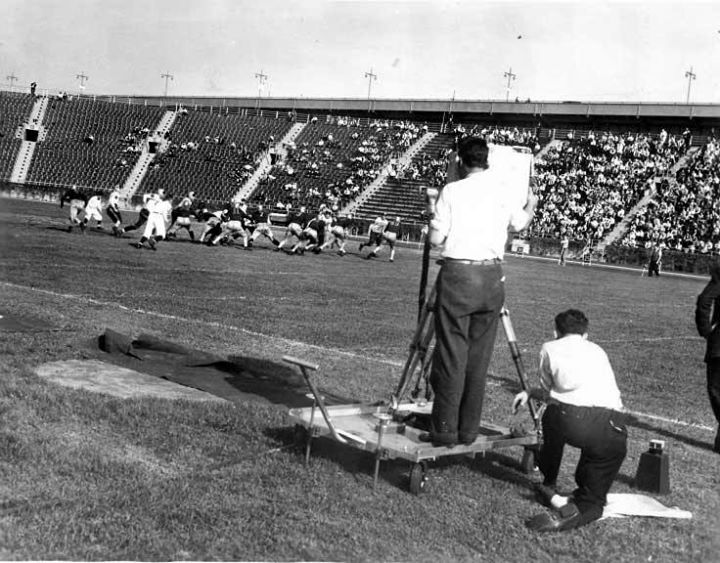
This is the best ever look at how 60 men brought 30 million viewers these great games every Saturday. “Second’s To Play” is presented in it’s original 30 minute format.
This is the most extensive look you’ll ever get of how ABC Sports crews covered the games in this era. Norelco PC 70s are in use, and our friend Don “Peaches” Langford is on the sidelines with the 49 pound Norelco PCP 90 hand held. Enjoy and SHARE! -Bobby Ellerbee
October 8, 1948…NBC’s WNBQ TV In Chicago Signs On
Thanks to long time WMAQ staff member Edward Dabrowsky, and a few others, here are some great shots from times gone by.
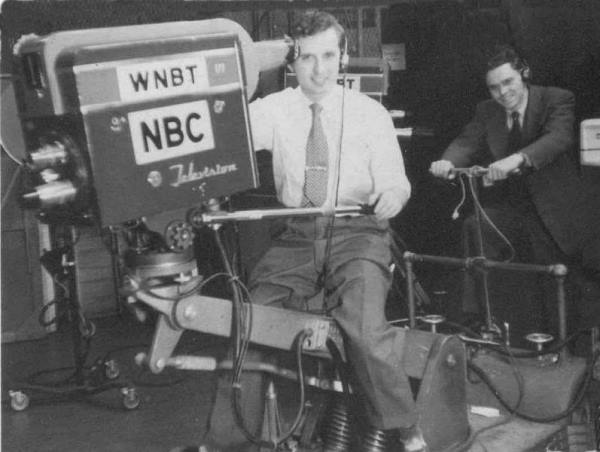
The station signed on October 8, 1948, as WNBQ, the last of Chicago’s four commercial VHF stations to launch. WNBQ is also the third of the five original NBC owned-and-operated stations to begin operations, after New York City and Washington and before Cleveland and Los Angeles. Eight years later, it became the first station in the world to broadcast all of its programs in color.
Though NBC had long owned WMAQ radio, it did not change the TV station’s call letters to WMAQ-TV until August 31, 1964.
WMAQ-TV originated several programs for the NBC television network from its studios in the Merchandise Mart during the 1950s, including Kukla, Fran, and Ollie, featuring Burr Tillstrom and Fran Allison; Garroway at Large, starring Dave Garroway; and “Studs’ Place,” hosted by Studs Terkel. Television critics referred to the broadcasts – often low-budget with few celebrity guests but a good deal of inventiveness – as examples of the “Chicago School of Television.”
WMAQ-TV gained fame for its newscasts during the 1960s, anchored by Floyd Kalber, John Palmer, Jim Ruddle, and Jorie Luelof. Though its role as a program provider to NBC diminished in the 1960s, WMAQ-TV gathered and distributed more than 200 feeds per month of news footage from overseas and the central United States to NBC News.
Memory Lane…Debut Ads For Some Of TV’s Most Memorable Shows
Thanks to Maureen Carney, here are some classic newspaper ads for the debuts of some shows that went on to make history. Enjoy! -Bobby Ellerbee
October 7, 1960…Second Kennedy-Nixon Debate, NBC Washington
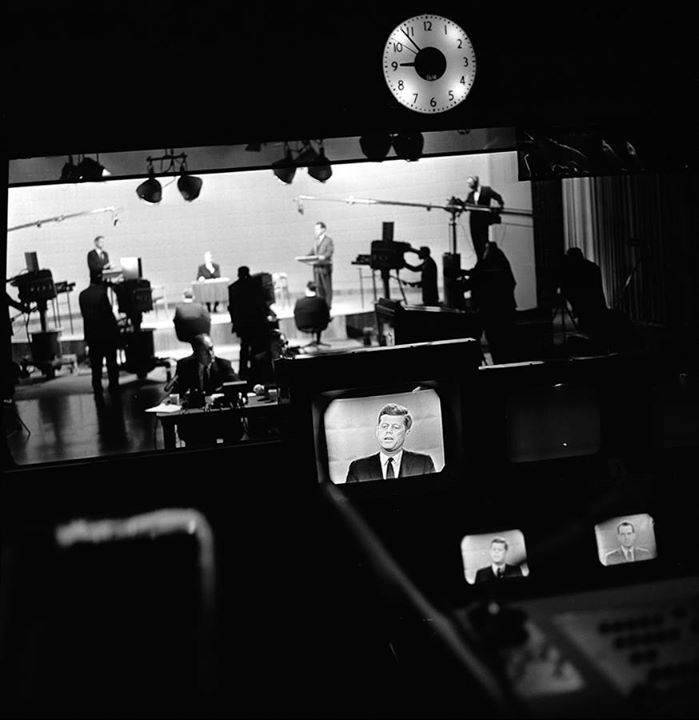
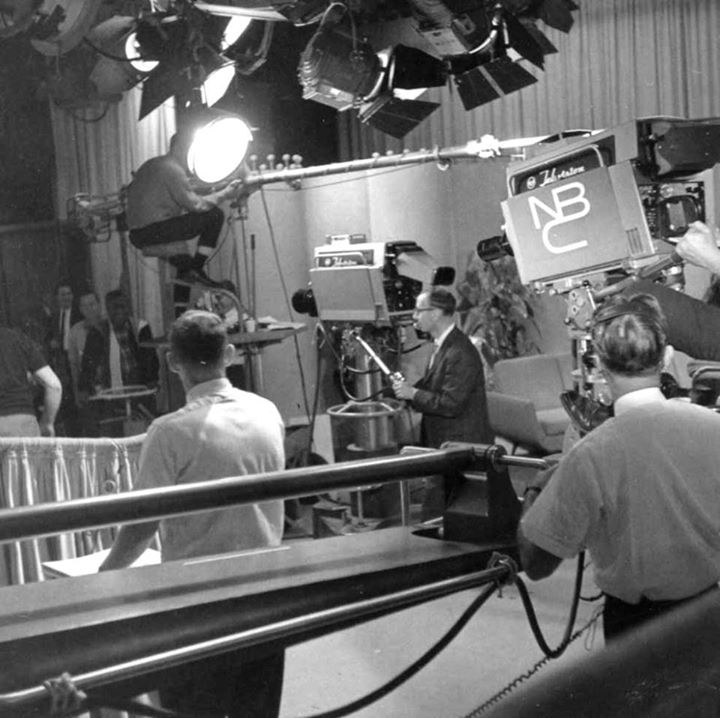
These are newly found photos of the second debate between Senator Kennedy and Vice President Nixon at NBC’s WRC-TV.
As you will see in the video, linked below, the moderator was NBC’s Frank McGee, and panel of questioners included Edward Morgan from ABC, Paul Niven from CBS, Alvin Spivak from UPI, and Hal Levy from Newsday. All four debates were simulcast live on all three networks’ radio and television stations.
The first debate was at WBBM in Chicago and hosted by CBS on September 26. The third was hosted by ABC with Kennedy at WABC in New York and Nixon at KABC in Los Angeles on October 13. On October 21, the fourth and final debate was hosted by ABC in New York. -Bobby Ellerbee
A Rare And Detailed Look At NBC’s Brooklyn Studios…Part 1 of 2
For me, these new photos and information have cleared up a lot of confusion about these famous and historic film and television studios. I hope they will do the same for you.
Here are two annotated aerial views of the property and the recently discovered September 29, 1951 article from the Brooklyn Eagle that announces the sale of the Warner Brothers – Vitagraph property to NBC.
I had always thought that NBC bought the entire Warner Brothers holdings in Brooklyn…the studios and property that WB had bought from Vitagraph Studios. This is not the case. As it turns out, the big white building was retained by WB, but they sold the property on the other side of 14th Street to NBC. This will not surprise you but Wikipedia and other wiki sites have a lot of wrong information on this.
The white Vitagraph building was built in 1906. Vitagraph was bought by Warner Brothers April 22, 1925. What we now know as NBC Brooklyn Studio 1 was built by WB in 1936 and was first used by NBC September 12, 1954. Studio II, the smaller studio was built new from the ground up by NBC and went into service in the fall of 1956.
All of this sheds new light on a bigger picture…a big color picture! As I compare notes on dates and locations, it is dawning on me that with the broadcast of ‘Satin And Spurs’ on September 12, 1954, NBC Brooklyn Studio I, became NBC’s second ever color facility. That is a fact I have never seen documented anywhere before, even in NBC’s press releases of the time.
It’s interesting to note that this property was bought about the same time RCA/NBC took over The Colonial Theater. That was NBC’s first real color facility and after transforming it from a movie theater to a color television studio, the first live broadcast was done from The Colonial on November 8, 1952 with a one time only broadcast of ‘Your Show Of Shows’ with the color burst removed, but viewed in color via closed at RCA Labs in Princeton.
I suspect the three year gap between when NBC bought the property and it’s first use was due in large part to a wait and see attitude regarding the NTSC color system court battles with CBS and the FCC. When CBS testified before Congress in March 1953 that it had no further plans for its own color system, the path was open for the NTSC to submit its petition for FCC approval in July 1953, which was granted in December. I think that is when NBC finally began the serious work of transforming Studio I from a film sound stage into the world’s largest color television studio.
Now that we’ve seen the outside and made some new discoveries, we’ll move to the inside of these two studios tomorrow with some great pictures. Thanks to Glenn Mack for the aerial views, Dave Miller for the Brooklyn Eagle article and to many NBC veterans that helped with this including Joel Spector, Dennis Degan, Jan Kassoff, Frank Gaeta, Russell Ross and more. Enjoy and SHARE! -Bobby Ellerbee
Here is a link to Part 2 A Rare And Detailed Look At NBC’s Brooklyn Studios…Part 2 of 2 – Eyes Of A Generation…Television’s Living History
A Rare and Detailed Look At NBC’s Brooklyn Studios…Part 2 of 2
Today, we will take a look inside what was once the world’s biggest color television studios…that’s biggest in size and reputation.
Starting with the floor plan and sizes, Studio I was 163′ by 70′ with 24′ from the floor to the light grid. The floor area is 11,200 square feet and had an audience capacity of 420 in fold away bleachers.
Studio II, built from the ground up by NBC, was the smaller of the two, but had much more head room. It had 9,700 square feet of floor space and from floor to lighting grid was 39′. It was 131′ by 75′ and held an audience of 582 in fold away bleachers.
The famous swimming pool built for ‘The Ester Williams Aqua Spectacular’ which aired live November 29, 1956 is still there, under the floor of Studio I. Amazingly, there is a full basement under both studios and back in the day, was jam packed with scenery, props and equipment. I think the swimming pool was on the back wall, at the top of the Studio I floor plan. Studio II was used as the “dry” set with all the dance numbers and Studio I was the “wet” set.
I’ve included an October 1956 Broadcasting Magazine article that talks about the three-color studios opening soon, which include Brooklyn II, The Ziegfeld Theater and Burbank’s Studio 4. Remember from yesterday’s post, Brooklyn I debuted September 12, 1954. I have put notes on all the attached photo to let you know what you are seeing, so please click on each individually. Thanks to Dennis Degan for saving these treasures from the now defunct JC Studios site. Enjoy and SHARE! -Bobby Ellerbee
Here a link to Part 1 A Rare And Detailed Look At NBC’s Brooklyn Studios…Part 1 of 2 – Eyes Of A Generation…Television’s Living History
Up top’s the floor plan…notice in the wedge, we see the control room for Studio I about halfway up. The control room for Studio II is near the entrance at the lower left. 14th Street is at the bottom, 13th at the top. On the left is Avenue M and, on the right, Locust Avenue.
October 1956 Broadcasting Magazine article
This is photo 1 of Studio I…to help you get your bearings, Studio II would be to our left. There are two 20′ doors on the left wall, one (the one open here) opens to a loading dock area, the other unseen door into Studio II. The CR would be on our right and is behind these recently added craft rooms on the right.
Photo 2 of Studio I, now we see both elephant doors…the one on the far left opens into Studio II. This is where all 4 color productions of ‘Peter Pan’ were done. I think in the live colorcast of 1957, the flying rig went through this upper left door into Studio II and both studios were used.
Photo 3 of Studio I. According to the floor plan, these added on structures on the right are craft rooms and are in front of the audio and control rooms which are behind them on that wall.
This is photo 1 of Studio II…here we are looking at the back wall and behind that elephant door is Studio I. The main entrance to Studio II would be behind us on the far right (not shown). On the right is the 14th Street wall and Avenue M would be behind us. The blue door opens into a hallway that gives access to production offices, audio, video and control.
Photo 2 of Studio II showing the grid.
Photo 3 of Studio II. 14th street is behind us, Avenue M to our left and Studio I, to the right. This door opens to the loading dock area.
This is the rear of Studio I…we are at the corner of E 13th and Locust Ave. The cars are parked on Locust Ave. I think the Esther Williams swimming pool was on this end, just behind this wall.
Just for fun, here is one of the old WB audio units that was garaged at WB-Vitagraph Brooklyn studios in the 40s. Nice restoration job,
October 5, 1969…”Monty Python’s Flying Circus” Debuts On BBC
How did one of the most beloved comedy shows of all time come to be? After hearing how the pitch went, it’s hard to believe that the show ever came to be…but it did! At 4 minutes into this fun trip down memory lane, John Cleese tells the story. SPAM! -Bobby Ellerbee
https://www.youtube.com/watch?v=W6xXcoVCKp0
Living legend John Cleese stops by to talk about his book “So, Anyway,” how he and his fellow Pythons pitched their show, and why fish are funny.
October 5, 1947…First Live Television Speech from The White House
On October 5, 1947, President Harry Truman became the first president to broadcast a speech live from the White House. The subject was food conservation, and Truman asked Americans to cut back on their use of grain in order to help starving Europeans. At the time, Europe was still recovering from World War II and suffering major shortages.
Although the majority of Americans did not see this live, because not many had a TV set, his speech signaled the start of a powerful and complex relationship between the White House and a medium that would have an enormous impact on the American presidency, from how candidates campaigned for the office to how presidents communicated with their constituents. Each of Truman’s subsequent White House speeches, including his 1949 inauguration address, was televised. In 1948, Truman was the first presidential candidate to broadcast a paid political ad.
Up top, NBC’s WRC is shown providing TV pool coverage of the speech with CBS’s WTOP handling the radio pool. In those early pool days, coverage alternated between CBS and NBC, and both used unmarked cameras and microphones for these occasions. -Bobby Ellerbee
October 4, 1976…Barbara Walters Co Anchors ABC Evening News
40 years ago today, Walters became the first female anchor for a US network evening news program. On her move from NBC’s “Today” show, she was teamed with ABC anchorman Harry Reasoner and the sparks immediately started to fly!
This short clip goes directly to the heart of the conflict and includes footage from that first night. Morbid curiosity was the main reason most viewers tuned in, and after the first week, the ratings bump went away as the dysfunction on screen continued. -Bobby Ellerbee
October 4, 1975…The Missed Debut Date For “Saturday Night”
As it turns out, “The Not Ready For Prime Time Players” were not even ready for late night television! Really! Here’s the story…
NBC’s new 90 minute, live comedy show “NBC Saturday Night” was scheduled to debut at 11:30 on October 4, 1975. The plane truth is, they just could not get the show ready in time for a number of reasons, with timing and blocking among the biggest hurdles to overcome.
Although Tom Snyder’s “Tomorrow” show was a one hour, Monday – Friday production, NBC called on him at the last minute to do special 90 minute Saturday show to cover the SNL hole in their schedule.
Fortunately, Jerry Lewis was in town and agreed to do the show. For the first 85 minutes, he was the single guest. The last five minutes were reserved for the introduction of the SNL cast and it’s producer Lorne Michaels.
In this clip, you will see the first ever network appearance of the original cast of “NBC Saturday Night”. The debut show was one week later, on October 11, with George Carlin as host. Enjoy and SHARE! -Bobby Ellerbee
A while back, my friend John Bolin came from California to see my camera collection. He brought along a few old Kodak shots of a camera he made as a boy of 13. No doubt it’s a TK30 mock up, complete with toilet paper rolls for lenses and Christmas tree lights for tally lights. You really have to marvel at the friction head and the viewfinder hood! Most excellent work, John! Unfortunately, we can’t see the pedestal, but it had a steering ring and wheels, just like the big boys’ version.

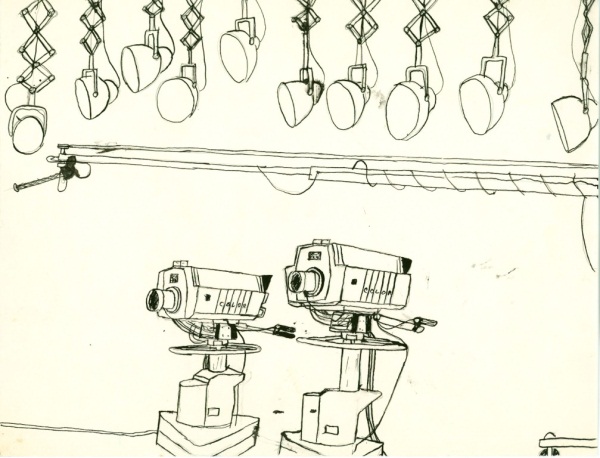
I made myself a camera at around age 10, and my dad even had one made for me for Christmas of 1961, when I would have been 11. It tilted up and down via a hinge in the pole that supported it, and unfortunately all it took was one good tilt forward and that was all she wrote, but it was the thought that counts. In conversations with many of you, I hear stories about the cameras many of you made, but like me, many of you drew them, too!
Below are more than a dozen really good pictures our friend Martin Perry drew as a kid. I swear, they look almost exactly like the pictures I used to draw. I started drawing them about age 10 and drew them until I was 15. Martin now runs Phillips Productions in Dallas, and owns a nice GE camera collection.


October 3, 1952…Television City Debuts 1 Day Before NBC Burbank
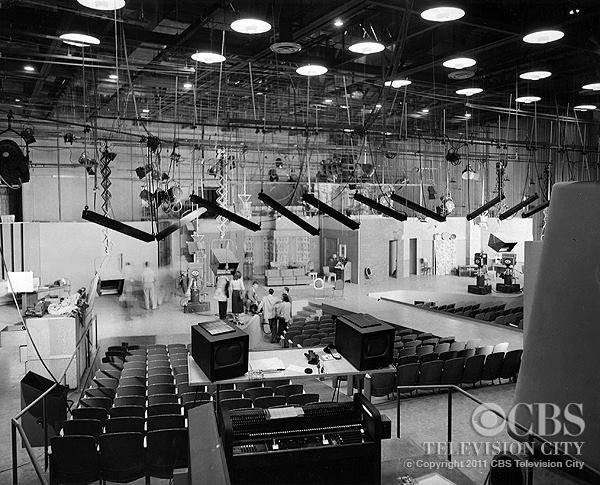
Both networks were working hard to finish their new west coast production facilities in the fall of 1952. When NBC announced in late September they had moved up their first broadcast date to October 4, a mad rush to finish CBS Studio 31 at Television City went into high gear, and on October 3, CBS broadcast “My Friend Irma” from there live. They were thrilled to beat NBC…even by one day.
In the photo, Studio 31 with the “Irma” set. In the foreground, the producers desk with the new master lighting console just behind it. Also shown here are tickets from what would be a wild weekend for TV audiences in Hollywood! -Bobby Ellerbee
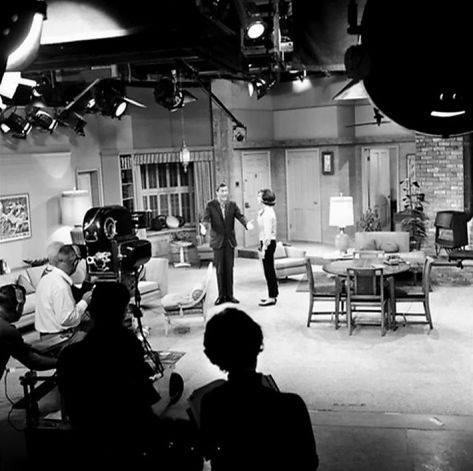
October 3, 1961…”The Dick Van Dyke Show” Debuts On CBS
If you compare photos of this show’s sets and layout to “I Love Lucy” stage photos, you’ll see that they are strikingly similar. Even today, filmed sitcoms adhere closely to this layout and 3 camera arrangement. Enjoy! -Bobby Ellerbee
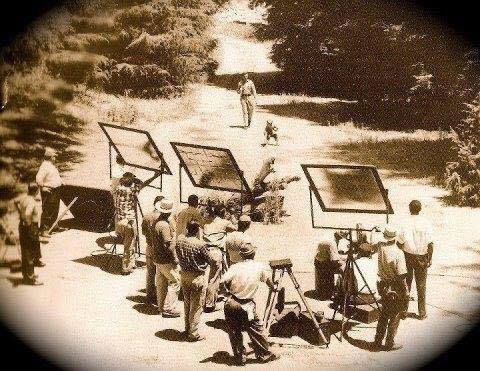
October 3, 1960…”The Andy Griffith Show” Debuts On CBS
This is a very rare shot of the opening sequence being filmed in Los Angles. Go ahead…whistle the theme song…I know you know it. Enjoy! -Bobby Ellerbee
October 3, 1955…”Captain Kangaroo” & “Mickey Mouse Club” Debut
What a great day for kids! One new morning show and one new afternoon show!
Above is the whole story of “The Mickey Mouse Club”…a 50 minute video, full of history and the story of how it came to be for ABC and Disney.
At CBS, Bob Keeshan (who started as an NBC page, but later became the original Clarabell on “Howdy Doody”), kicked off a show that would run almost 29 years. By the way, the “Captain Kangaroo” theme song, which we all know by heart, was actually a stock music track from Chappell Music called “Puffin Billy”, which was used from ’55 till ’74.
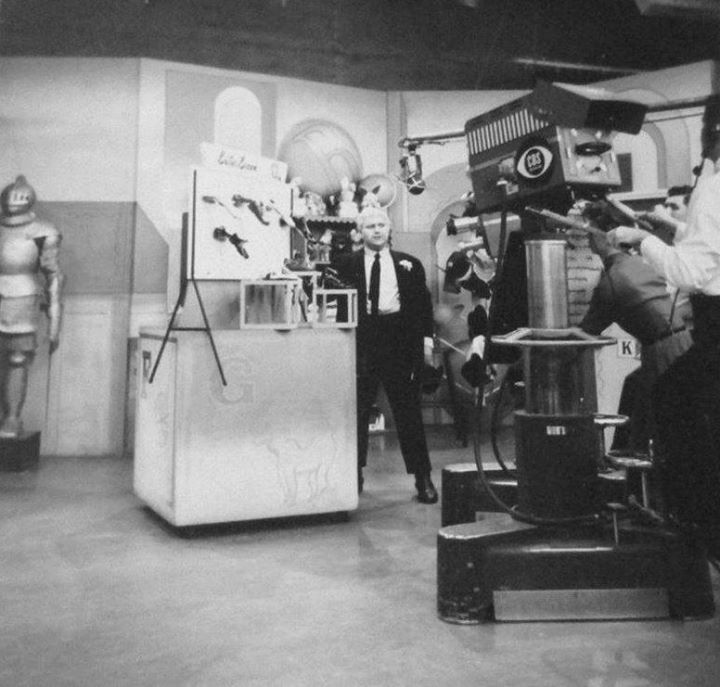
Below, a shot in from the early years in CBS Studio 54 at Leiderkranz Hall. 53 and 54 were the two smaller upstairs studios there at 111 East 58th Street, and were equipped with Dumont cameras. 55 and 56 were the two larger studios downstairs where the soap operas were done with RCA cameras.
Seen with the Captain is the show’s puppeteer Cosmo Allegretti, who animated Mr. Moose, Bunny Rabbit, Grandfather Clock, Dancing Bear, and more. Enjoy and share! -Bobby Ellerbee
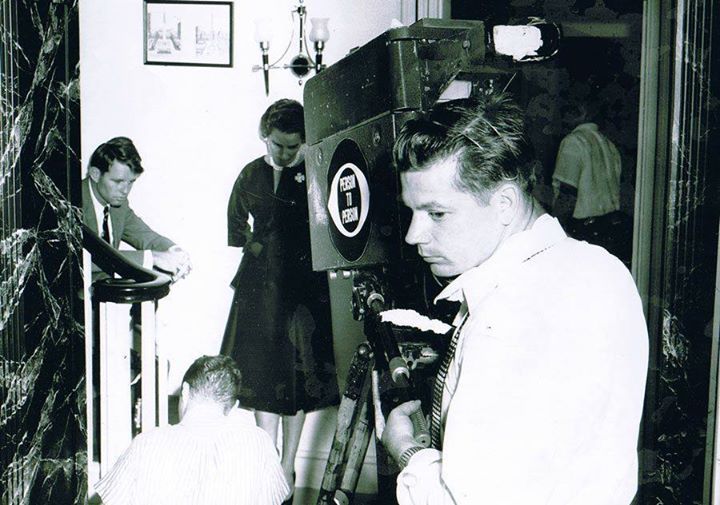
October 2, 1953…”Person To Person” Debuts With Technical Marvels
By 1953, television had been using it’s new, two year old ability to reach from coast-to-coast in a number of unique ways, but none were more unique than the challenges this show brought.
It took a lot of planning and a three camera crew at each remote location to do this show, and many times, there were two guests on each show, from different locations. All live!
In Los Angeles, our friend George Sunga, was the Television City production manager, and had the responsibility of working out all the west coast interviews. Needless to say, it was quite a task, but that is something the viewing audience never noticed, as newsmakers from all over the US appeared seamlessly on screen with Mr. Murrow…usually. It would be interesting to hear some of the stories from these crews about the times it wasn’t so “seamless”.
Up top, the Bobby Kennedy interview, and at the bottom, video of the Dean Martin interview. Enjoy! -Bobby Ellerbee
Top at home with Bing, then Jerry Lewis and below Mickey Rooney
Above, at Jane Mansfield’s home and below, the show featuring Jack Paar began in his limo as he “arrived” home in New York. Fortunately for the crew, the car didn’t have to move more than a few feet.
Soon after the passing of CBS great Don Hewitt, I got a note from my friend Steve Dichter with an interesting question and a photo, shown below. It’s a video capture from a 60 Minutes montage of Hewitt’s early work and introduces innovation number four, but first…innovations one, two and three.

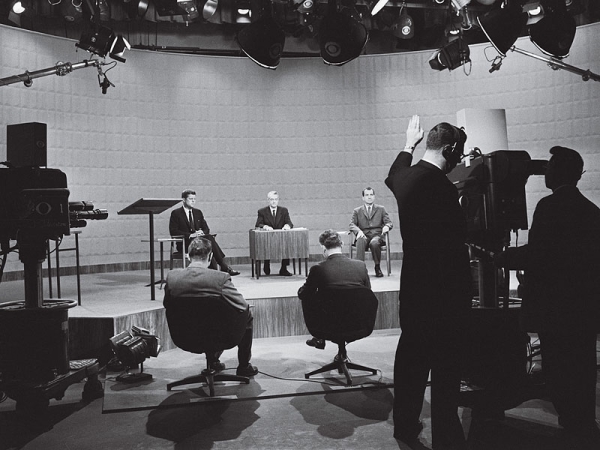
Don Hewitt was the producer of the first of four Kennedy-Nixon debates that were broadcast nationwide on radio and television in 1960. He’s seen below with both men just before air at the WBBM-TV studios in Chicago. Although he “officially” produced only the first debate, I do think he consulted on the following three. But even if he didn’t, one of his creations was there for all four events.

CBS hosted the first debate at WBBM in Chicago, NBC the second from WRC in Washington D.C., and ABC the third and fourth rounds. In debate three, Kennedy was in New York and Nixon in Los Angeles. Now that would account for innovations one and two, as this was the first time presidential candidates had debated on television, and the first-ever bi-coastal debate with split screens and more. Below is a photo of Kennedy at the WABC-TV studios in New York during the third debate. Nixon was at KABC-TV in Los Angeles.

Innovation number three came in the fourth and final debate. It can be seen in the photo below. Can you spot it?

The final debate came from Studio TV 1 at ABC in New York. In the photo above from that night, notice that the mic booms have two microphones. Now there was an instant backup in case there was an audio problem. This is thought to be the first use of dual mics on booms.

And now for the big finish…innovation number four. Above, you can see a back shot of Kennedy and Nixon in Chicago. Notice the large boxes on top of the TK11s. So far, we haven’t seen whatever those are in action. Below, the question is answered.

Now we can clearly see that’s a countdown clock that shows one-minute, 30-second and 10-second warnings to the candidates that their time is expiring. This was Don Hewitt’s innovation. These timers, or duplicates, were used in all four of these televised debates. If you look closely at the images above, you can see them in every studio. That’s innovation number four, but before we leave, two more photos deserve a look.

Above is one of the two remaining cameras used in the first historic debate at WBBM. It belongs to the Museum of Broadcast Communications in Chicago.
Below is the other WBBM camera, on display at the Kennedy Presidential Library and Museum in Boston.

Below is a link to the MBC site and to a page showing some of Steve Dichter’s vintage television collection. Also included for the younger set is a little general background on the debates themselves.
http://www.tvhistory.tv/Dichter.htm
The key turning point of the campaign were the four Kennedy-Nixon debates; they were the first presidential debates held on television, and thus attracted enormous publicity. Nixon insisted on campaigning until just a few hours before the first debate started; he had not completely recovered from a recent hospital stay and thus looked pale, sickly, underweight, and tired. He also refused makeup for the first debate, and as a result his beard stubble showed prominently on the era’s black-and-white TV screens.
Nixon’s poor appearance on television in the first debate is reflected by the fact that his mother called him immediately following the debate to ask if he was sick. Kennedy, by contrast, rested before the first debate and appeared tanned, confident, and relaxed during the debate. An estimated 80 million viewers watched the first debate. Most people who watched the debate on TV believed Kennedy had won while radio listeners (a smaller audience) believed Nixon had won.
After it had ended polls showed Kennedy moving from a slight deficit into a slight lead over Nixon. For the three remaining debates, Nixon regained his lost weight, wore television makeup, and appeared more forceful than his initial appearance. However, up to 20 million fewer viewers watched the three remaining debates than the first debate. Political observers at the time believed that Kennedy won the first debate, Nixon won the second and third debates, and that the fourth debate, which was seen as the strongest performance by both men, was a draw.

Below is a shot of the Today set in the RCA Exhibition Hall on January 14, 1952, the morning the program first went on the air. Host (or “communicator”) Dave Garroway is at his desk welcoming viewers to a new concept in television. Television pioneer – and my friend – Frank Merklein is behind the RCA TK30 to the right. NBC cameraman Howard Katzman also worked that first Today show, and all the rest, for 16 years.

Today is one of Pat Weaver’s great ideas, and like so many of them, lives on as a legacy to NBC Television’s first president. Today was the first show of its genre and it was seen live only in the Eastern and Central time zones, broadcasting three hours per morning but seen for only two hours in each time zone. Since 1958, Today is tape-delayed for the different time zones.
In 1996, NBC started feeding all four continental time zones from New York using Tektronix Profile video servers. With the final conversion of Broadcast Operations Control to high definition completed in 2009, Today is now seen in HD on network feeds live in the East and delayed for the three later time zones in the continental US.
For many years Today was a two-hour program, from 7:00 a.m. to 9:00 a.m. in all time zones except for Alaska, Hawaii and U.S. Virgin Islands, until NBC expanded it to three hours on October 2, 2000. A fourth hour was added on September 10, 2007.

Above is the NBC Broadcast Operations Center on the second floor of 30 Rock prior to its 2009 HD conversion. Here you see the center of the “front deck” with controls for all 40 channels of NBC’s output feeds. Channels 9 through 12 (left to center) are the four time zone outputs for NBC’s regular standard definition feeds. Text displays indicate the status of each channel. Picture monitors at the top show the outputs of each channel while the lower monitor displays a received return of the respective channel for transmission assurance. Audio bar graphs similarly indicate the status of audio for each channel.

The Today program first originated from the RCA Exhibition Hall on 49th Street (above photo) in a space now occupied by the Christie’s auction house, just down the block from the current studio. The first set placed a functional newsroom in the studio, which Garroway called “the nerve center of the world.” The barrier between backstage and on-stage was virtually nonexistent. Garroway and the on-air staff often walked through the newsroom set. Glimpses of camera crew and technicians were a frequent occurrence, as were off-screen voices conversing with Garroway. Gradually, machines and personnel were placed behind the scenes to assemble the news and weather reports, and the newsroom was gone by 1955.

From that very first morning, the big storefront window attracted onlookers. But as Today gained popularity, the window went from being a curiosity to an attraction. During intervals when recorded music was played, the in-studio cameras would often turn and do slow pans of the faces outside. Often people would bring signs with a message for family and friends watching back home. Sometimes Garroway would go out and talk to some of the folks outside, as we see him above doing on a sunny morning in March 1957.
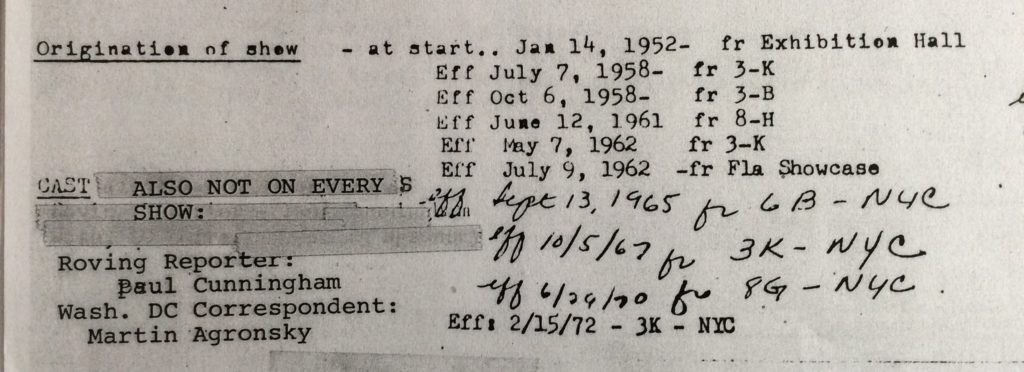
After a complaint from Philco that staging Today in a streetfront studio provided RCA an unfair advantage in marketing its products, Today moved out of the Exhibition Hall, broadcasting its first program from Studio 3K in the RCA Building on July 7, 1958. Soon after, most portions of Today began to be videotaped the prior afternoon, with the only live segments being Frank Blair’s news updates. Although this arrangement allowed more flexibility in scheduling guests, who were no longer tied to Today‘s early hours, the change was mainly an accommodation for Dave Garroway, who was facing exhaustion and health issues. This practice continued until Garroway left Today in July 1961.
On July 9, 1962, Today began broadcasting from the Florida Showcase, a glassed-in storefront at 61 West 49th Street at the ground level of 30 Rock, leased by the Florida tourism board. The program would originate from the storefront in the morning, then cameras and sets would be stowed before the storefront opened for regular business.

This arrangement lasted until September 13, 1965, when Today moved back inside the NBC studios. Not only did the move back to a regular studio simplify matters, but it allowed Today to go all-color. NBC couldn’t justify allocating four huge and expensive color cameras to the Florida Showcase.
For the next twenty years, the show occupied a series of studios on the third, sixth, and eighth floors of 30 Rock, notably Studio 3K in the 1970s, Studio 8G (adjacent to Studio 8H, home to Saturday Night Live) in the late 1970s and early 1980s, and finally Studio 3K from 1983 to 1994. Today moved to the current street side studio (Studio 1A) on June 13, 1994, just east of the former RCA Exhibition Hall, providing a link to the show’s 1950s origins. In this 2014 shot, note the temporary barricades that are set up each morning for the fans who gather outside.

In 2006, Studio 1A underwent a major renovation to prepare for high-definition broadcasting. While a new set was readied that summer, the program originated from a temporary outdoor studio in Rockefeller Plaza. It was the same set NBC used at the 2004 Olympic Games in Athens, in 2006 at Torino, and it would be re-used for Beijing in 2008.

Here’s Today‘s “Summer Stage.” While Studio 1A was being completely refurbished for HD in the summer of 2006, Today was produced from this outdoor stage on Rockefeller Plaza in front of the GE Building.
On September 13, 2006, Today moved into its brand new set. The new studio is divided into five different parts on the lower level. It includes the interview area, the couch area, the news desk, the performance/interview/extra space area, and home base, which is where the anchors start the show. A gigantic Panasonic 103-inch plasma monitor is often used for graphic display backgrounds in the Satellite studio upstairs on the same level as the kitchen set.
The blue background window treatments (or shades) seen in the opening of the show in home base move up and down to allow a view of the outside from the home base. The screen is used for many things, but the main use for it is to prevent TV viewers from seeing early morning darkness outside when their own (later delayed) time zone may be in full daylight. Another reason for raising the screen is to shield TV viewers from outside visitors holding distracting signs during serious show segments.
Below are seven photos showing two different Today set dressings and all the major “areas” like the news desk, conversation sofas and performance area for bands or kitchen segments. All the cameras are SONY HD models, mostly 1500-model ENG/EFP size cameras in the buildup sleds and hard-bodied HD 1000s in the final two shots. Take a look at that cool jib camera mounted on a Vinten Fulmar ped. To get a real education on the new Sony cameras and systems, please see the Conan section of the Tonight Show History.


Over time some minor changes were made to the set, including the elimination of the “news desk” in 2013 in favor of a larger anchor desk with room for all four anchors. On August 16, the program left Studio 1A while it underwent a month-long renovation. The newest set configuration has a “home base” platform that can spin 360 degrees, new decor in the “sofa area” set, and the “Orange Room” area for social media.
One byproduct of the 2013 set renovation is an attraction for tourists. When the new “Shop at NBC Studio” opened inside 30 Rock in 2015, the anchor desk that had briefly served on Today became part of the store’s attractions. Visitors can sit at the desk for a photo opportunity.

Today anchors started out as “Communicators.” Creator Pat Weaver envisioned a person whose responsibilities would go beyond the bounds of traditional sit-down news anchors and wanted well rounded, curious and authoritative hosts. Although the “Communicator” nomenclature has since dropped out of favor, the job remains largely the same. The principal anchors/hosts of the show have included:
October 1, 1955…”The Honeymooners” Debuts On CBS
Setting The Record Straight On “The Honeymooners”
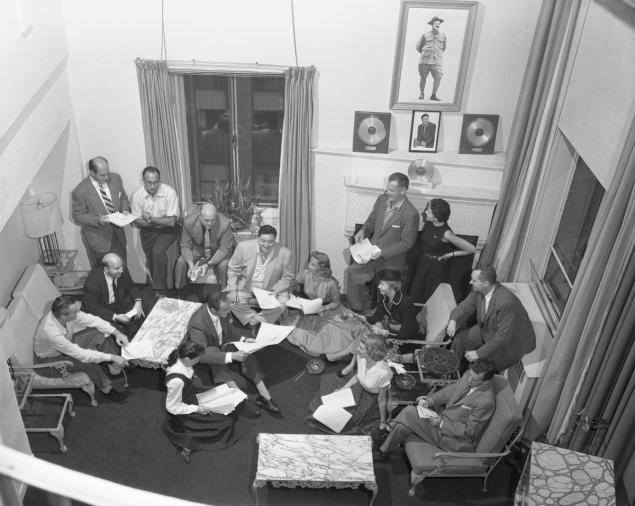
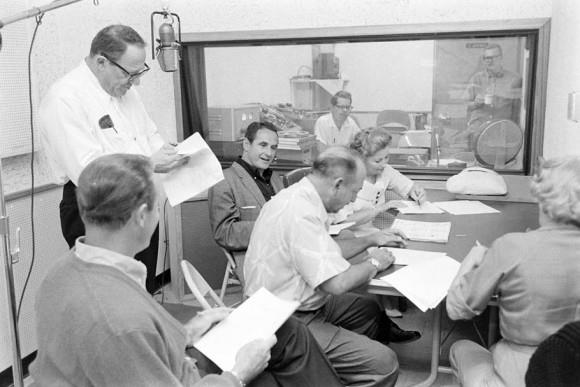
Above is a great shot of the cast and writers going over a script at Jackie Gleason’s office.
Today is the anniversary of The Classic 39 “Honeymooners” episodes done on film for the 1955-56 season on CBS. but the younger generation may not know, those characters were not new.
Actually, “The Honeymooners” live sketches began October 5, 1951 on Dumont’s “Cavalcade Of Stars” which Gleason began hosting in June of that year. That first sketch was six minutes long, but often, on that one hour show, they went as long as 45 minutes. These sketches continued into the late 60s.
When Gleason moved to CBS in the fall of 1951, they called Studio 50 (Ed Sullivan Theater) home, and the sketches continued on the new “Jackie Gleason Show”. It was the top show for CBS, but after a few years, Jackie needed a break from the grind of a live one hour show every week, so they decided to do a season of Honeymooners on film, which was done at Dumont’s Adelphi Theater a few blocks away.
About a third of the way through the 39 episode, Gleason began to rethink this half hour film idea. To him, 30 minutes was often not enough time to develop the story, and Perry Como’s one hour show on NBC was tough competition for a half hour show. The last show aired on September 22, 1956, and one week later, the live one hour “Jackie Gleason Show” came back to blockbuster ratings for another year, with the Honeymooners sketches included. And Away We Go! -Bobby Ellerbee
October 1, 1962…The Johnny Carson “Tonight” Theme Debuted
How Johnny Carson’s ‘Tonight’ Show Theme Song Came About…
Today, October 1, 1962, Carson took over as host and that night was the first time this song was played…at least on television. It was written by Paul Anka and here is the backstory on a song we all know now as “Johnny’s Theme”
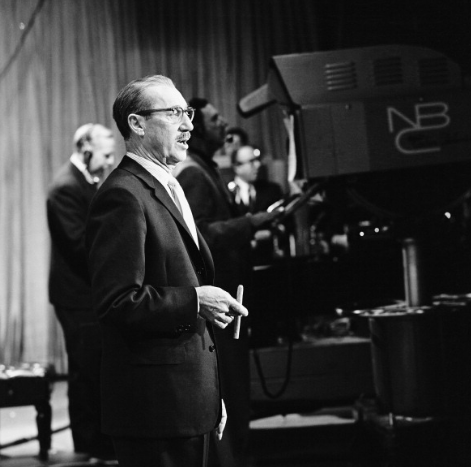
First though, a note. In today’s earlier post that let you hear the first 3 minutes of Groucho Marx introducing Carson on his debut, the band did not play this at the 11:15 start, but at the 11:30 start (when most stations joined the network for the show), it was played.
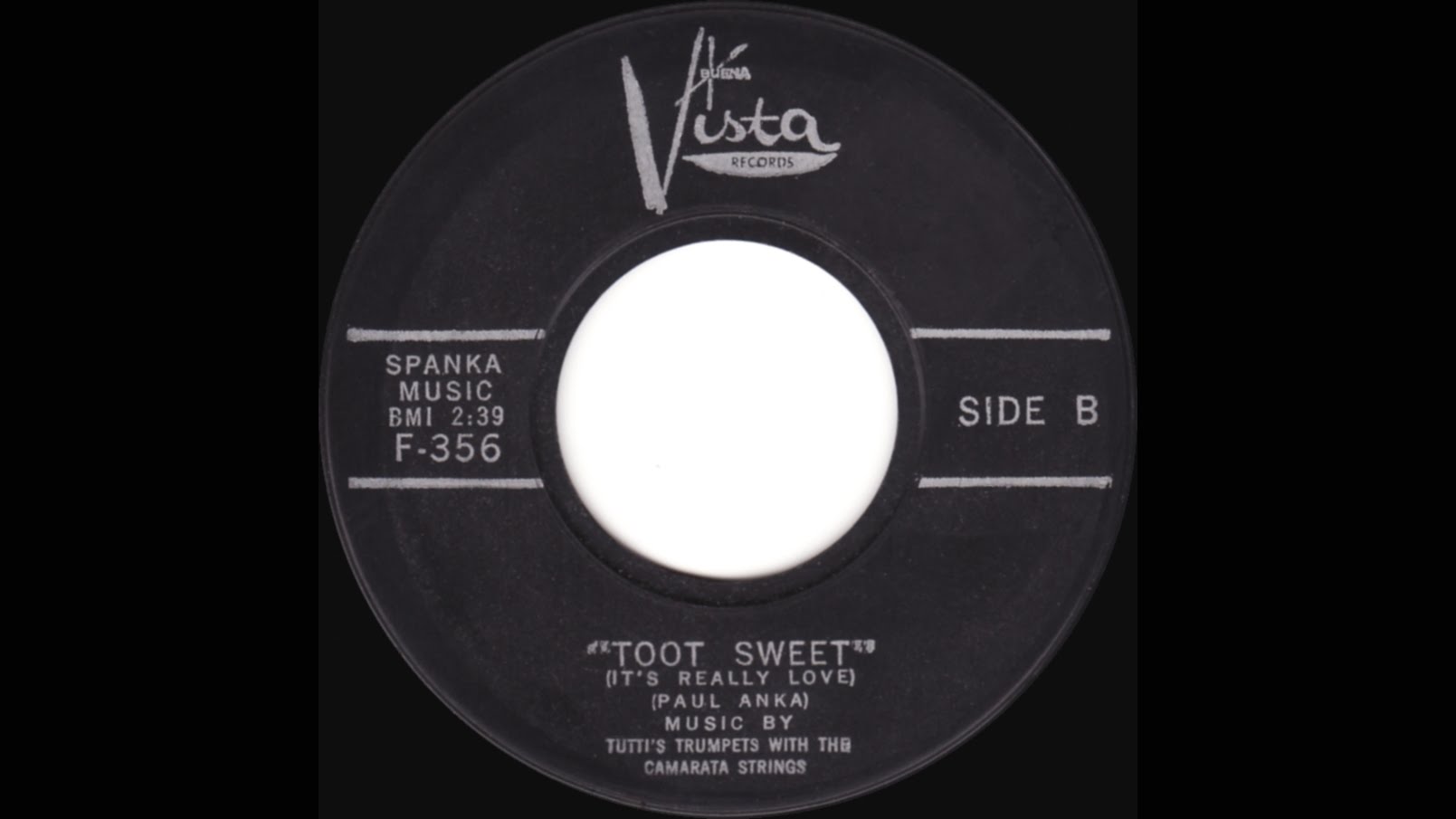
In 1958, Anka wrote an instrumental for Salvatore “Tutti” Camarata’s band. The band’s name was Tutti’s Trumpets. Paul named the song “Toot Sweet”. Tutti was actually the head of Walt Disney Records and started the legendary Sunset Sound Recorders studio the same year this was released and this was one of the first sessions ever recorded there.
After a lyric was added in 1959 “Toot Sweet” was re-named “It’s Really Love”, and under that title was recorded by Annette Funicello on her LP, “Annette Sings”. There is a link to the recording below.
In 1962, when Johnny Carson took over the NBC “Tonight Show”,
he commissioned Anka for a new theme song, via his company
called Management Agency & Music Publishing, Inc.
Anka suggested re-using this old tune and the project was technically a deal under a “work for hire” contract. Carson knew all about royalties and wanted to be listed as an author so, being a drummer, he said he would think of something to put at the beginning of Anka’s tune to “help author it.” That something turned out to be a little drum break before the band joins in. So for 6 – 7 years there was that one-bar drum break at the beginning of the theme. Eventually that little break was shortened even further to just one and a half beats.
So, on September 12, 1962, less than a month before his debut Johnny became an “author” of his theme for copyright purposes, and got not only a piece of the publishing royalties, but a composer’s share of royalties as well.
The co authoring offer must have been worth it to Paul Anka who once said he got $200 in royalties every time the show aired. Over the course of Johnny’s 30 year run, that would give Carson and Anka about $1,664,000 apiece. Not bad for an old tune that was re-cycled twice. Enjoy and share! -Bobby Ellerbee
“Toot Sweet” https://www.youtube.com/watch?v=stvuxq5upKQ&ab_channel=the45prof
“It’s Really Love” https://www.youtube.com/watch?v=FWgg8zvQTMg&ab_channel=MarcelloFelici
The Walt Disney company’s record label Buena Vista boasted both Mouseketeer singing star Annette Funicello and veteran composer-arranger Tutti Camarata, who …