Posts in Category: TV History

The Original Beauty Of The Ed Sullivan Theater…Rare Images…

The Original Beauty Of The Ed Sullivan Theater…Rare Images From 1927

More of the history of the venue is in the original article below. Enjoy and share! -Bobby Ellerbee


Rare Ed Sullivan Theater Photos…1927

I love it that these rare photos are now pouring in! Take a look!

This is the theater as is looked when it was built. It opened in 1927 as The Hammerstein Theater and was designed by architect Herbert Krapp who designed about a dozen of NYC’s most famous theaters. Due to the depression, the theater closed in 1931.

It was taken over by Broadway Billy Rose and became a night club with all the theater seating removed and replaced by tables. In 1936, CBS took a long term lease on the building and converted it to CBS Radio Theater 3 (one of five in NYC). The first radio show from here was “The Major Bowes Amateur Hour”.

In early 1950, the theater was converted to television and became CBS Studio 50. The first broadcast was “Arthur Godfrey’s Talent Scouts” show. Godfrey’s talent show had been on CBS radio for over a year and originated here before the TV conversion. Thanks to Simon Crawshaw and Nick Van Hoogstratten for the rare photos. Enjoy and share! -Bobby Ellerbee

Source

October 24, 1934…”Santa Clause Is Coming To Town”, Recorded


October 24, 1934…”Santa Clause Is Coming To Town”, Recorded

Until broadcast radio and talking pictures came along, there hadn’t really been any “popular” or secular Christmas songs…most were still traditional, religious carols.

The first recorded version of the song was by banjoist Harry Reser and his band, and was done on October 24, 1934 featuring Tom Stacks on vocals. In 1925, Reser found fame as the director for NBC’s Clicquot Club Eskimo Orchestra, continuing with that weekly half-hour until 1935. At the same time, he also led other bands, including Harry Reser and His Six Jumping Jacks, with vocals by Tom Stacks. They were the zany forerunners to comedy bands like Spike Jones and tune was right up Harry’s alley.

“Santa Claus Is Coming To Town”, was first heard live on Eddie Cantor’s NBC radio show in November 1934. It was said that Cantor agreed to introduce this new song (by songwriters J. Fred Coots and Haven Gillespie), because other well-known artists of the time had rejected as being “silly” and “childish.” Cantor liked it, and after the broadcast, the song had overnight orders for 100,000 copies of sheet music, and had sold 400,000 copies by Christmas of that year.

Here it the original version! Enjoy, and let me be the first to wish you a Merry Christmas! -Bobby Ellerbee

https://www.youtube.com/watch?v=kbePb9xNNII

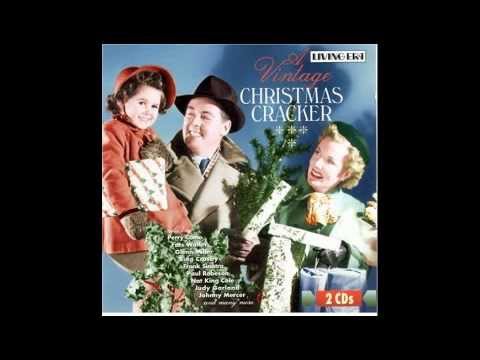
By John Frederick Coots & Haven Gillespie. The first recording of this song. Oct. 24, 1934. New York. from A Vintage Christmas Cracker. Living Era CD AJS 275…

Source

October 24, 1980…Letterman Daytime Show Finale & Studio Tour


October 24, 1980…Letterman Daytime Show Finale & Studio Tour

Classic, Classy Letterman! Last day of his NBC morning show.
Although it only ran from June 23, until October 24, 1980, a lot of what would come later, in the late night years started here, including Stupid Pet Tricks.

From NBC Studio 6A, here is the last 15 minutes of the show, but the first 6 are spent touring the studio and meeting producer Barry Sand, announcer Bill Wendell, director Hal Gurnee, and more, and at the end, a full credit roll with names that are still familiar, like John Pinto, Bill Bonner and Jack Young. The cameras are RCA TK44s.

By the way, near the end, watch for the showgirls in the huge peacock head dresses….if you remember, those were used at the start of the “Late Night With David Letterman” debut show.

Enjoy and share! -Bobby Ellerbee

https://www.youtube.com/watch?v=_z7YGgn-x-0

October 24, 1980. Final Letterman Morning Show excerpts(pt 2 of 2) Live. w.”(Theme from)Las Vegas Gambit Show”( to Theme of David Letterman Show)

Source

October 23, 1956…Videotape Debut Network TV: Setting The Record Straight

October 23, 1956…Videotape Debut Network TV: Setting The Record Straight

Most people think the November 30, 1956 time delayed broadcast of “CBS News With Douglas Edwards” was the first use of videotape on network television. That is not correct, but it was the first use of tape as a time-shifter, in that the east coast broadcast was videotaped at Television City for rebroadcast two hours later to the mountain and west coast time zones.

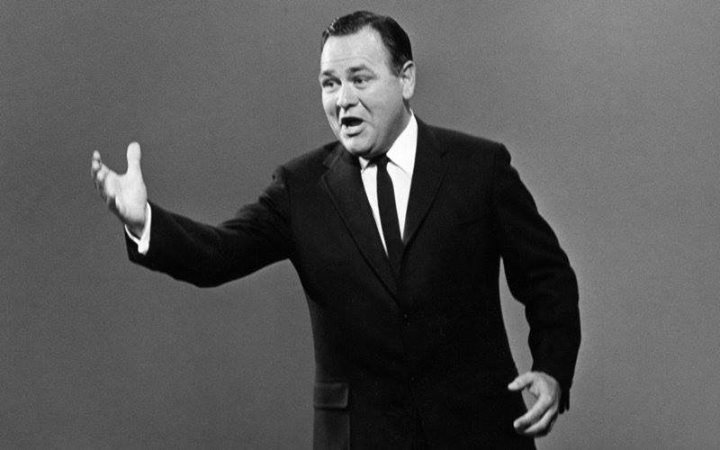
As for the first known network use of videotape, that happened 60 years ago today at NBC. At the time, “The Jonathan Winters Show” was 4 weeks old. The 15 minute variety show ran from 7:30-7:45 Tuesday nights, just before “The Camel News Caravan” with John Cameron Swayze, replacing one of the two weekly Diana Shore shows that had for years, aired in that slot on Tuesday and Thursday nights.

On October 23, 1956, the NBC engineers in New York wanted to see if the viewing public could tell the difference between a videotape and the live portion of the show. Jonathan’s musical guest that night was Dorothy Collins, of “Your Hit Parade” fame. She had a new record out called “The Italian Theme” and her performance, with dancers and backup singers, was recorded earlier in the day. During the live show, Winters introduced her, as if she was there, and the tape rolled seamlessly. In case there was a problem, NBC had extra operators on duty that night in New York, and to their great relief and amazement, no one called or noticed. With that quiet event, videotape had passed the final acceptance test.

Remember, this is only six months after Ampex introduced videotape at the 1956 NAB in April. In the book “A Companion To American Technology”, Carroll Pursell reports that a month later, in November of ’56, Winters used videotape to play two characters in the same sketch. Unfortunately, there is no kinescope or tape of this historic event either, and about all that’s available from Jonathan’s 1956 show is this single program. Enjoy and share! -Bobby Ellerbee

Source

October 22, 1939…The First Ever Pro Football Telecast

October 22, 1939…The First Ever Pro Football Telecast

77 years ago today, the relationship between professional football and television began when NBC earned a spot in history by televising a pro football game. Only 22 days before, NBC had televised the first ever college game on September 30th.

A crowd of 13,050 were on hand at Brooklyn’s Ebbets Field on that now-historic day when the Philadelphia Eagles fell to Brooklyn’s Dodgers 23-14. Yes, there was a Brooklyn Dodgers football team, from 1930 to 1943.

Five hundred-or-so fortunate New Yorkers who owned television sets witnessed the game in the comfort of their own homes, over NBC’s experimental station W2XBS. Many others saw the telecast on monitors while visiting the RCA Pavilion at the World’s Fair in New York where it was scheduled as a special event.

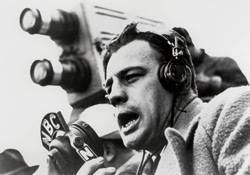
According to Allen “Skip” Walz, the NBC play-by-play announcer (pictured above), only eight people were needed for the telecast. Walz had none of the visual aids…monitors, screens or spotters used today, and there were just two cameras. One was located in the box seats on the 40-yard line and the other was in the stadium’s mezzanine section.

“I’d sit with my chin on the rail in the mezzanine, and the camera was over my shoulder,” remembered Walz. “I did my own spotting, and when the play moved up and down the field, on punts or kickoffs, I’d point to tell the cameraman what I’d be talking about.”

The television log records of that day say that the game began at 2:30 p.m. and ran for exactly two hours, thirty-three minutes. By comparison today’s games run almost three full hours. Of course there were no commercial interruptions during the 1939 game. There were, however, interruptions of another sort.

“It was a cloudy day, when the sun crept behind the stadium there wasn’t always enough light for the cameras,” according to Walz. “The picture would get darker and darker, and eventually it would go completely blank, and I would begin to call the game in the style I used for radio broadcasts.” Enjoy and Share! -Bobby Ellerbee

Source

October 22, 1962…In The Oval Office For The Cuban Missile Crisis

October 22, 1962…In The Oval Office For The Cuban Missile Crisis

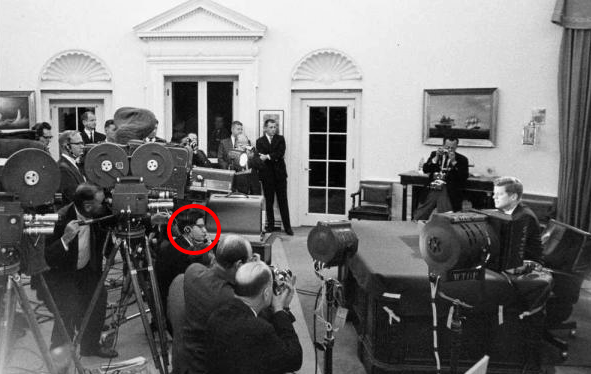
As Told By The Guy In The Red Circle, A MUST READ STORY! From the October 21, 2012 edition of The Savannah Morning News, here is the story in his own words.

______________________________________________________________________________

Barry Ostrow was front and center for the Cuban Missile Crisis Speech! This is the fascinating story of that fateful day…October 22, 1962. Just out of college, he was a brand new hire at WTOP and has a great story to tell! Enjoy and share. -Bobby Ellerbee

My number was up. Some five months after graduation from Ithaca College, my friends and neighbors on the draft board in Poughkeepsie, N.Y., had decided it was time for me to take my pre-induction Army physical. The day designated for my exam at Fort Holabird, Md. – Oct. 22, 1962 – would prove to be not only an emotional personal experience for me but also for the entire nation.

I had been working in Washington, D.C., since June as part of the “management training” program at WTOP-TV, a CBS affiliate, and the CBS News Bureau was located in WTOP’s Broadcast House off Wisconsin Avenue in northwest Washington.

It was a heady time for a young TV production graduate. I was making a whopping $50 a week, but working on loan to CBS more than made up for my penury. From the beginning I served as a floor director for a who’s who of nationally known journalists – Walter Cronkite, Harry Reasoner, Roger Mudd, George Herman, Robert Pierpoint, Marvin Kalb, and bureau chief George Schoenbrun.

On the local news team was an unknown, brash reporter named Sam Donaldson.

Some highlights leading up to Oct. 22 included crewing the expansion of the “CBS Evening News” from 15 minutes to a half hour, an Oval Office taping and news conferences by President John F. Kennedy, and briefly meeting Edward R. Murrow.

On Oct. 21, I was working on the Sunday morning interview show, “Washington Conversation.” The CBS newsroom was buzzing with talk of “something big” going on. Most thought it had to do with the Berlin Wall. The president’s cabinet and the nation’s military leaders reportedly had been spotted entering and leaving the White House, but no one suspected that the brewing crisis was just 90 miles off the tip of Florida.

The next day I rendezvoused with a military bus heading to Fort Holabird, an hour away outside Baltimore. After a morning of filling out forms and some preliminary poking and prodding, our group lined up on the wooden floor of a spare, barracks-like room dressed only in our shorts. As we awaited our next humiliation, a soldier called out, “Is there a Barry Ostrow from CBS in the room?”

As perhaps 30 people looked on, the soldier handed me a telephone. They listened intently to my side of the conversation:

“The White House? How am I supposed to get to the White House? I’m standing here an hour away and half naked in the middle of my draft physical.”

At this point, those in the room began chanting, “Go. Go. Go.”

An Army recruiting officer helped. Within a few minutes, I was in his car speeding down the Baltimore-Washington Parkway. En route, he did his best to convince me that if there was a balloon about to go up, it would be in my best interest to sign up with him on the spot.

The recruiter took me to my apartment on Connecticut Avenue just south of the National Zoo, waited while I changed into a suit and drove me to Broadcast House where he left me with his business card.

I picked up my gear – headphones and a small makeup kit – and hurried out to Wisconsin Avenue to flag down a cab. I always carried the kit with me even though Kennedy was always tanned and freshly shaved. I never had to use it on him. Many politicians, such as Hubert Humphrey and Everett Dirksen, always appreciated a little help with their appearance.

It was now about 3 p.m., and the D.C. rush hour hadn’t begun. A cab picked me up, and a lawyer in the back seat was willing to share a ride downtown. When we arrived at 1600 Pennsylvania Ave., I reached into my jacket for my wallet and discovered I had left it in my apartment.

My co-rider shrugged off the debt, maybe $3, saying, “I think I can trust someone going to the White House.”

He gave me his business card and probably was surprised when a check arrived at his office a couple of weeks later.

Before Dallas in November 1963, it was relatively easy to enter the White House. At a pre-designated gate, the security person had only to check my I.D. against an index card in a small box of approved media credentials. I don’t recall any metal detectors or pat downs.

I caught up with the late Bob Camfiord, the television pool director, outside CBS’ big white remote truck parked near the Rose Garden. Rumors were flying, but no one knew for sure why we were there other than the president would address the nation at 7 p.m.

About 5 p.m., I was ushered down the narrow West Wing hallway outside the office of Pierre Salinger, the president’s press secretary, and into the Oval Office. This wasn’t my first rodeo, but it was always a thrill each time I entered this iconic room. The white curved walls. The blue rug with the presidential seal. The facing white couches and, between them, JFK’s rocking chair.

I sat behind the president’s Resolute desk standing in for him while Camfiord, out in the truck, conducted camera, sound and light checks.

At about 6 p.m. embargoed copies of the president’s speech began to circulate in the West Wing. The topic was not Berlin, but Cuba and the discovery of Soviet missile bases under construction there. Soon those missiles would be operational and pointed at Washington and other U.S. locations only minutes away.

America’s second-youngest president was about to face off with the bellicose Nikita Khrushchev. The doctrine of mutually assured destruction could be tested over a small Caribbean island.

While the imminent prospect of a nuclear war was frightening and heightened by the thought that we were all standing at Ground Zero, there was calmness in the room. Each of us was involved with our immediate responsibilities.

We were not yet privy to the tension that had been building since the missile installations were discovered on Oct. 14 during a U-2 surveillance flight.

The Oval Office began to fill up. In addition to the CBS pool technicians, there were administration officials, at least three news film cameramen and five still photographers.

Shortly before 7 p.m., the president emerged through one of the doors almost hidden in the curve of the office walls. Usually relaxed and casual with the media, this night he appeared tense. I was in my usual position, attached to the camera by my earphones and crouched under the lens directly in front of the president.

At Camfiord’s direction, I raised my arm at 5 seconds before the speech and gave the president a verbal warning. Moments later I pointed in his direction and he began to speak.

Later, in the remote truck, I used the network’s dedicated landline to New York to call my parents. Like so many Americans, especially those in or near major East Coast cities, they were deeply concerned. My mother kept urging me to return home from Washington, but I reminded her that if the missiles should begin to fly, there would be no refuge.

I wish now that I had kept a diary of the ensuing six days of the crisis when the three networks broadcast daily from the White House, the U.S. Department of State, the Pentagon and the headquarters of the Organization of American States.

I remember it as a time of dark remote truck interiors, dark control rooms and dark television studios.

To cover official Washington, CBS brought in Bobby Vitarelli (later, director of the “CBS Evening News”) from New York to work with Camfiord.

They also pressed WTOP-TV’s senior directors Clark Pangle, Bill Linden and Eddie Colbert into service. Remote trucks were at a premium, and I remember Colbert standing outside a station wagon on the White House grounds looking inside at a bank of monitors and directing a stand-up report.

The technicians worked around the clock, sleeping – when they could – on cots at Broadcast House. Working at “golden time pay,” they made thousands of additional dollars that week. Those of us further down the totem pole filled in working as assistant directors and directors.

I readied a lot of film to be rolled and directed a few one-camera cut-ins in the studio with talent like Schoenbrun, Mudd and Kalb. With all of the CBS overtime, I made my first thousand-dollar payday.

As the nation and the world held its collective breath, the crisis played out. Khrushchev blustered, Adlai Stevenson admirably stated the U.S. case in the United Nations, and Kennedy resolutely pursued the naval blockade of Cuba and offered to remove (aging) missiles from Turkey.

And then it was over.

In March 1963, I finally completed my physical at Walter Reed Hospital in Washington, and by August I was in the Fort Carson, Colo., public information office producing mini film documentaries about the base for television stations in Denver and Colorado Springs.

That’s where I heard about the assassination in Dallas, 13 months to the day after Kennedy’s Cuban Missile Crisis speech. The world, of course, was in shock. For me, Nov. 22, 1963, held a particularly personal emotional impact. As I watched the nation grieve, my thoughts were, “I knew him.”

In the ensuing decades, I’ve had many great experiences from the birth of my children and grandchild, to meeting other presidents, to the good fortune of seeing much of the world. But if I had to pick one outstanding time in my life, it would have to be the events of October 1962.

ABOUT BARRY J. OSTROW

Barry J. Ostrow began his career in communications at WTOP-TV where he was on the television production staff working primarily with CBS News. Following Army service with the Armed Forces Korea Network, he worked as a director at WETA-TV in Washington, D.C., and WBZ-TV in Boston.

Later he worked as department head for biomedical communications at Bell & Howell and television division manager for Scientific Communications, both in Chicago. In the cable television industry, he guided television production in the northeast region of TelePrompTer out of Hartsdale, N.Y.

Ostrow spent 31 years guiding communications programs in educational settings, including Richmond, Va., Lee County, Fla., and Savannah-Chatham public schools, South College and Armstrong Atlantic State University.

Since his retirement in January 2010, he has been a freelance writer and continues his passion for international travel.

http://savannahnow.com/news/2012-10-21/savannah-man-cued-jfk-cuban-missile-crisis-speech#.UUL90hzvsuB

Source

STATE OF THE ART: The Studio Cameras…A Primer On Innovations

STATE OF THE ART: The Studio Cameras…A Primer On Innovations

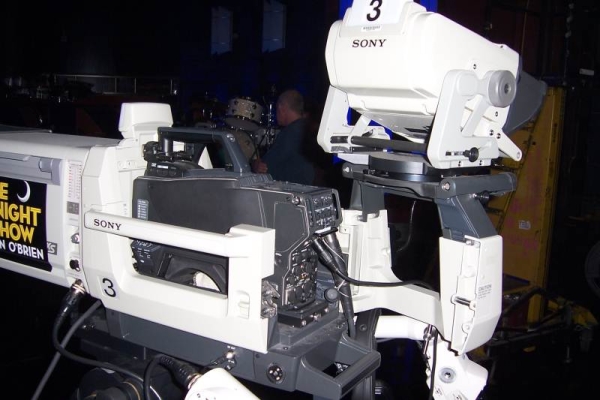
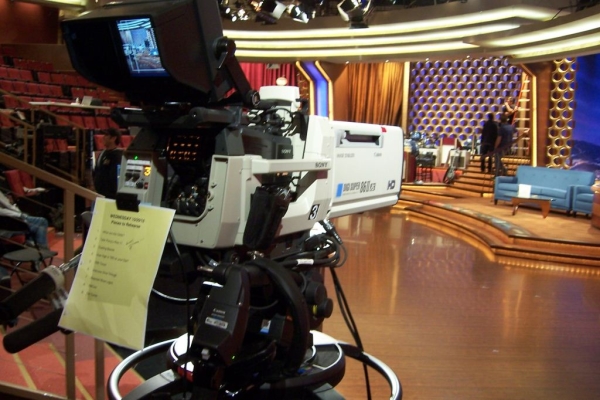
The best way to illustrate the current configurations of camera platforms is with this set of images from Conan O’Brien’s “Tonight” show, taken for us by Bruce Oldham, who was Camera 3 with Conan for many years. Below is a typical setup…a Canon DigiSuper studio lens and a Sony HDC 1500 camera, and some interesting mounting as we will explore in detail. Now is the time to look closely if you have never seen this kind of arrangement.

Above is what is now called a “studio buildup kit.” Below is a Sony HDC 1000, and it’s called a “hard body” camera. This is the configuration most of us are familiar with, as this is was the traditional design since there was such a thing as television.

The first departure from the norm came from RCA when they introduced the TK760, which in essence was a ‘hard body’ chassis with an RCA TK76 ENG (Electronic News Gathering) camera inside. The TK76, was their first shoulder mounted color portable, but with in the 760 configuration, the 76 gained a full size box lens and full size viewfinder.

RCA TK760 Camera - Studio 3

Above, the RCA TK760 with and TK76 inside…below, the RCA TK76. Both cameras have a 1976 vintage.

image003

If you haven’t quite caught on yet, this should do the trick. Do you notice the difference in the light and dark parts of the camera? Well, that’s because these are two unique elements. Below, you can see the sled’s back opened up to reveal a small ENG/EFP-size camera inside. In this case, the camera is a Sony HDC 1500.

image004

image005

Okay, here’s what is going on. Above is the Sony HDC 1500 (Hi-Definition Camera) and below is the Sony HDLA 1505. (HDLA means “Hi Definition Lens Adapter.”)

image006

Ike%20version%20of%20HDLA%20ses500

Ikegami has a slightly different version of its build-up kit, called a System Expander. Above is the Ikegami SE S500 in the studio. Below is yours truly behind an Ikegami HDK 79EX III with the SE S500 field configuration. Chuck Pharis took the picture at the University Of Georgia’s Sanford Stadium while I was visiting him at work the day before game day. Below that is the Ikegami HDK 790 EX III hard body camera.

Grass Valley LDK 8000

hdk790exiii%20hard%20body

ldk%20sled%209%20%20350x231Thomson-LDK-6000%20%20350%20wide

Thomson did something like this in the 1990s and called it a “sled.” One each side, you can see their sled that started as an easy new way to move their big cameras without taking them apart, like the LDK 9. A few years later, Thomson had a better idea, and mounted an ENG camera in the sled as you can see on the right. The arrangement sidesteps the need for ‘hard body’ cameras and allows the small camera to be quickly and easily removed from the large lens adapter for maintenance and repair, or for use in the field or studio as a hand-held with quick addition of a smaller EFP-style lens. Call me old-fashioned, but I still like hard bodies.

Before we go further, let’s talk about ENG and EFP. ENG stands for “Electronic News Gathering” cameras.The term started with the RCA TK76 that debuted in 1976. EFP, which stands for “Electronic Field Production” cameras, is a new manufacturers designation for the same small cameras most of us still refer to as ENGs. I may be wrong, but I think the difference is mostly in the usage. ENG cameras are usually sound-equipped and are used in “stand alone” point-and-shoot, news-gathering situations. EFP cameras have no audio capabilities, are usually used in pairs or threes, and require setup time, cables and switchers.

image007

Above and below are more interesting new technical developments. Above, we see a camera using the standard EFP-style camera lens instead of the large Canon box lens. Below is a great side-by-side comparison shot.

image008

As mentioned above, the camera itself can be used in the studio with the large or small lens configurations. The small lens allows for quick use of the camera as a hand-held medium. In the-hand held mode, the camera’s eye piece viewfinder must be used. When mounted, one of several kinds of large viewfinders can be used with the Sony Large Viewfinder Adapter. This can be seen in the two images below. Upper image is the Sony HDLA1507US catalog image; the real thing is seen just below.

image009

image010

image011

Closer looks at the EFP large viewfinder adapter’s use are above and below. With Sony, when the camera is seated in either the viewfinder adapter or larger lens adapter, the power and controls of the camera are partially transferred to the control panel on the back of the sled, as seen in the image below.

image012

image013

We’ll close with a couple of camera shots that show Bruce’s camera 3 (above) and the main interview set. Below, a full large lens adapter kit was in use next to Andy’s podium; to the right, the smaller EFP camera is naked. It’s just mounted on a light weight ped and ready to go hand-held instantly. Bruce’s camera was one of the three large lens cameras mounted on the new Vinten Quattro peds, and was equipped with a Canon 72X DigiSuper lens. It did guest close-ups at home base and other zones. The other two large lens cameras had Canon 27X DigiSuper lenses and were cameras 1 and 2. All together, there were nine cameras with eight operators in the studio. Cameras 4 and 6 were the combo hand-held and ped-mounted. Camera 5 was the jib, and 7 and 8 were robo-cams with one operator. There were also 2 Iconix lockoff lipstick cameras for audience shots.

image014

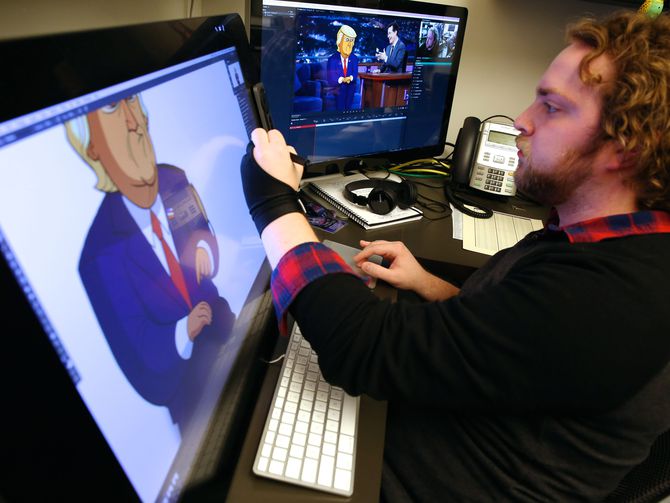
How Cartoon Trump/Clinton Come To Life On ‘The Late Show’

How Colbert Does “Live” Interviews With Cartoon Hillary & Donald

New technologies to create live animations are gaining attention this year with the use of Adobe’s Character Animator. The new program can shorten the time to create animations from weeks to hours, by allowing animation puppets to immediately mimic the movements of someone’s lips, shoulders and eyes using a face-tracking camera. Here is the story. -Bobby Ellerbee

https://www.cnet.com/news/cartoon-donald-trump-late-show-stephen-colbert/

How Cartoon Donald Trump comes to life on ‘The Late Show’

Live cartoons of Trump and Clinton could be just the beginning of real-time animations.

Source

October 21, 1954…James Bond Moves From Page To TV Screens

October 21, 1954…James Bond Moves From Page To TV Screens

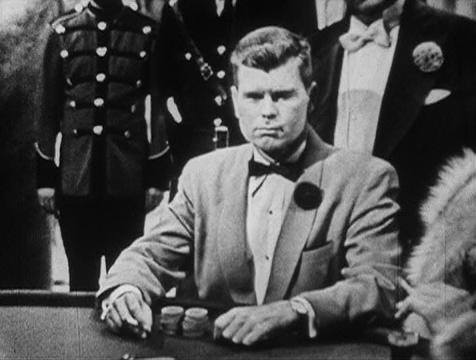
On this day in 1954, Barry Nelson became the first actor to play James Bond. Before this, 007 had only been a literary character in the novels written by Ian Fleming.

The event was a one hour, live presentation of “Casino Royale” on “Climax”; a Sunday night CBS drama showcase that ran from ’54 till ’58. Fleming was paid $1,000 to adapt the novel to a screenplay for the CBS production.

It would be six more years before Bond came to the big screen with “Dr. No” in 1962.

Interestingly, the run time for the TV play is 00:51:45 leaving only 8 minutes for commercials. How refreshing! -Bobby Ellerbee

Source

A Guided Tour Of Some Of Television’s Early Studios…


A Guided Tour Of Some Of Television’s Early Studios…

You may have seen this before, but may not have known the historic places you were seeing. Today, we will remedy that with a guided tour of this film, so let’s get started.

At 1:58 we are in GE’s WRGB in Schenectady NY. RCA began as a part of GE and early on, this facility was the GE experimental television center.

At 2:36 we see in the foreground at WRGB a three wheel camera “trolley”. It survived and is now on display at the Schenectady Museum along with two of these camera.

At 3:00 we see television’s first ever Mobile Unit…the twin van RCA creation with the camera control in one and the transmission gear in the other. These 38 foot units were built in 1938.

At 3:20 an RCA Field Iconoscope camera is being mounted and just after that, we are in the camera control van.

At 3:55 we see an RCA Type 1840 Orthicon camera in action. This is the first version of this camera we saw here yesterday.

At 4:04 we enter hallowed ground. This is NBC Studio 5F which was home to the first ever television film chain with a 35 and 16MM capacity. It was built in 1936, just after Studio 3H was converted from radio to television.

At 4:15 we get a rare look as CBS Studio 41…the largest of the two production studios at their Grand Central Terminal location. The cameras are the RCA A500 Iconoscope models. Studio 42 was a bit smaller.

At 5:06 we see the first ever animated television ID. I think the voice is Ben Grauer. This was rolled from Studio 5F.

At 5:30 we see the NBC antenna atop the Empire State Building

At 5:44 we are back inside WRGB where we get a look inside one of the GE Iconoscope cameras.

At 8:14 we are inside the RCA plant in Camden.

At 8:40 we may be inside the RCA Labs in Princeton where much of the early television testing was done.

Enjoy and share! -Bobby Ellerbee

A U.S. Armed Forces report about the future of television in 1945. Footage from this subject is available for licensing from www.globalimageworks.com

Source

The Historic Hudson Theater…Newly Renovated & Broadway Ready

The Historic Hudson Theater…Newly Renovated & Broadway Ready

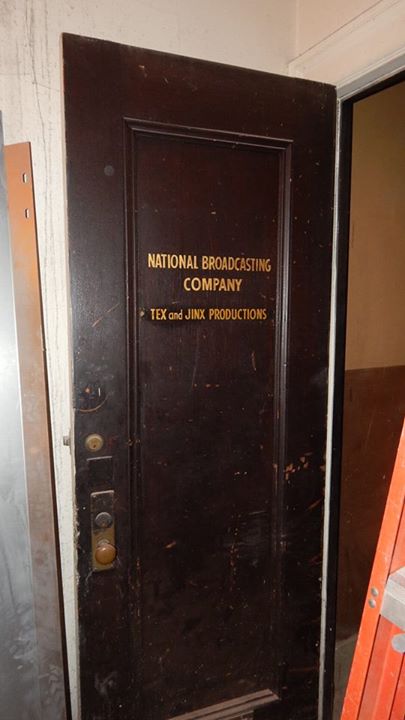
Look what they found in the basement!

In 1995, the theater was bought by the Millennium Broadway Hotel and used it as a conference center, but last year it was sold to the London based Ambassador Theater Group. Since then, the theater has undergone more major renovation, and will soon become a Broadway theater again, just as it began in 1903, but here is some of The Hudson’s TV history.

The Hudson Theater became NBC’s newest New York studio on September 25, 1950 with the debut of “The Kate Smith Show.” Her daytime show was on at 4PM weekdays from ’50 till ’54. From September of ’51 till June of ’52, she also hosted the “Kate Smith Evening Hour” at 8PM Wednesday nights from the Hudson.

On Sept 27, 1954, “Tonight” with Steve Allen debuted from The Hudson and stayed there until December of 1959. Jack Paar had taken over in June of ’57 after the strain of hosting “‘Tonight” and, the Sunday night “Steve Allen Show” became too much for Steverino. Both Allen shows were done at The Hudson.

With the January 1960 debut of “Tonight” from Studio 6B, NBC’s lease on the Hudson was up and the theater went back to legitimate theater after having spent the ‘30s and ‘40s as a CBS Radio theater and the ‘50s as an NBC Television studio.

As for the door, at one point in the 1950’s, ”Tex and Jinx,” were known in virtually every American household. They had two radio programs, a five-day-a-week television show and a syndicated column in The New York Herald Tribune. They were among the first to refine the format that came to be called the talk show.

The beautiful Jinx Falkenburg was one of America’s highest paid cover-girl models during World War II, and later, with her husband, Tex McCrary, a pioneer talk-show star on both radio and television they became a national fixture. This is where Barbara Walters began her broadcasting carrier.

There is more on Tex and Jinx at this link in a remembrance of the two by William Safire. They died a month apart in 2003. Break a leg Hudson! -Bobby Ellerbee

http://www.nytimes.com/2003/09/15/opinion/of-tex-and-jinx.html

Source

“SNL” Production Designer Eugene Lee; There Since Day 1

“SNL” Production Designer Eugene Lee…There Since Day 1

As sure as “Saturday Night Live” is television’s most unique production, Eugene Lee is television’s most experienced designer. No one has imagined more sets and scenery than this man, who at 77, is still going strong. Here is part of his amazing story. Enjoy and share! -Bobby Ellerbee

http://deadline.com/2016/08/saturday-night-live-eugene-lee-production-designer-emmy-interview-1201802593/

‘Saturday Night Live’ Production Designer Eugene Lee On His 40 Years With The Sketch Series

Approached by a Canadian television producer for a variety sketch series back in the early 1970s, production designer Eugene Lee couldn’t have realized then that he’d stumbled on the job of a lifet…

Source

October 19, 1951…The CBS Color System Comes To An End

October 19, 1951…The CBS Color System Comes To An End

The CBS field sequential color cameras broadcast 111 hours of live color over a 17 week period between June 24, 1951 and October 20, 1951.

On October 19, less than a month after sales of the first CBS made color receivers began, Charles E. Wilson of the Defense Production Administration asked CBS to suspend mass production of color receivers “to conserve material for defense” for the duration of the Korean emergency.

CBS announces (almost too quickly) that it agrees and will also drop color broadcasts; color receivers are recalled and destroyed. Strangely, monochrome receiver production is not affected, and the only “end item” product ever prohibited by the Defense Production Administration was color television sets. The ban lasted until early 1953 and applied to RCA as well.

According to Allan B. DuMont, this was, “a move to take Columbia and it’s color system off the hook.”

The next day, October 20, 1951, the last commercial CBS color system broadcast came with the North Carolina – Maryland Football Game. Eleven stations, as far West as Chicago, had carried the CBS color system broadcasts.

On December 6,1951 the first transcontinental color broadcast was done via closed circuit as USC doctors preformed surgery with new Smith, French & Kline instruments. It was viewed by surgeons in New York. After that, the CBS color system became the Industrial Color System and was manufactured in limited numbers by Dumont and CBS Labs. -Bobby Ellerbee

Source

October 1955…Sid Caesar, With One Of Live TV’s Most Famous “Saves”


October 1955…Sid Caesar, With One Of Live TV’s Most Famous “Saves”

Sid Caesar made television history on “Caesar’s Hour” with this improvised bit of comic genius, which has become one of the most famous “saves” in the history of live television.

During this 13 minute sketch of “Gallipacci” (a take off on the famous opera Pagliacci), Sid was supposed to paint a teardrop on his cheek, but then, the mascara pencil broke (at 8:30 in) at the beginning of his nonsense rendition of “Just One of Those Things”.

Not breaking his stride, Sid proceeds to pick up one of Nanette’s lip brushes and paints an unscripted tic-tac-toe board on his face. This aired October 10, 1955, live from The Century Theater.

Some unverified sources report that ‘Cirque du Soleil’ has credited Sid Caesar as the origin of the made up gibberish the show’s performers use as a way to make any nationality at home with the narration and performance of their presentations.

Caesar was the master of this, and as you’ll see, Nanette Fabray (who took over for Coca), Carl Reiner and Howard Morris have studied hard at their masters knee. This is cued to start a minute before the “save”, but I think you’ll enjoy watching the whole thing from the start, as the made up lyrics are sung to the comically paired with melodies we all know. Enjoy and share! -Bobby Ellerbee

October 18, 1964…Hallmark Brings “The Fantasticks” To Television

October 18, 1964…Hallmark Brings “The Fantasticks” To Television

At the link above is a kinescope of the famous Broadway play, that was the October 18, 1964 presentation of “The Hallmark Hall Of Fame”. Below, the photo shows John Davidson speaking to his father, who is played by Bert Lahr.

This was done live to tape at NBC Brooklyn, but only the kinescope work copy remains. The way tape was edited at the networks then, required a kinescope copy of the raw footage, which was then edited as a master of how to manually edit the tape. The odd look was common in kinescopes of color productions, which black and white film didn’t handle well.

‘The Hallmark Hall of Fame’ debuted on Christmas Eve 1951, with the world premiere of “Amahl and the Night Visitors” on NBC TV. Until 1955, the production schedule was near frantic with an average of 40 new presentations a year. In 1954, the show began color broadcasts and in 1956, it went to a bi monthly format with six or seven shows a year.

The Hallmark anthology series was one of the highest rated and most awarded in television history. For nearly three decades the series was broadcast by NBC, but the network cancelled it in late 1978 due to declining ratings. Since then, the series has been televised occasionally by CBS from 1979 to 1989, then on ABC from 1989 to 1995, then CBS again from 1995 until 2011, when that network cancelled the series due to low ratings. As of 2014, the series has earned 80 Emmys, 9 Golden Globes, 11 Peabody Awards and many others. -Bobby Ellerbee

Source

October 18, 1952…RCA’s First Experimental Color Football Broadcast

Below is a rare look at RCA/NBC’s first color remote unit, used for this color-cast. Although it was seen by 99.9% of the audience in black and white, it did at least prove the “compatible color” claim RCA made for its Dot Sequential color system. The year before, CBS had broadcast a football game in color, using their Field Sequential system, but there were no receivers available, except the few CBS had built for their experimental tests. Enjoy and share this exclusive peek at the first color mobile unit. -Bobby Ellerbee


EXCLUSIVE…Inside The First Color Television Remote Unit

Thanks to Chuck Pharis, and his very rare RCA “Red Book”, I have new information and images to share with you, that include not only the first color remote unit, but also, new details on the Washington, Studio 3H and Colonial Theater color trials. I will set the stage with some background on color history, and with some new dates which have been confirmed by RCA information.

Remember, Washington was where the first phase of color experiments were done, with two first generation cameras at Wardman Park studios. Both of those cameras were retired and sent back to RCA in Camden in December of 1950.

The second phase of color testing was done in New York in NBC’s Studio 3H. In January of 1951, work began on the color installation there, and was completed by March. Three experimental cameras were installed in 3H and are called the “coffin cameras” due to their size and black color.

The third phase of color testing began at The Colonial Theater in New York. RCA/NBC leased the theater and began installation in late September of 1952 and the first transmission from here was March 19, 1953. There were four prototype models of the RCA TK40 in operation there, that underwent a full year of tests before RCA began production on the TK40 in Camden.

I felt it would help to refresh your memory, as we now know that this mobile unit was used in both the 3H and Colonial field test. As I mentioned in Thursday’s (8/4) post on this unit, this is one of the original NBC Telemobile units built in 1937.

The first use of the color mobile unit was in September of 1951 with a five day remote test from The Merchant Marine Academy at Kings Point, NY. Support equipment was permanently installed in the unit, but a “coffin camera” (seen below), was borrowed from Studio 3H, which for a week, sent pictures three times a day. The morning test was shown in black and white on WNBT, to see how the images looked on the monochrome sets. The two afternoon tests were closed circuit color test seen on color sets at The Center Theater, The RCA Exhibition Hall across from 30 Rock, Studio 3H and in Princeton at the RCA Labs.

In 1952, there were over 30 remote tests, including two from Palisades Park NJ, but the big one was on October 18, when two of the new Colonial Theater TK40 cameras were used to telecast, in color, the Columbia-Pennsylvania football game from Baker Field. One of the cameras was equipped with the new RCA Electa Zoom lens, while the other used the a normal field array of lenses on the turret, as seen below.

Although there were very few color sets, RCA’s main objective with the experimental color broadcasts was to satisfy the FCC, with the fact that their Dot Sequential system was truly “Compatible”- in that it could deliver the same quality image to black and white TV sets, that monochrome broadcasts offered. Via newspaper ads, local viewers was asked to write to NBC with their comments on reception and picture quality of the color segments.

When color operations moved to the Colonial Theater, the 4 new TK40 prototype cameras were delivered (with 2 seen in the above photo), which had very different control equipment. So, the mobile unit had to have a complete refitting, but when remotes were done, cameras were borrowed from The Colonial for a few days at a time. For more, click on the pix. Enjoy and share! -Bobby Ellerbee

Source

Eyes Of A Generation…Celebrating 10,000 Page Likes! THANK YOU!

Eyes Of A Generation…Celebrating 10,000 Page Likes! THANK YOU!

One of the reasons I started this page was to be able to share unique photos and videos that depict television’s glorious history, that also include the back stage element of the business. Like this.

The other reason was to create a home for television history that could make it, a living history…and with your help, eye witness accounts and stories, we have done that…together. Thank You! -Bobby Ellerbee

Thanks to Jim Davis for this new, crystal clear shot of the “Tonight” show set with the great RCA TK41s in use in Studio 6B in New York.

Source

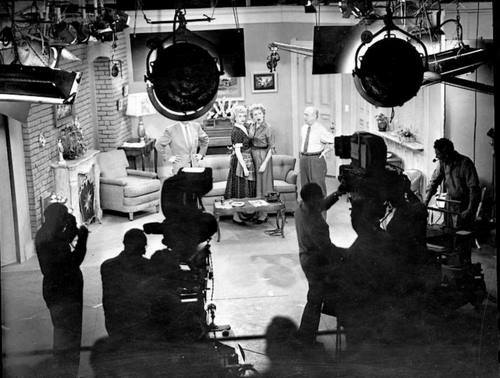
“I Love Lucy” RARE On The Set Video

This is a close to “being there” as we’ll ever get. This clip, from an “I Love Lucy” movie, takes us inside the Desilu Playhouse and gives us an ultra rare glimpse of what it was like on the set of one of television’s most famous shows.

The location is General Services Studios, Studio 2, which in 1952 got its own audience entrance at 6633 Romaine Street. The sign at the new entrance invited you into the Desilu Playhouse. The first few years of the show were done here.

As we have confirmed with other sources, this was pretty much the same warm up that Desi used for the entire six years, including the camera push in. Enjoy and share! -Bobby Ellerbee

Source

October 15, 1973…”Tomorrow” Debuted On NBC

October 15, 1973…”Tomorrow” Debuted On NBC

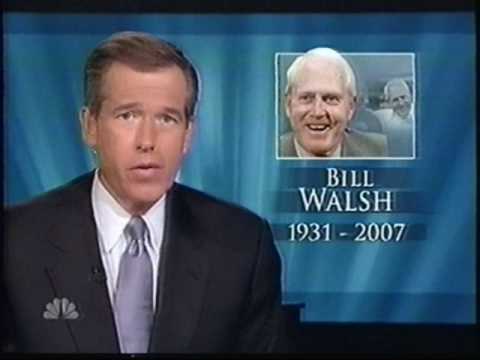
The only way to remember this great show is to remember what made it great…Tom Snyder. On the event of his death in 2007, here are remembrances from Brian Williams, Jay Leno and David Letterman. Incidentally, Letterman’s NBC show replaced “Tomorrow”.

“Tomorrow” followed “Tonight” With Johnny Carson and started as a 60-minute series which aired only four nights a week, Monday through Thursday, in order to accommodate the weekly shows ‘Midnight Special’ (1973–81) and SCTV (1981–82) in that time slot on Fridays.

It was originally broadcast from the NBC studios in Burbank, but relocated to New York in December 1974 when Snyder took on additional anchor duties for NBC News and the network’s flagship station, WNBC-TV.

In June 1977, the show returned to Burbank until 1979, when Snyder once again began originating from 30 Rockefeller Plaza.

On September 16, 1980, when “Tonight” was shortened to 60 minutes, “Tomorrow” was scheduled at 12:30 Eastern and lengthened to a 90 minute format that lasted until its cancellation 16 months later. In February 1982, NBC replaced “Tomorrow Coast-To-Coast” with “Late Night With David Letterman”. Enjoy and share! -Bobby Ellerbee

Source

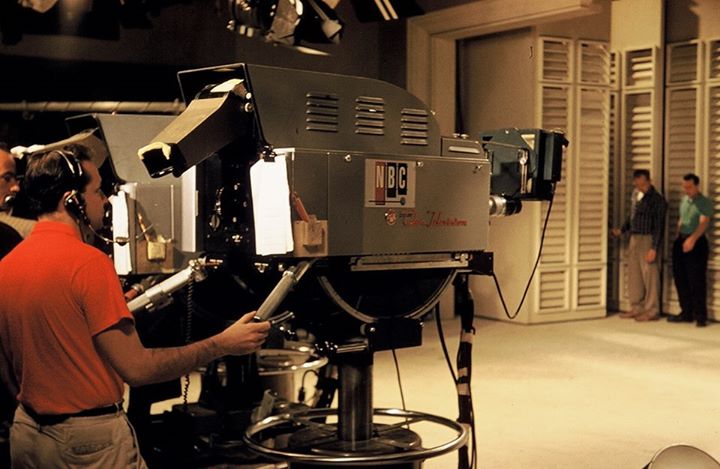
Cameraman Don Davis at NBC Burbank

Cameraman Don Davis at NBC Burbank

Source