- Home
- TV History
- Network Studios History
- Cameras
- Archives
- Viewseum
- About
The Old Shoe…Seth Meyers Desk Platform
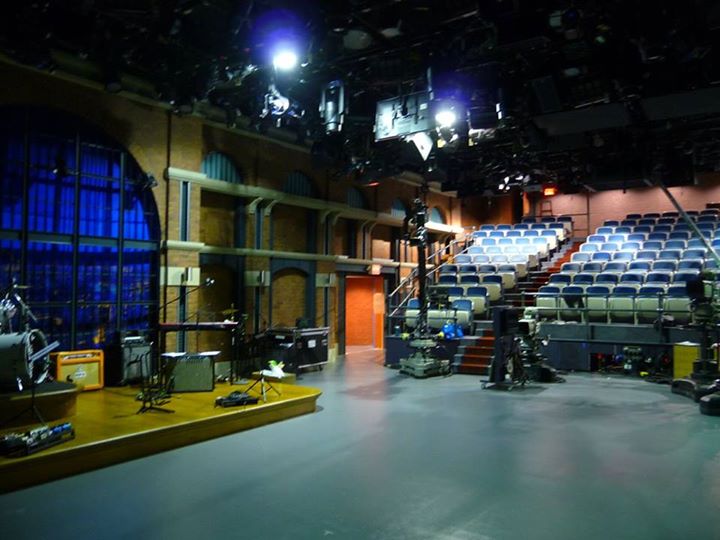
Last week, ‘Late Night With Seth Meyers’ debuted their new set, but in case you never saw this up close, here is the old desk platform.
Around Studio 8G, this was called “the shoe” because it kind of looks like one and works like one. The “heal” is where the mechanics are located…the electric motor and axis that moves the desk set in and out of the stage floor. Since the host is the soul of the show, it’s only fitting that the desk was on the “sole” of the shoe. Now you know. Enjoy and share! -Bobby Ellerbee
September 9, 1926…NBC Was Incorporated By RCA
The incorporation process was the first step on a very long and profitable road for the nation’s first broadcasting network which came to life on November 15, 1926, with a gala four-hour radio program originating from the ballroom of the Waldorf-Astoria Hotel in New York City. Here is some of NBC’s early history which includes the Red and Blue Networks and their sale. Enjoy and share!
-Bobby Ellerbee
NBC was the joint effort of three pioneers in mass communications: Radio Corporation of America, American Telephone and Telegraph and Westinghouse Electric Corporation. Two early radio stations in Newark, New Jersey, and New York City—WJZ, founded by Westinghouse in 1921, and WEAF, founded by the American Telephone & Telegraph Company in 1923—had earlier been acquired by RCA and, after NBC was created, became the centres of NBC’s two semi-independent networks, the Blue Network, based on WJZ, and the Red Network, based on WEAF, each with its respective links to stations in other cities.
The formation of NBC was orchestrated by David Sarnoff, the general manager of RCA, which became the network’s sole owner in 1930.
The National Broadcasting Company was the first permanent, full-service radio network in the U.S. RCA’s goal in forming NBC was to be able to provide a large number of quality radio programs so that, as one of its newspaper ads said, “every event of national importance may be broadcast widely throughout the United States.”
NBC’s first radio broadcast, on November 15, 1926, was a four-and-a-half hour presentation of the leading musical and comedy talent of the day. It was broadcast from New York over a network of 25 stations, as far west as Kansas City; close to half of the country’s five million radio homes tuned in. The first coast-to-coast broadcast soon followed, on New Year’s Day, 1927, when NBC covered the annual Rose Bowl football game in California.
The demand for a network service among local stations was mounting so rapidly that less than two months after its first national broadcast, NBC split its programming into two separate networks, called the “red” and the “blue” networks, to give listeners a choice of different program formats.
By 1941, these two networks blanketed the country; there were 103 blue subscribing stations, 76 red, and 64 supplementary stations using NBC programs. The blue network provided mostly cultural offerings: music, drama, and commentary. The red featured comedy and similar types of entertainment. There were regular radio programs for children, and soap operas and religious programs. When the Federal Communications Commission declared in 1941 that no organization could own more than one network, NBC sold the blue complex, which became the American Broadcasting Company.
From the first coast-to-coast broadcast of the Rose Bowl in 1927, sporting events were a radio mainstay. That same year, the red and blue networks tied in with a number of independent stations to broadcast the second Tunney-Dempsey fight from Soldier Field in Chicago. Two years later NBC broadcast the Kentucky Derby. During the 1920s and 1930s, the network featured the World Series many times. It also covered major football games, golf tournaments, and the Olympics in Los Angeles in 1932.
NBC’s first special-events broadcast was Charles A. Lindbergh’s arrival in Washington on June 11, 1927 after his historic trans-Atlantic flight. In 1928, the network began coverage of national political events, covering the Republican and Democratic national conventions in 1928; the inaugurations of presidents Herbert Hoover in 1929 and Franklin D. Roosevelt in 1933; the opening of the 73rd Congress on March 9, 1933; and Roosevelt’s first “Fireside Chat” on March 12 of that year. “NBC News” was officially created in 1933.
The first international NBC broadcast was also in 1928, when the network carried a pick-up of President Calvin Coolidge opening a Pan-American conference in Havana.
Speaking Of ‘Star Trek’….
On this 48th anniversary of the series debut, here’s an idea of just how wildly popular the show was. Mad Magazine did a parody!
Our friend Dick DeBartolo wrote “Star Blecch” for Mad’s December ’67 issue and here is Shatner and Nimoy reading it on location. Dick’s story was beautifully illustrated by Mort Drucker, and at the link below is a colorized version for you to share and enjoy! – Bobby Ellerbee
http://startrekanimated.com/mad_01.html
MUST SEE! The History Of Visual Trickery…
This is the best presentation and history of visual effects I have ever seen! If you have ever wondered where it all started and how it was done, here are the answers.
Starting in 1898, this comes all the way to today and lays out the evolution of the processes that have given us to many unforgettable moments. Enjoy and share! -Bobby Ellerbee
MIND BLOWING! Prepare To Be Astonished!
The question is, can you believe your eyes? After seeing this…you may wonder if you ever can again! Especially at the movies.
The computer generated visual effects in this clip from ‘The Wolf Of Wall Street’ are simply stunning. See for yourself! Tomorrow, more stunning CGI effects but for now, enjoy and share! -Bobby Ellerbee
https://www.youtube.com/watch?v=pocfRVAH9yU
A look at some of the more challenging shots Brainstorm Digital put together from Martin Scorsese’s new film The Wolf of Wall Street, starring Leonardo DiCap…
Behind The Scenes…The CBS News Studios
This is a great clip that takes us inside both the CBS Morning and CBS Evening news studios. The big production studios, 41- 45, are in another part of the building, but the news studios 47 and 57 are close to the front entrance and lobby. I was here in May.
CBS has done a great job on the setup for not only the studios, but the actual newsroom and office spaces. I think this was all done about six years ago. By the way, thanks to our host, Erica Hill, for pointing out that the original Cronkite newsroom map is in the CBS Morning News studio and the replica is on the Evening news set. It was too big to go in the Pelly set in Studio 47. Enjoy and share! -Bobby Ellerbee
A Rare Look (In Color) At Early Electronic Television…
This is quite an interesting look at Philo Farnsworth’s television studio and station in operation. From the technical to the theatrical side, including the wild makeup, we’ve got 10 minutes of great color film to show us how this all came together.
Farnsworth and RCA, under Vladimir Zworykin, were basically neck and neck in development and I think Philo was actually ahead of RCA, but they had the money and he didn’t. There is a famous story of Zworykin visiting Farnsworth on Green Street in San Francisco…during the visit, Philo demonstrated a new Image Dissector tube and as he did, it was reported that a big light went off in Zworykin’s head. Seeing what Farnsworth had done gave him the answer to a huge problem he had with his Iconoscope tube. As soon as he got back to RCA, Zworykin fixed his problem.
Farnsworth had talked with Zworykin as one inventor to another but Zworykin was hearing trade secrets from a competitor. RCA screwed him royally, and although he did finally get some money from the patents RCA had used, it was nothing close to what RCA was making. So, if Philo didn’t get the respect from RCA that he deserved, we can at least give him ours. Enjoy and share! -Bobby Ellerbee
NBC Television Logos…1926 – 2000
As part of today’s 57th Anniversary of the NBC Peacock logo, I thought I’d add this montage. Someone did a good job with this, which is actually pretty accurate and inclusive…especially the first three minutes or so. I always thought the Snake logo was the best. What’s your favorite? Enjoy and share! – Bobby Ellerbee
https://www.youtube.com/watch?v=FkjlCbOjyWM
HOPE YOU LIKE IT!!! List: 1920s Radio on USA – 1926 1930s 2nd logo – 1931 Man plays chimes – 1933 1940s Microphone WNBT – 1944 Curtain with text – 1949 1950s…
September 7, 1956…NBC Debuts The Animated Peacock
57 years ago today, this animated film clip rolled at NBC for the first time at the start of ‘Your Hit Parade’ which at the time, was originating live and in living color from NBC Studio 8H. The voice belongs to legendary NBC announcer Ben Grauer. The animation was done by Electra Film Labs in New York City. The man who designed the peacock is John J. Graham.
There will be much more on this in the next post or two, but I wanted you to see this in the clear. Below in the comments section is the original peacock slide that debuted in July of 1956…fourteen months before this historic bird came to life. Enjoy and share! – Bobby Ellerbee
https://www.youtube.com/watch?v=Ug9ndBnWi9A
www.technologynewstimeline.com In 1957, NBC used this to indicate that the following program would be in color. It was the true beginning of the color-TV era.
Barbra Streisand’s Network Television Debut…April 5, 1961
Filling in for the vacationing Jack Paar, Orson Bean hosts ‘Tonight’ and introduces the world to Barbara. The actual video will start about a minute into this, but the visuals leading up to it are interesting photos and newspaper clips about the rise of this budding singer.
After her performance, she’ll join (on the couch) Phyllis Diller, Gore Vidal and Hugh Down’s (Paar’s announcer and sidekick) and with Orson behind the desk Albert Dekker. Naturally here singing is flawless but she’s quite funny and at ease in the interview too. Enjoy and share! – Bobby Ellerbee
https://www.youtube.com/watch?v=3DXvLD-pxms&list=PL0DA39002B63082AB
Barbra Streisand performing “A Sleepin’ Bee” on the Jack Paar Show in 1961.
The First Photo Of An NBC Studio? Quite Possibly…
This is the Green Brothers Novelty Band inside NBC’s Studio B at 711 Fifth Avenue. The date is 1928, and although there are other photos of the network’s first radio studios, they are all dated 1929, so this could be the first inside look.
Included here is a New York Times article about NBC’s first home and some interesting history from the late 1920s till now. In the drawing below, we see the studios that occupied the top few floors of the building.
MICKEY MOUSE has left the building. That is, left the marquee over the World of Disney Store on Fifth Avenue at 55th Street, where he, Minnie and Pluto guarded the entrance for well over a decade. They were removed earlier this year, after Disney moved out.
What’s left is a big, conservative limestone office block built in 1927, home until 1933 to the radically modern headquarters of NBC.
The developer Floyd Brown began work on the 15-story office building, at first called 711 Fifth Avenue, in mid-1926. At the end of the year Mr. Brown announced that the new National Broadcasting Company would be leasing the upper floors for its offices and broadcast studios. By that time the exterior design must have been set, and so it must reflect Mr. Brown’s tastes.
An architect, he founded the Bethlehem Engineering Company in 1918 to develop and design structures; only Bethlehem’s name appears on the NBC drawings.

Even on Fifth Avenue, a full limestone facade is sumptuous for a commercial structure, and Mr. Brown gave it a double-height second floor designed for a bank tenant, with a giant colonnade on both street elevations. Above that his building is not much to look at, just window punch-outs and a few setback floors with some detailing.
The pseudonymous critic T-Square, writing about the building in 1927 in The New Yorker, commented that “No matter what the modernists say — or do — there is no getting away from the fact that a Corinthian column is a swell thing.” However, he did note that the essence of the new structure was “economy and simplicity.”
For the design of its offices, NBC, established only in 1926, retained the provocative urban theorist Raymond Hood. He told The New York Times in April 1927 that he was unhappy with the drabness of typical recording studios, and certain that such surroundings affected performers negatively.
Thus, The Times reported, he was designing the various studios as a Gothic church, the Roman forum, a Louis XIV room and, in a space devoted to jazz, something “wildly futuristic, with plenty of color in bizarre designs.”

However, photos of the finished interiors show uniformly modernist designs, although tempered by traditional motifs. For instance, a sinuous strip of Art Deco wall painting is based on the Vitruvian wave, a pattern dating back to the classical period. Some peculiar, bundled light fixtures are topped by anthemion leaves, another classical allusion.
The lighting was dramatic and copious; in 1928 The Architectural Record quoted Mr. Hood as explaining that it did the work of an audience, helping to keep a performer alone in a studio “keyed up to a high pitch.”
The broadcast studio was a new problem in architectural design, and rooms had to be soundproofed in ways hitherto not considered. There were separate air ducts for each studio, with interior baffles and special flooring. The broadcast facilities in NBC’s building were the most advanced in the country.
The broadcast network, too, was a new idea. The established pattern was for local stations to generate their own programming, all live. Thus, New York-area show listings in The Times on Armistice Day 1927 included the dedication of the Canadian monument at Arlington National Cemetery on WEAF (one of two NBC stations), French lessons by V. Harrison-Berlitz on WNYC, farm market reports on WJZ (the other NBC station), “The Smiling Baritone” on WOR, and the Beaux-Arts Orchestra on WABC. Somehow the radio industry was able to function without vulgar language and incendiary political insult.

The development of NBC and other networks promised economies of scale. There was no reason that WGY in Schenectady had to pay the local Van Curler Orchestra if it could just take an NBC feed. In such a calculation, Van Curler became just another fungible content provider.
At first, major artists resisted appearing on the radio, believing that their concert fees would be reduced or that their voices would be presented in an unflattering way. In 1928 after an initial radio appearance, the pianist Ignace Paderewski announced that he would never play for broadcast, according to The Times.
But in the same year the soprano Amelita Galli-Curci changed her mind and performed on NBC. In 1929 the band leader John Philip Sousa also reversed his position and broadcast from the NBC building. His decision was perhaps influenced by his fee, in excess of $50,000; NBC said it spent over $5 million on talent in 1928.
In 1933, having outgrown 711 Fifth Avenue, NBC moved to Rockefeller Center, sometimes called Radio City at the time. After that, its old home was repeatedly altered. Patricia Maes, a vice president of Jones Lang LaSalle, the managing agent, says only scraps are left of Mr. Hood’s remarkable design.
Disney opened on the ground floor in 1996 and installed the bronze-toned sculptures over the Fifth Avenue entrance. But now they are gone and the space is for rent. Zoraya Suarez, a spokeswoman for Walt Disney World, says mice and dog are bound for Florida — snowbirds like so many New Yorkers.
A headline last Sunday with the Streetscapes column about 711 Fifth Avenue, a building that over time has housed NBC and the World of Disney store, erroneously included a reference to NBC’s peacock logo. The logo was created in 1956, 23 years after NBC left the building, in 1933; therefore the Fifth Avenue building was not “where the peacock nested.”
After only a few years here, RCA and NBC began the process of designing the space they would move into at 30 Rockefeller Plaza in 1933. Enjoy and share! – Bobby Ellerbee
FANTASTIC! Johnny Carson Punks Joan Rivers! RARE MUST SEE VIDEO!
I had never seen this till just this morning and bet that you never have either. This is one of the most elaborate practical jokes ever and you’ll love the very end too! Thanks to John Marelli for sending this along. Enjoy and share! – Bobby Ellerbee
#t=205″ target=”_blank”>https://www.youtube.com/watch?v=BainzD2lKmk #t=205
Johnny Carson plays an elaborate practical joke on Joan Rivers (about 1983). Because of her many jokes about the British Royal Family, Johnny Carson hires Br…
Pure Gene!
As you watch Gene Rayburn cut promos for ‘The Match Game’ at WBZ in Boston, you’ll see him transform into his “hosting personality” right before your very eyes. This is fun! Thanks to Kevin Vahey for the clip. Enjoy and share! – Bobby Ellerbee
https://www.youtube.com/watch?v=HljIGil9i3s
1982 Gene Rayburn/WBZ-TV Promos
These are excerpts from a promo record session that Gene Rayburn taped at WBZ TV-4 in Boston in the spring of 1982. The spots highlight the station’s afterno…
How Television Goes From Coast To Coast…The 1949 Version
Before I get too far along, I wanted to mention that at the start of this, and again, scattered throughout, we get a rare look inside at what I think is NBC Studio 8G in action. This would have been shot not long after 8G was dedicated on April 22, 1948.
In today’s post just before this one, we celebrated America’s first coast to coast television broadcast of September 4, 1951. When this AT&T film was made in 1949, the network lines only went as far west as Chicago but in early 1950 went to St. Louis.
This is full of very interesting information on the coaxial cables and systems of the day and at around the 6 minute mark, we get into how AT&T handled the microwave part of broadcasting.
Many of today’s younger generation of broadcasters do not know that back in the early days, Ma Bell was in charge of long distance transmissions for both radio and television. They were as much a part of engineering and remote crews as the camera and audio men, because without the hookup, there was no show. Enjoy and share!
– Bobby Ellerbee
September 4, 1951…America’s First Coast To Coast TV Broadcast
63 years ago yesterday, the first live television signals were transmitted from San Francisco to the east coast. On that day in 1951, President Harry S. Truman’s opening speech before the Japanese Peace Conference was broadcast across the nation, marking the first time a television program was broadcast from coast to coast. The speech focused on Truman’s acceptance of a treaty that officially ended America’s post-World War II occupation of Japan.
The broadcast, via then-state-of-the-art microwave technology, was picked up by 87 stations in 47 cities. In his remarks, Truman lauded the treaty as one that would help “build a world in which the children of all nations can live together in peace.” As communism was threatening to spread throughout Pacific Rim nations such as Korea and Vietnam, the U.S. recognized the need to create an ally in a strong, democratic Japan.
Since the end of World War II in 1945, Japan had been occupied and closely monitored by the American military under the leadership of General Douglas MacArthur. By 1951, six years later, Truman considered the task of rebuilding Japan complete. Truman praised the Japanese people’s willingness to go along with the plan and expressed his pride in having helped to rebuild Japan as a democracy. Enjoy and share! – Bobby Ellerbee
ULTRA RARE! Joan Rivers Debuts Her Own Show…September 1968
Until yesterday, Joan Rivers was a pioneer in every way and we will miss her! 46 years ago this month, ‘That Show With Joan Rivers’ debuted as one of daytime television’s first ever syndicated talk shows. Like Joan, the show was a bit ahead of it’s time and only lasted one season. This was her first solo enterprise on television.
This video is the debut episode…the topic is one that opens itself to “a river” of double entendres and puns, nudism. Joan’s guests are a lady who owns a nudist camp and her great friend, Johnny Carson. Her emotional intro of Johnny comes around 4:40.
This was shot at NBC New York and I think was done on the third floor in either 3A, 3B or 3K. It could have also come from 8G as at the time, I don’t think there was permanent seating in these studios. Anyone know?
The show’s producer, JEM Productions was owned by Joan and her husband Edgar Rosenberg. Joan often made fun of Edgar for being so cheap, and in this case, the story is true! It takes a lot of expensive video tape to syndicate a show and as the story goes, every couple of days, Edgar and company went dumpster diving for old video tape at the networks and production houses in New York.
In the monologue, you can glimpse a couple of the RCA TK41s, but later in the Q&A session there are some good shots of the cameras around 17 minutes in. Enjoy and share because this is the only place you’ll ever see this! – Bobby Ellerbee
Frame Sizes With Fixed Focal Length Lenses…
In the days before Zoom lenses, cameras had rotatable turrets which usually held four fixed length lenses. Here is a scene that shows the difference between the frame sizes each lens gave.
In those early days, cameraman and technical directors would go over the lenses needed for a production on each camera. Part of the set up process was manually adjusting the F stops on each lens. Enjoy and share! – Bobby Ellerbee
Priceless!
Look closely…this is very interesting on two counts. First, this is the hard way to do a mat shot…holding the Lucky Strike transparency still for the camera to shoot through is no easy trick, especially in a crowded football stadium.
Second, take a look at the top of the camera door. See the tubes glowing inside? This must have been one of the RCA TK30s permanently assigned to one of the NBC mobile units. It seems that instead of adding the round screen vents, they have cut a piece out of the top of the door for ventilation. Even if the camera was hot, it would usually keep making pictures…the real problem was the heat transfer into the viewfinder and if that got too hot, it would go out and the operator would be blind.
As in the ‘America’s Got Talent’ post just before this, we have a 1950s example of Field Innovation 101. Thanks to Reno Bailey for the photo! Enjoy and share! – Bobby Ellerbee
Christina Skaggs And ‘Tattletales’…Photo And Video
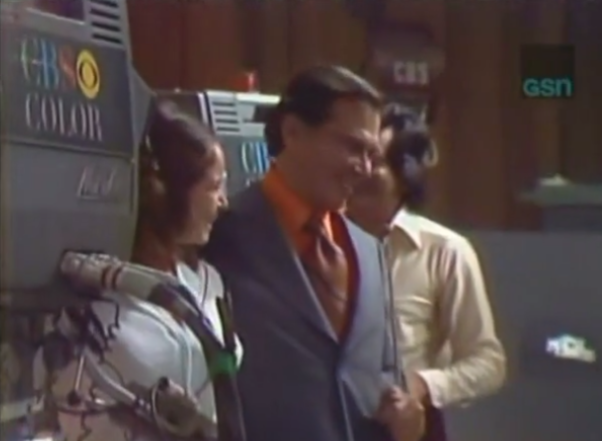
At the very start of this video clip of ‘Tattletales’, you’ll see the crane shot from this camera operated by Christina Skaggs. Here she in high on her Chapman Electra behind the set for that opening shot.
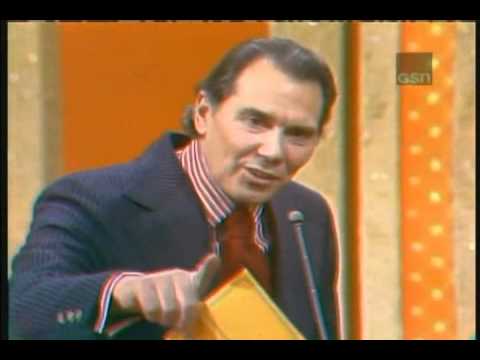
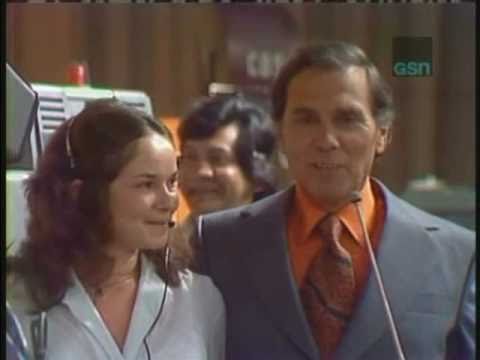
There is better quality video of this show, but this is a wildly unique clip from ‘Tattletales’. The show’s regular host was Bert Convy, but in this episode, Jack Narz is hosting with Bert playing the game with other daytime game show hosts, Richard Dawson and Bob Barker and…their wives.
I have not seen this show since it was on (’74-78 and ’82-84) and had forgotten how much fun it was to see these husband and wife teams together. Thanks for the pictures Christina and for reminding us of ‘Tattletales’! Enjoy and share! – Bobby Ellerbee
Christina Skaggs…CBS Veteran And Pioneer Female Camera Op
A few days back, we met Christina in videos of her work on ‘The Match Game’. As promised, she’s sent us a few new photos and this the first one…the second one will follow in a separate post with video.
Although camera work has mostly been a “mans world”, there were some highly skilled women along the way who joined in this fraternity and several of them are our friends, like ABC’s Donna Quante.
Here’s what Christina wrote as a caption for this photo…
“This is me on the crane camera on ‘Tattletales’, a Goodson-Todman game show at CBS TV City that aired in the seventies. With me is Jim Riley, my arm operator and a great cameraman who shot Red Foxx and the old Playhouse 90’s way back when. I was so lucky that I came in at a time when big variety shows were the norm and I worked with the men who came from radio and started TVC when it was nothing but an orange grove. A lot of great talent on this show – one of the very friendliest who sat on my crane arm and told me stories about shooting Playhouse 90’s on that very stage many years before was Robert Blake”
Thanks for the pix and background Christiana, and thanks for reminding us of ‘Tattletales’…more on that in today’s next post! Enjoy and share! – Bobby Ellerbee