Posts in Category: TV History

Television Milestones…1939 – 1940 Historical Events Timeline

Sometimes, it’s good to put things is perspective with a big picture overview of how television developed. Here is a look at the early milestones of the new media…baby steps along the way. By the way, W2XBS became WNBT or what we now know as WNBC. Enjoy and share! -Bobby Ellerbee

Apr. 30, 1939. President Roosevelt is the first President to appear on television, from the New York World’s Fair on W2XBS, now transmitting on 45.25 MHz visual and 49.75 MHz aural.

May 17, 1939. A Princeton-Columbia baseball game is telecast from Baker Field in New York by W2XBS, making this the first sports telecast 4 p.m. to 6:15 p.m. Bill Stern was the announcer.

June 1, 1939. First heavyweight boxing match televised, Max Baer vs Lou Nova, form Yankee Stadium on W2XBS.

Aug. 26, 1939. First major league baseball game telecast, a double-header between the Cincinnati Reds and the Brooklyn Dodgers at Ebbets Field, Brooklyn, announcer Walter L. “Red” Barber on W2XBS.

Sept. 30, 1939. First televised college football game, Fordham vs Waynesburg, at Randall’s Island, New York, on W2XBS.

Oct. 22, 1939. First NFL game is televised by W2XBS: the Brooklyn Dodgers (correct, there was such a team) beat the Philadelphia Eagles 23-14 at Ebbets Field in Brooklyn. Play by play announcer was Allen (Skip) Walz.

Nov. 10, 1939. W2XB in Schenectady NY goes on the air (became WRGB in 1942). This GE property (W2XB) was the first experimental station licensed and RCA (W2XBS) was second. The XB stand for Experimental Broadcast…the S in W2XBS is for South, as NYC was to the south of the first licencee.

Jan. 1940. The FCC holds public hearings on television.

Feb. 1, 1940. The first NBC network television program was broadcast (with help from AT&T) from W2XBS NYC to Schenectady.

Feb. 25, 1940. First hockey game televised, Rangers vs Canadians, on W2XBS, from Madison Square Garden.

Feb. 26, 1940. The first quiz show, “Spelling Bee”, on W2XB (WRGB).

Feb. 28, 1940. FCC announces a limited commercial television service will be authorized beginning on September 1. Standards were not set, pending further research until the best system could be determined. Two days later the FCC suspended its authorization for commercial service, declaring that the marketing campaign of RCA disregarded the commission’s findings and recommendations.

Feb. 28, 1940. First basketball game televised, from Madison Square Garden, Fordham vs The University of Pittsburgh, by W2XBS.

Mar. 10, 1940. W2XBS utilizes the Metropolitan Opera to broadcast a scene from the opera “Pagliacci” from NBC Studio 3H. The audio portion is carried over radio station WJZ.

Mar. 15, 1940. Broadcasting reports RCA cuts price of television sets, starts sales drive intended to put a minimum of 25,000 in homes in service area of NBC’s W2XBS.

Apr. 1, 1940. Broadcasting reports FCC suspends order for “limited commercial” operation of TV, censures RCA for sales efforts which are seen as an attempt to freeze TV standards at present level, calls new hearing; critics call move “usurpation of power.”

Apr. 13, 1940. W2XWV (WABD) licensed to DuMont.

June 1940. W2XBS (NBC) covers the Republican National Convention from Philadelphia for 33 hours over five days. Broadcast to NYC, Schenectady and Philadelphia as first three city NBC network feed. W3XE (WPTZ) was the Philadelphia station.

Aug. 5, 1940. W9XBK (WBKB) Chicago goes on the air (Balaban & Katz/Paramount).

Aug. 29, 1940. Peter Goldmark of CBS announces his invention of the Field Sequential color TV system.

Sept. 3, 1940. First showing of color TV, by W2XAB, (WCBS) transmitting from the Chrysler Building, using 343 lines. This was the first telecast of any kind from CBS since the closing of their scanner station February 2, 1933.


Source

Just For Fun…”The Frank Sinatra Show”, ABC 1957

Just For Fun…”The Frank Sinatra Show”, ABC 1957

From October of ’57 through June of ’58, ABC broadcast this show, usually live, from the El Captain Theater in Los Angeles, which was also home to “Queen For A Day”.

Notice above, I said “usually live”…actually only a few of the shows were supposed to be live variety shows with the bulk being filmed dramas that either starred Sinatra or had him hosting the drama. As it turned out, Sinatra hated to rehearse and tried to film 11 shows in 15 days. They were so bad, ABC settled for the live variety shows and cut it’s losses with a short season.

Below are a couple of clips with Frank, Dean Martin, Bing Crosby and Mitzi Gaynor. With this Chesterfield ad, we are reminded of the old red and white ABC camera colors. Enjoy and share! -Bobby Ellerbee

http://www.youtube.com/watch?v=ZqGPtwvsh6A
http://www.youtube.com/watch?v=eQgHV9OFazE

Source

A Primer On The History Of Chroma Key In Television


A Primer On The History Of Chroma Key In Television…

Was this Milton Berle chroma key sketch the first? No, but it is one of the most sophisticated early uses of the technology as it employs both chroma key and video tape editing. This was quite a feat in 1959!

Motion picture production had been using compositing for years prior to the invention of television, but it was an involved process requiring optical printers and intermediate film mattes, hardly suitable for the immediacy of live television.

In July of 1957, chroma key had its first on-air test on one of NBC Burbank’s more ambitious projects, ‘Matinee Theater’ that ran from 1955 to 1958. Every weekday afternoon, a one-hour live dramatic production was presented. The source material varied, but often it was an adaptation of some famous literary work.

A television version of the H.G. Wells classic “The Invisible Man,” lent itself perfectly for the first live use of chroma key. When the title character’s hands and head were wrapped in blue and he stood in front of a blue screen, the chroma key amplifier would replace the blue parts of the video with an image from another camera. All that would be seen in the composite shot was the man’s clothing in front of scenery being shot by the background camera, thus making him appear to be invisible.

Chroma key was developed by Frank Gaskins, NBC Burbank’s technical operations supervisor and Milt Altman, graphics arts supervisor. Together, they pooled their talent to develop what has become standard equipment on live video switchers throughout the world and now can be launched on any home computer. Today, blue has been largely replaced by the use of green, but is the same process. The key color change became necessary when video started to be compressed and primary colors began to be sampled at the ratio of 4:2:2, with luminence and green being the only fully sampled channel in most cases. -Bobby Ellerbee

Source

NBC Tour Time #2…30 Rock As Only David Letterman Can Show It


NBC Tour Time #2…30 Rock As Only David Letterman Can Show It

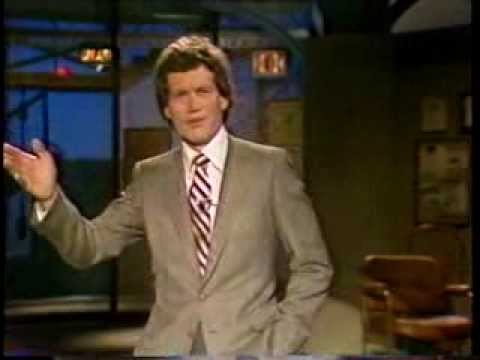
Just for fun, here a clip from around 1985, just before the GE sale, with Dave bring out some of the many selling points. I particularly like the trip to the Tom Brokaw news set;>) Thanks to David Crosthwait for the clip. Enjoy and share! -Bobby Ellerbee

https://www.youtube.com/watch?v=R6RKlrq5sbs

Ghosts and headlocks.

Source

Guess Who’s Network Broadcasting’s Longest Running Host

Guess Who’s Network Broadcasting’s Longest Running Host…

Bob Barker is a close second with 34⅔ years years on “The Price Is Right”, but the winner and still champion is Don McNeil with a 35½ tenure as host of a network entertainment program.

Counting only television, Barker wins, but when you add radio to the mix, “The Don McNeil Breakfast Club” from Chicago comes in first. The show started on the NBC Blue Network, but then became an ABC Radio show with the divestiture.

It originated in Chicago and ran from 1933 to 1968. In 1950, the show was simulcast on ABC for a year, and then again in 1954. Below is a clip from 1954. Thanks to Barry Mitchell for reminding us of Don. Enjoy and share. -Bobby Ellerbee

Source

Another New Rarity! “Life Begins At 80”

Another New Rarity! “Life Begins At 80”

This is a beautiful shot of Dumont’s main studio at the Wanamakers Department Store location. It wasn’t always this dressy, but this special set was built to entice the show’s producers Jack Barry and Dan Enright away from NBC where “Life Begins At 80″ had aired from 1950 till ’52.

The show had actually started on radio in 1948. In ’55, the show left Dumont and moved to ABC for a year and was finally retired to give Barry and Enright time to work on a new show you may have heard of….”Twenty One”! Yes, ground zero for the quiz show scandals. Once again, thanks to Mike Clark for finding this for us. Enjoy and SHARE! -Bobby Ellerbee

Source

NEW, ULTRA RARE! The Kraft Cameraman

NEW, ULTRA RARE! The Kraft Cameraman

Before “The Kraft Television Theater” debuted on a regular basis from NBC Studio 8G in May of 1947, it had been done occasionally from Studio 3H in 1945 with their big silver Iconoscope cameras.

I think this super rare picture of the opening shot display was taken in May of ’47 in 8G. We see two men working on the rotation table here, but over the years, the mode of travel changed. This turntable setup was the first arrangement. In the early ’50s, the cameraman was rotated back and forth by a visible stick from underneath. By the mid to late 50s, the cameraman was dollying into the picture and then turning with the invisible help of magnets.

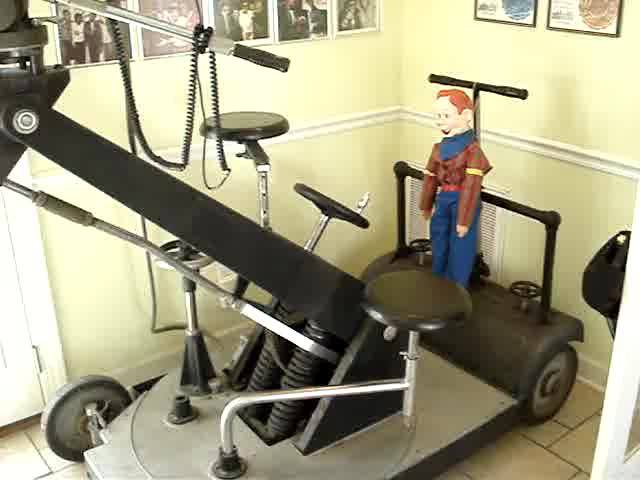
In 1954, Kraft began offering this as a toy for fifty cents with a Velveeta box top. I’ll post the introductory announcement below in the Comment section. Again, thanks to Mike Clark for sharing this. Enjoy and SHARE! -Bobby Ellerbee

Source

NEW, ULTRA RARE! “Texaco Star Theater”

NEW, ULTRA RARE! “Texaco Star Theater”

This is just amazing! I have studied this very closely and believe this to be, if not the debut show, at least a photo taken in the first month of “The Texaco Star Theater” starring Milton Berle. This is the ONLY behind the scenes photo I have every seen of this show in production.

This was taken in NBC Studio 6B that was converted from radio to television on June 8, 1948, just in time for the debut of Berle’s show. I have several pictures of this studio in late ’48 in which the camera platforms have back rails, but notice there are none here yet which makes them brand new and this is possibly their first use.

Also notice the title card on the right side of the stage. As you can see at the start of this earliest video of the show, it is the same.

At the time this was taken, only NBC Studios 3H and 8G had their own cameras. Television was being done in what were then radio studios 3A, 3B, 6A and 6B with several in house mobile units with three cameras each. The Camera Control Units were on wheels and were placed in the sound locks of the studio.

When I mention the dates the studios were converted from radio to television, that means the date that these studios finally got their own control rooms. Even before the June 8, 1948 debut of 6B, some television was done here with the mobile units, which was also the case for 3A, 3B and 6A. In September of 1949, these mobile units would also finally enter Studio 8H for the television debut of “The Voice Of Firestone”. Many thanks to Mike Clark for sharing this, AND some great pictures yet to be posted! Enjoy and SHARE! -Bobby Ellerbee

Source

Double Header History In The Making

Double Header History In The Making

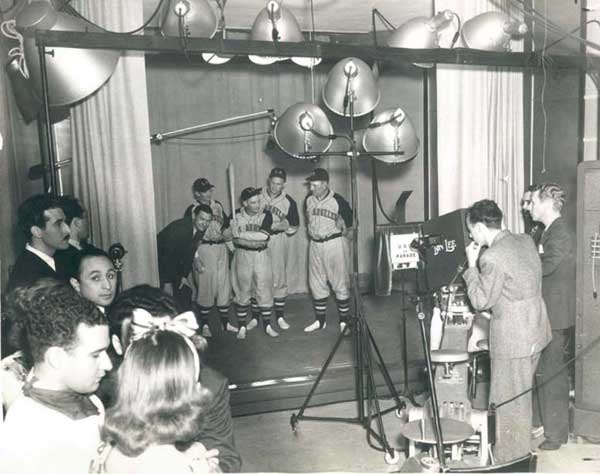
This is the story of the first MLB night game broadcast and…a little more. The article from June of 1941 also gives us what I think is the first ever look at the RCA Model 1846 Orthicon camera.

It has been hard to get a date on when these cameras were actually put into service, but in the photo, we see the 1846 on the right of the RCA field Iconoscope camera. More than likely, it was here to use as a side-by-side comparison test for RCA and NBC engineers. This is a couple of years earlier than the 1943 date we had thought. Enjoy and share. -Bobby Ellerbee

Source

You’ve Come A Long Way Baby!

You’ve Come A Long Way Baby!

Given all of the Super Bowl coverage, I thought a look back at 1960 state of the art mobile production was in order. This is the new RCA twin truck unit recently purchased by Los Angeles based Glenn-Armistead Productions.

The production truck (bottom) carried 4 RCA TK11/31 black and white and 4 RCA TK41 color cameras. The tape truck had two huge RCA TRT 1B color tape machines and an entire 16 and 35mm film chain. Enjoy and share! -Bobby Ellerbee

Source

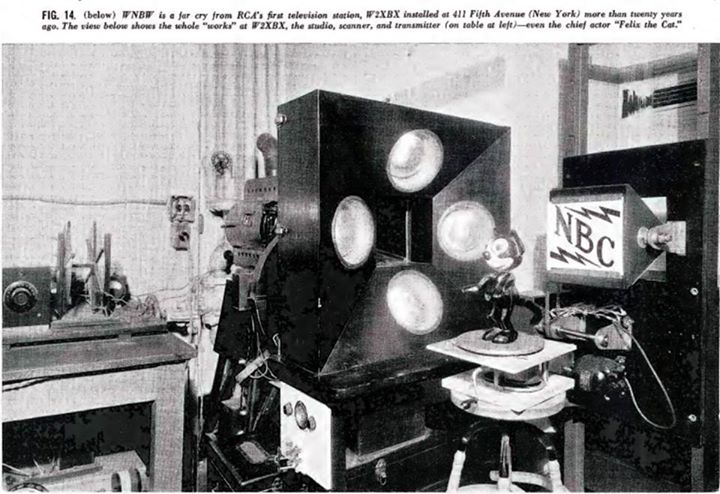
NBC’s First Television Station, 1928

This photo is from a 1948 RCA Broadcast News Magazine. The article was about some new equipment at the NBC Washington station, WNBW and this was added as a reminder of how far television had come.

Note the caption states that, aside from an antenna, this is the whole station! The transmitter is on the table to the left and now we finally have a location…411 Fifth Avenue.

In 1928 the futuristic idea of television was close to becoming reality. That year The Radio Corporation of America, began construction of a transmission studio at 411 Fifth Ave. The R.C.A. Photophone, Inc. already had a recording studio here and the new equipment room was adjacent to it.

On March 22, 1929 the Radio Corporation of America announced that “television images are now being broadcast daily from 7 to 9 P.M.” The company’s vice president, Dr. A. N. Goldsmith said that the program was intended to give “experimenters an opportunity to look in on the development work, which, it is contemplated, will in due course evolve into a service to the public on a commercial basis similar to that of sound broadcasting.”

Decades before the television set would be commonplace in America’s living rooms, pictures were appearing on a screen at 411 Fifth Ave. “Transmissions consist of pictures, signs and views of persons and objects,” said Goldsmith. “Announcements are made frequently by transmitting a picture of the call letters of the station…occasionally actors from the sound movie studios will appear before the photocells of the transmitter.”

Below is a link to an article on this address, that until today, I had never though much about. Enjoy and share! -Bobby Ellerbee

http://daytoninmanhattan.blogspot.com/2012/09/the-unique-1915-no-411-fifth-avenue.html

Source

NBC’s Felix The Cat Camera…Displayed At 1939 World’s Fair

These Photos Unlocks Some Mysteries!

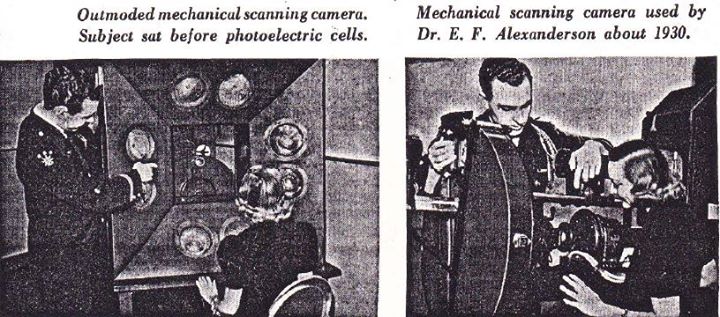
If you ever wondered what happened to NBC’s “Felix The Cat” mechanical camera after tests were concluded in 1932, here’s the answer. It was on display at the RCA Pavilion at the 1939 World’s Fair in New York.

In the diagram, we see it in the Museum being displayed along with E F Alexandrson’s mechanical camera from 1930. In the photos, we see it being demonstrated at the fair. The question is, what happened to it after the fair closed? I’ve seen a replica, but I think the real thing is long gone. At least we know they saved it for a while anyway. Enjoy and share! -Bobby Ellerbee


Source

One Of The First Television Commercials

One Of The First Television Commercials

Somehow looking forward to new commercials has become a part of the Super Bowl madness we experience each year, but I seriously doubt that the people that made the very first TV spots would believe us if we could tell them.

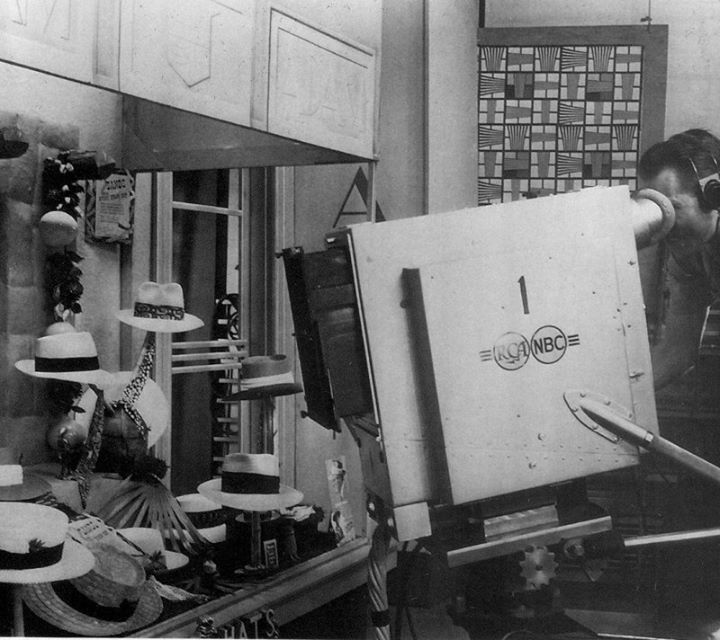
Here is a shot from inside NBC Studio 3H that shows an RCA A500 Iconoscope camera shooting a mockup of an Adam Hats store window. Along with Botany suits and Bulova watches, Adam Hat’s and Sunoco were among the first ever advertisers. Enjoy and share!

Source

Don Lee Broadcasting…Pioneering West Coast Television

KTLA and Klaus Landsberg were not the only ones innovating in Los Angeles in the 1930s. There was also Don Lee who’s station W6XAO (now KCBS) is credited with airing the first movie and the first news film on television. This short video covers the whole story very well.

Here is an interesting pictorial history and article I thought you would enjoy from my friend Steve McVoy at the Early Television Museum. Enjoy and share! -Bobby Ellerbee

http://www.earlytelevision.org/w6xao.html

Source

February 2, 1950…”What’s My Line” Debuts on CBS


February 2, 1950…”What’s My Line” Debuts on CBS

On this day in 1950, WML began a 17 year run which reportedly makes it the longest running prime time network game show ever.

Produced by Mark Goodson and Bill Todman, the show was initially called “Occupation Unknown” but the day before air, the name was changed. The show debuted on Thursday, February 2, 1950 at 8:00 p.m. Eastern. It originally aired alternate Thursdays, the alternate Wednesdays till October 1, 1950 when it settled into its weekly Sunday 10:30 p.m. ET slot where it would remain until the end of its network run on September 3, 1967.

Here is the debut episode and it’s a good thing they made a lot of changes to the show, and quickly. Dorothy Kilgallen was the only original panel member to survive the line up shifts until her death in 1965. Enjoy and share! -Bobby Ellerbee

Source

Super Bowl…The Magic Of Half Time! Amazing Video


Super Bowl…The Magic Of Half Time! Amazing Video

http://www.youtube.com/watch?v=PNRm7OwXpGo
Two videos here…below, rare shots of the stage being set up for Madonna in 2012, and above is the performance.

Amazingly, they have only 6 minutes to set up and 6 to tear down these incredibly complex stages. I hear there are 600 on the stage crew to carry and assemble all this on the field. Enjoy and share!
-Bobby Ellerbee

http://www.youtube.com/watch?v=bD8HbpHkoYw

Follow me on twitter: http://twitter.com/sjernigan14 Personal video taken at Super Bowl 46 that shows the stage being built in 5 mins. Madonna was the halfti…

Source

February 1, 1954…”The Secret Storm” Debuts On CBS


February 1, 1954…”The Secret Storm” Debuts On CBS

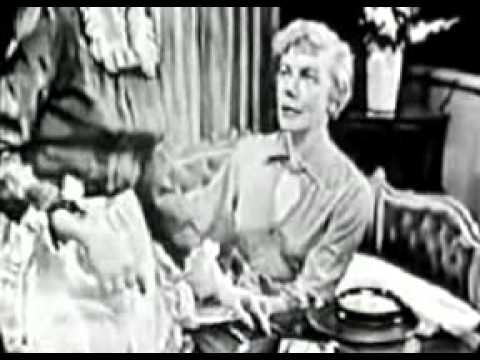
At the time this episode aired, the show was about a year into production and holding its ground from 4:15 – 4:30 weekdays, even though it was up against “American Bandstand”.

The show originated from CBS Studio 65, The Hi Brown Theater at 221 West 26 Street. On June 18, 1962, CBS extended “The Secret Storm” to a half hour and moved it to the 4:00 PM time slot, where it ran for six years against NBC’s “The Match Game”.

In 1966, “Dark Shadows” premiered against it on ABC, and CBS moved the show forward an hour to 3:00 PM on September 9, 1968, facing NBC’s fast-rising “Another World”.

“The Secret Storm” went to color broadcasts on September 11, 1967. In all the turmoil of its later years, the main reason for the show’s demise may have been CBS’s choice to buy the show from the original sponsor/packager, American Home Products, in 1969. Ever since CBS purchased the show, it suffered from numerous headwriter and producer changes. The show was canceled in 1974 and replaced with a less-expensive game show, “Tattletales”.

You may remember that in 1968, Joan Crawford, who at the time was over 60 years old, filled in for her ailing daughter, Christina, who played the role of Joan Borman Kane, a character who was only 28. The episodes were broadcast on October 25, 28, 29 and 30. The 1981 film “Mommie Dearest” portrayed Crawford’s appearance without specifying the name of the series. Enjoy and share! -Bobby Ellerbee

http://www.youtube.com/watch?v=v6vb0yAJ28Y

an episode of ‘The Secret Storm’, dated February 18, 1955 (2 days b4 i was born!!)..complete with original commercials, organ music and all, this episode sho…

Source

Ellerbee Camera Collection Video Tour

https://www.facebook.com/watch/?v=10200462127141865

For those of you that have never seen this, here it is again. I shot this a couple of years back with a small 35mm photo camera and it shows all of the 16 cameras I have on display here in my home. At the time, I had about 25 cameras, now, with the addition of the 70+ ENG cameras, there are about 100 cameras in the collection. Enjoy!

Source

February 1, 1982…”Late Night” With David Letterman Debuts, NBC


February 1, 1982…”Late Night” With David Letterman Debuts, NBC

Two videos for you to mark the 33rd Anniversary, first here are two rare promos that ran the weekend before the show debuted on a Monday night.
http://www.youtube.com/watch?v=sIUPlDEFgfw

The second video below is from the second night on the air and Dave starts the show by letting an audience member take over one the the RCA TK44s in NBC Studio 6A.

After the camera clip, we get a minute with Pat Paulsen and the shows open is at the end. Bill Wendell is the announcer and Hal Gurney is directing. Enjoy and share! -Bobby Ellerbee

http://www.youtube.com/watch?v=NraxSgAPKXQ

2.2.82 2nd Late Night show. opening segment.

Source

But Where Are Our Pants?

But Where Are Our Pants?

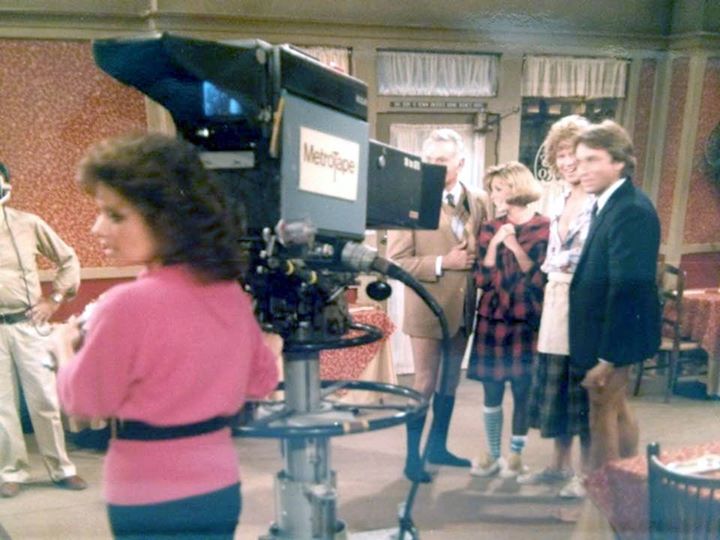
Thanks to Bettina Levesque for this picture of her behind the camera at the Metro Media Square Studios where the last two seasons of “Three’s A Crowd” were shot in ’84 and ’85. Was This George Sunga’s idea? The camera is an RCA TK45. Enjoy and share! -Bobby Ellerbee

Source