- Home
- TV History
- Network Studios History
- Cameras
- Archives
- Viewseum
- About / Comments
Look Sharp…Feel Sharp…Be Sharp!
That was the Gillette Razor ad copy and I still remember it, and the great opening music of the Cavalcade Of Sports show like it was yesterday. I used to watch this with my dad on Friday nights. Here’s the intro…enjoy.
http://www.youtube.com/watch?v=C6cyy_rziuk
Featuring the Look Sharp March 1958
Flying By The Seat Of Her Pants…Almost
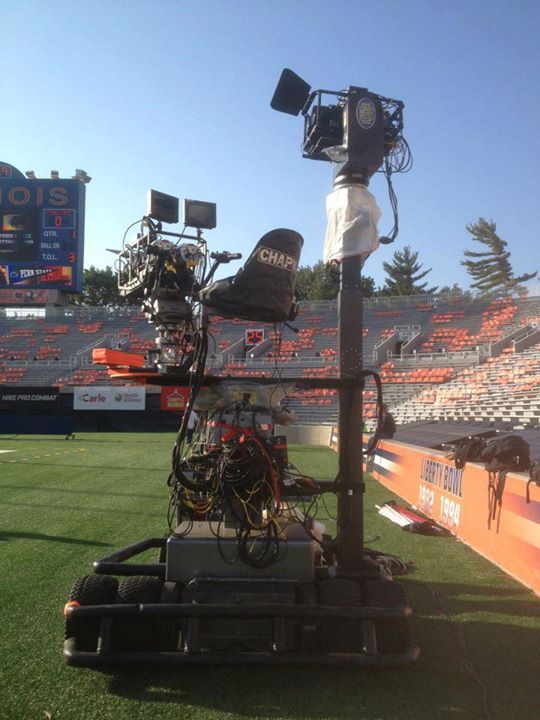
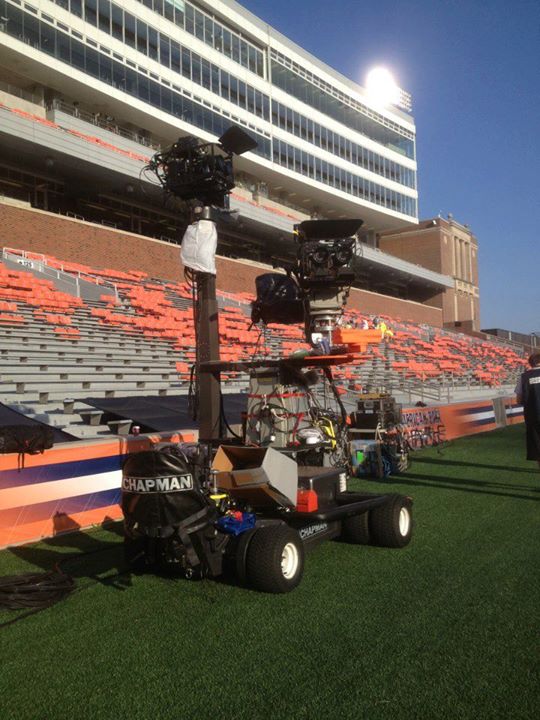
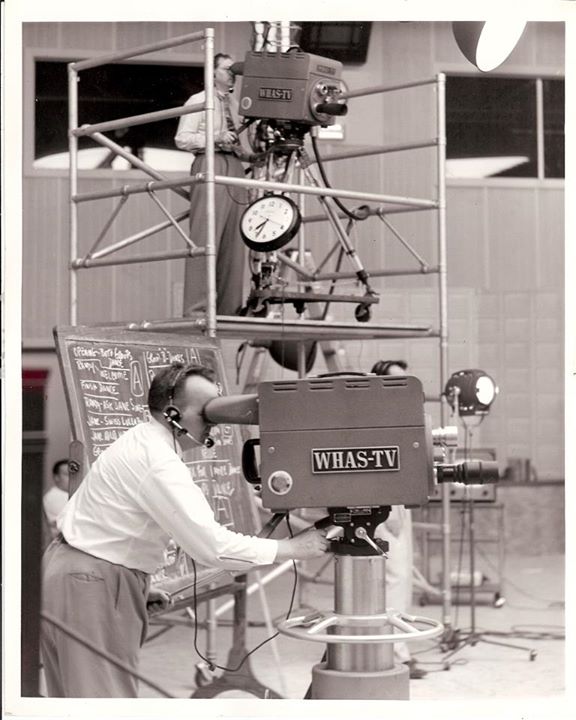
Before mounting the Chapman Electra stage crane for another round of ‘Family Feud’, our friend Donna Quante ‘checks the oil’ on her Norelco PC70. Very nice shot and we thank Donna for it, and many others. Do you have pix to share?
Flying By The Seat Of His Pants…But Just Barely
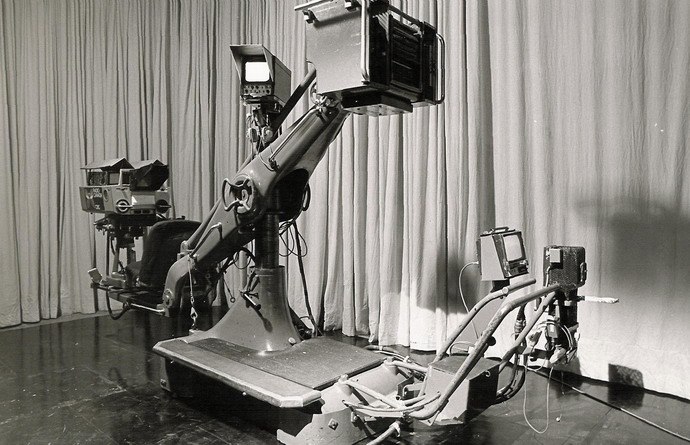
Marconi Mark II cameras capture the action of scene, but the real action is on the end of that dolly boom. That’s quite a balancing act. I see a Vinten logo on the boom arm, but don’t recognize the model. Neither the Pathfinder II dolly or the Heron stage crane had lattice work supports in the boom arms like this one. Maybe this is a Pathfinder I manual dolly. Anyone know?
The First Hand Held Broadcast Camera
This is the RCA ‘Walkie Lookie’ miniature wireless Vidicon camera designed for coverage of the 1952 Political Conventions. With so much attention to the Ikegami ‘Handy Lookie’ in the posts below, I just wanted to remind you who was actually first with this technology. RCA and the USA!
Mystery Solved #1 The First Ikegami Studio Camera
Without a doubt, this is the first professional studio camera from Ikegami. The camera with the big box zoom lens is the Ikegami TK 301A. I had searched and searched for a photo, but all I could find was a tiny thumbnail size. When I blew it up, I realized I had a photo of it in my archives from the NHK Museum in Japan. FYI, the two cameras behind it are early Toshibas. This camera debuted in 1971 and made the name of Ikegami synonymous with cameras. The TK 301A was used extensively in the Sapporo Winter Olympic Games in Japan.
Ikegami was busy developing it’s ENG line with the HL 33 debuting in 1973 and the HL 79A in 1979. Their experience with these lead them to the studio sized HK 312 in 1981. With the introduction of the 312, came the change from the TK designation to HK (Handy Kamera) and of course the HL stands for Handy Lookie.
Mystery Solved #2
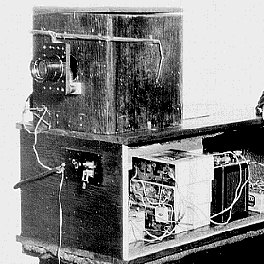
I had thought the old pedestals used with the Iconoscope cameras in the 30s and 40s were perhaps hydrolac, but…not anymore. Thanks to further research by our friend Paul Beck, we now know these peds had an electric motor to take them up and down. In reexamining my archives, I came across this photo that may actually show the foot switch that operates the motor. Take a close look at the bottom right of the pedestal. These cameras were more bulk than weight and a small electric motor could easily handle the load of 100 pounds or less.
Ampex Training Tape: VR 2000
In a super rare set of tapes from Ampex, here are all three parts of the 1964 master training session for all new owners of the Ampex VR 2000, color capable, video tape recorder. Enjoy!
http://www.youtube.com/watch?v=5bFPPJgFUJg
http://www.youtube.com/watch?v=uVmqqNitHJg
http://www.youtube.com/watch?v=SjC-TsFbClI
Ampex training on the operation of the VR-2000 2″ Quad VTR, part 1
Ah Ha!
Ever wonder how they get those great underwater shots in swimming events? This the the Spirit system from Deep Vision. Check out the demo video.
The EMI 203
This handsome camera debuted in 1960 with a 4 1/2 inch Image Orthicon tube. Here, BBC veteran cameraman Ron Green is at the controls and both are riding the Vinten, Heron studio crane. A few weeks back I posted a photo of this lens model from Angenieux, which is made for use with turret cameras. The show is ‘Top Of The Pops’.
Time For Beany! April 1950
Above is a photo from April of 1950 at KTLA. In the middle, doing Cecil is Stan Freberg and on the right is Daws Butler doing Beany. I’m not sure who the ‘spare hand’ is handling the seltzer bottle, but it could be producer Bob Clampett. If not, it may be one of the writers Charles Shows or Lloyd Turner. The puppets, created by Maurice Seiderman. The puppet show ran from 1949 till 1955. Freberg and Butler left in early 53 and were replaced by Jim MacGeorge and Irv Shoemaker.
Here is an early episode.
‘Westinghouse Studio One’, The Scarlet Letter: April 1950
In 1948, ‘Westinghouse Studio One’ made a quantum leap from radio to television. The television series was seen on CBS from 1948 through 1958, under several variant titles: Studio One Summer Theater, Summer Theater, Westinghouse Studio One and Westinghouse Summer Theater.
CBS produced the show in New York and it was telecast live in the east, but a kinescope had to be shipped to LA for broadcast the next week until AT&T connected east and west in 1951. In later years, they moved the show to Television City as ‘Studio One From Hollywood’. Offering a wide range of dramas, Studio One received Emmy nominations every year from 1950 to 1958 and produced 466 memorable teleplays.
Gone, But Not Forgotten…The Orange Bowl Parade
Tomorrow, one of the nations oldest bowl games will be played in Miami but today, New Years Eve was the day the Orange Bowl Parade happened. It was a rare night parade and kicked off at 7PM, just like it had since 1936. Unfortunately, in 2002 that came to an end. In 1997 the parade lost it’s television contract and limped along for five years without the big money, but…for all of us that remember watching, here’s a 1953 ad from The Miami Herald.
We’ll Miss Dick Clark Tonight!
The photo is from New Year’s Eve 1988, and the story below is from the New York Times from April of this year. It’s a nice and interesting read. Enjoy and Happy New Year!
____________________________________________________
Dick Clark had a commuter’s relationship with New York — a long-distance commuter’s relationship. He did not arrive on a train from the suburbs; he arrived on a plane from the West Coast.
For the man who kept Times Square in the national consciousness in the 1980s and 1990s, New Year’s Eve was a one-night-a-year broadcast and home was 2,500 miles away.
For nine years as the host of the “Pyramid” game show — “The $10,000 Pyramid” until, in inflationary times, it became “The $20,000 Pyramid” — he spent two days a week in Manhattan. He arrived in time to be at the studio on West 58th Street at 8 a.m. on Tuesday. He taped five shows, returning on Wednesday to tape five more. Then he was off to catch a flight to Los Angeles.
“Here is the incredible thing,” Mike Gargiulo, who was the show’s director, recalled on Thursday, one day after Mr. Clark’s death. “In nine years, we had only one day when he missed his 6 o’clock plane at J.F.K.”
So he was here but not here. Dick Clark’s New York was transitory, almost ephemeral, the New York of appearances on television, of parties for other television types, of business meetings. In a stopover in Manhattan in 2000, he said he had flown more than nine million miles, produced more than 7,000 hours of television programs and signed more than 800,000 autographs.
Then he added two postscripts. The first was, “That estimate was made three years ago.” The second was, “Thank God I have a short name.”
It was a name everyone seemed to know. Jane Rothchild, a producer on “The $20,000 Pyramid,” remembered a night when she and Mr. Clark went out for a drink after the day’s tapings. “We passed a guy who was lying drunk in the gutter,” she said. “Dick lifted him up and leaned him against a parking meter. As he was teetering with drunkenness, he barely opened his eyes, but did so, focused on who had lifted him, and said, ‘Thanks, Dick.’ You knew he’d be thinking the next day, ‘Did Dick Clark really lift me out of the gutter last night?’”
For television viewers, he lifted Times Square out of its seediness, just by sticking with his New Year’s Eve show.
“He really understood that New Year’s Eve in Times Square could be a vehicle for changing the perception of Times Square,” said Gretchen Dykstra, who was the president of the Times Square Business Improvement District from its creation in 1991 through 1998. “He and his producers were very amenable to accepting from us suggested scripts that he could include. We would write short pithy paragraphs that he could plug in throughout the evening about a new day coming to Times Square.”
Times Square is a 20-minute walk from the Elysee Theater, where the “Pyramid” shows were videotaped. Mr. Gargiulo said Mr. Clark was unflappable. Did Tony Randall, a guest panelist, say a word you can’t say on television? In the control room, Mr. Gargiulo was frantically figuring out a do-over. On the set, Mr. Clark stayed cool.
“It was like the ball coming down in Times Square,” Mr. Gargiulo said. “He didn’t get overly excited when people were winning, he didn’t get under-excited when they were losing. He had his own choreography that worked for him.”
In 2006, Mr. Clark auctioned off memorabilia he had collected presiding over “American Bandstand” and “New Year’s Rockin’ Eve” and producing made-for-television movies and specials. On the block were such items as his hand-held microphone from “American Bandstand.”
“It saw every famous rock ‘n’ roller that was ever born,” he said.
Guernsey’s, the auction house that handled the sale, arranged to have the auction in the Rose Theater at Jazz at Lincoln Center, in the Time Warner Center. Arlan Ettinger, the president of Guernsey’s, remembered a moment from the night before the sale, when he and Mr. Clark walked outside.
“He was saying how he had grown up in Mount Vernon, you know, a suburb,” Mr. Ettinger said, “and had these visions that someday he hoped he could have an influence on people. We could see down Broadway, and he said, ‘Just think, here I am in this greatest of all cities, and now they all look at me on New Year’s Eve.’”
“He was very humbled,” Mr. Ettinger said. “He wasn’t saying it in a braggadocio style. He was saying how wonderful to have had an impact on so many lives, how lucky he was. It was very touching.”
http://cityroom.blogs.nytimes.com/2012/04/19/looking-back-at-new-yorks-dick-clark/
KOTV: Tulsa, Oklahoma
KOTV signed on in October of 1949 and became the nation’s 90th TV station. As the only station in the market for several years, they ran programs from ABC, CBS, NBC and Dumont. At first, network programming was aired about a week after being broadcast live on the East Coast; it would be 1952 before a microwave link with New York City made live network programming possible.
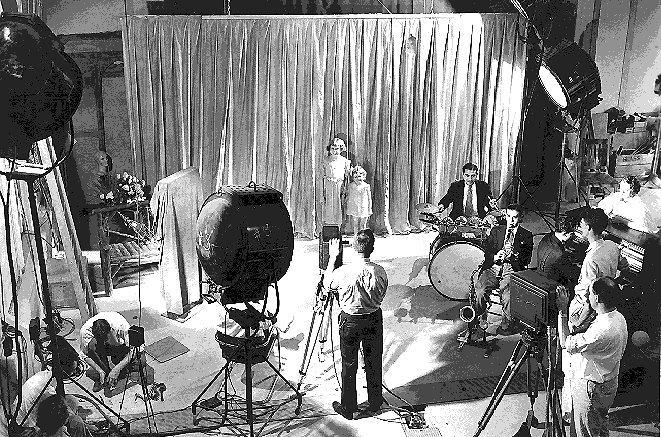
Three hours of programming were filled in the evening by the network shows, but with a broadcast schedule that began at 12:30pm, Channel 6 had to fill the rest of its schedule with local programming that was broadcast live. I think this photo is from the ‘Lookin’ At Cookin’ show that had a 32-year run. The station cost a total of $400,000 to build and equip. Notice the Elecrozoom lens on one of their RCA TK30s. I can’t imagine why there is a casket in the studio unless it is for a live spot from a local funeral home.
A Big Move For CBS…
The Norelco PC60 and 70 cameras were bought in bulk by CBS starting in 1965. With an aging fleet of cameras, CBS began to wonder what was next. It’s quite common for camera makers to loan a network several camera for evaluation and that process started in the late 70s at CBS. Eventually the Hitachi SK 110 was chosen and built to specs for CBS studios and trucks. Below is a shot from ‘The Young And Restless’ set at Television City in 1985 with the SK 110s in use.
Ampex VRX 1000: First Videotape Recorder
The Ampex VRX-1000 (later renamed the Mark IV) was introduced on March 14, 1956, at the National Association of Radio and Television Broadcasters in Chicago. This is the world’s first practical videotape recorder and is hailed as a major technological breakthrough. In this photo, CBS goes on air with the first videotape delayed broadcast, Douglas Edwards and The News, on November 30, 1956, from Television City.
The TRT 1: RCA’s First Videotape Recorder
Although Ampex beat RCA to the punch, with the introduction of the VRX 1000 in March of 1956, RCA knew how to record in color and Ampex didn’t. For each one to get what they needed, they made a deal to share technology. At RCA this resulted in the 1957 debut of the TRT 1 and the TRT 1B in late 1958 or early 59. While the Ampex was a flat deck machine with a bridge, the RCA VTRs were rack mounted in 3 racks.
Remember Pinkey Lee? I do!
Pincus Leff (May 2, 1907 – April 3, 1993) was born in Saint Paul, Minnesota. Pee Wee Herman and Pee Wee’s Playhouse is loosely based on Pinkey Lee. I’m not sure but think this was done at KHJ. Anyone know?
Good News, Bad News…RCA TK 76
The good news was, that now, any news could be covered more easily with the new TK 76 Electronic News Gathering (ENG) camera introduced in 1976. This was the fully self contained portable color camera RCA made for news crews. It weighed 19 pounds.
The bad news was that portable video tape machines were still not up to the job. Granted, there was the Ampex VR 3000 that came out in ’67, which was a suitcase sized 2″ quad unit, and in 76 Ampex rolled out the VPR-1, helical scan, Type C, 1-inch, videotape recorder, but all they could do is record and play back. You could not edit on them in the field.
Basically, you had to either feed pictures live via microwave as is being done in this shot from KETV, or tape the story and rush back to the station to edit it for air. You could also feed the taped story back to the station to be recorded on a machine there for editing, but then you are into a second generation and back then, that was not a good thing. How did you do it? Anyone have stories about how it was done where you were?
Jack Paar: The Joke, Walk Out & Return…The Whole Story
On February 11, 1960, Jack Parr walked off The Tonight Show for a month after NBC censors edited out a segment, taped the night before. As he left his desk, he said, “I am leaving The Tonight Show. There must be a better way of making a living than this.” Parr’s abrupt departure left his startled announcer, Hugh Downs, to finish the broadcast himself.
Parr returned to the show on March 7, 1960, strolled on stage, struck a pose, and said, “As I was saying before I was interrupted…” After the audience erupted in applause, Parr continued, “When I walked off, I said there must be a better way of making a living. Well, I’ve looked… and there isn’t.”
All of the history and more is in the great link above and is a MUST SEE clip as much of the story is told by Jack himself with footage of the departure and return. Below is the text of the four minute bit in question which is based on an innocent mix-up involving the initials W.C. The NBC censors decided it was dirty and cut it from the broadcast without bothering to consult or even notify Paar. Here’s the joke; YOU decide:
An English lady, while visiting Switzerland, was looking for a room, and she asked the schoolmaster if he could recommend any to her. He took her to see several rooms, and when everything was settled, the lady returned to her home to make the final preparations to move.
When she arrived home, the thought suddenly occurred to her that she had not seen a “W.C.” [water closet, a euphemism for toilet] around the place. So she immediately wrote a note to the schoolmaster asking him if there were a “W.C.” around. The [Swiss] schoolmaster was a very poor student of English, so he asked the [Swiss] parish priest if he could help in the matter. Together they tried to discover the meaning of the letters “W.C.,” and the only solution they could find for the letters was “Wayside Chapel.” The schoolmaster then wrote to the English lady the following note:
Dear Madam:
I take great pleasure in informing you that the W.C. is situated nine miles from the house you occupy, in the center of a beautiful grove of pine trees surrounded by lovely grounds. It is capable of holding 229 people and it is open on Sunday and Thursday only. As there are a great number of people and they are expected during the summer months, I would suggest that you come early: although there is plenty of standing room as a rule. You will no doubt be glad to hear that a good number of people bring their lunch and make a day of it; while others who can afford to go by car arrive just in time. I would especially recommend that your ladyship go on Thursday when there is a musical accompaniment. It may interest you to know that my daughter was married in the W.C. and it was there that she met her husband. I can remember the rush there was for seats. There were ten people to a seat ordinarily occupied by one. It was wonderful to see the expression on their faces. The newest attraction is a bell donated by a wealthy resident of the district. It rings every time a person enters. A bazaar is to be held to provide plush seats for all the people, since they feel it is a long felt need. My wife is rather delicate, so she can’t attend regularly. I shall be delighted to reserve the best seat for you if you wish, where you will be seen by all. For the children, there is a special time and place so that they will not disturb the elders. Hoping to have been of service to you, I remain,
Sincerely,
The Schoolmaster