Posts in Category: TV History

NBC Studio 6A…Before TV And After TV

NBC Studio 6A…Before And After, Side By Side

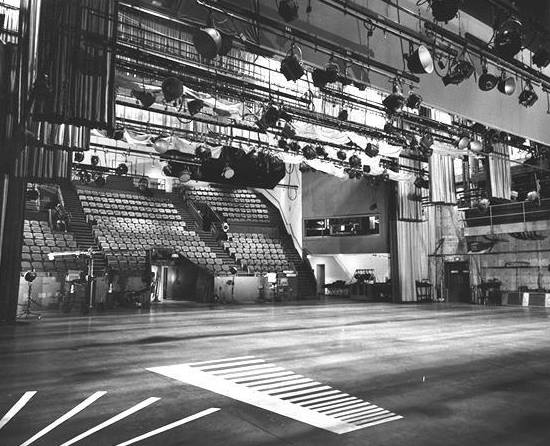
These two photos were taken from almost the same spot 18 years apart. This is Studio 6A in 1943 as a radio studio and in 1961 as a television studio.

Notice that even after the break of the lighter and darker parts of the stage floor, there is still a lot of room in the darker area which would have usually been behind the main set or a curtain. Barely visible on the back wall is a double door that opens into the back stage storage area. Enjoy and share!


Source

NBC Studio 6A, Circa 1943…New Photos Just In

NBC Studio 6A, Circa 1943…New Photos Just In

Thanks to Alec Cumming, here are three new unwatermarked photos of NBC Radio Studio 6A just after it was built. As I mentioned yesterday in the 6B stories, 6A is a mirror image of B, with the on stage control room, observation deck window and twin double doors on the left wall instead of the right.

6B was converted to television in 1948. It was 1950 when 6A converted, but as early as the fall of ’48, some of the first ‘Chesterfield Supper Club’ television shows were being simulcast from 6A with one of NBC’s in house “mobile units” which each unit made up of three RCA TK30s on tripods and some extra floor mounted scoop lights. There were four units with three cameras each…they were color coded and referred to as the red, blue, green and yellow units with equipment marked with corresponding colored paint. More on that soon. Enjoy and share!


Source

And Away We Go! Gleason Moving To Miami…

And Away We Go!

Jackie Gleason’s last show from his longtime home at CBS Studio 50 in New York, aired May 23, 1964. After the summer break, the show debuted from The Miami Beach Convention Center on September 26.

Here is a photo of Jackie and well-known gossip columnist Hedda Hopper on the train from New York to Miami. Gleason had done another famous train trip/tour from NY to LA, and like this one, it was a nonstop party all the way.

Source

Can You Guess Who This Violinist Is?

Can You Guess Who This Violinist Is?

Here are a few clues…

He is a descendant of Edward Rutledge, a signer of The Declaration of Independence. For many years, he was the conductor of Arthur Godfrey’s orchestra on his radio and television shows and conducted orchestras at several Presidential Inaugurations. He’s known Goldie Hawn all her life and even gave her, her name. Who is this man? It is Goldie Hawn’s DAD!

Source

Dean Martin & Greg Garrison…A Match Made In Showbiz Heaven


Dean Martin & Greg Garrison…A Match Made In Showbiz Heaven

Thanks to a comment and link shared here yesterday by our friend Andy Rose, we have a unique insight into how Greg Garrison produced and directed ‘The Dean Martin Show’, and later, ‘The Dean Martin Roasts’.
http://www.newsfromme.com/2005/04/01/greg-garrison-r-i-p/

The link above it so an article written by Mark Evanier in 2005. Mark is a writer and from time to time, he would wander into rehearsals at NBC Burbank in the ’60s. Along the way, he got a first hand view of how the show was done and the one-of-a-kind relationship that Dean Martin and Greg Garrison had. It is a fascinating story of trust and ability from both men.

As you will read, Dean’s level of “casualness” goes far beyond what we ever have ever heard before. It seems that the usual modus operandi was for Dean to come in the day of the taping, watch stand ins run through the show. After that, he would put on his tux and do what they did while reading from Q cards. There were guest complaints, but there was a trust that Martin had in Garrison and the writers that made it all work…for nine years.

By the way, this video is of the first ever episode that aired September 16, 1965. The guests that night were Frank Sinatra, Bob Newhart, Danny Thomas, Jack Jones and Steve Allen, plus Diahann Carol and Jodie Heatherton. Jan & Dean were also on the show and sang “Little Old Lady From Pasadena”. Enjoy the article and clip and share this!

https://www.youtube.com/watch?v=FgcCfMo1HcY

Dean Martin & Frank Sinatra Part.I Show Variety No copyright. Sin los derechos de autor.

Source

A Leisurely Stroll Down Memory Lane…WBOC, Circa 1964


A Leisurely Stroll Down Memory Lane…WBOC, Circa 1964

This video will start at the beginning of the television studios tour, but for engineering and radio fans, the tour starts at the transmitters and radio studios just before this.

WBOC is in Salisbury, Maryland and this twenty minute video has a very generous helping of RCA TK60 action from here on out. The visit to the control room is just after this segment and will bring back a lot of memories too! I hope you’ll share some of yours.

Thanks to our friend Bryan Durr at ‘Late Night with Seth Meyers’ for sharing this link with us. Enjoy and share!

Source

The First Color Picture I Ever Saw Of An RCA TK41…I Was Moved

The FIrst Color Picture I Ever Saw Of An RCA TK41

I was almost 13 when I first saw this photo and for a long time, I thought TK41s were light green. This was the front cover of an NBC magazine called ‘Star Time’ that introduced the 1963-64 fall lineup. If you sent them a postcard, they would send you one of these. Naturally, I sent two.

I can tell that this photo was taken at NBC Burbank by the shape of the viewfinder hood. They made their own custom versions in the shop there. The extra side vent is not unusual and some CBS TK41s had this too. This was and RCA aftermarket kit and came with vents for both doors. In the comment’s section is the full cover of the magazine. Did you have one of these magazines? NBC put these ‘Star Time’ magazines out for several years in the 60s and I think this was the first edition.

Source

You Mean Godzilla Was Just A Guy In A Rubber Suit?

Yes, but not just any guy! It was Haruo Nakajima who’s now 85 at the time of this writing in 2013. He was considered by most to be the best “suit actor” in Japanese monster movie history. He started in 1954 with ‘Godzilla’ and played the role, and many other monsters for 23 years. Nakajima retired from suit acting upon completion of ‘Godzilla vs. Gigan’ in 1972, Enjoy and share!


Source

‘ The Dean Martin Show’…September 16, 1965 – April 5, 1974

‘ The Dean Martin Show’…September 16, 1965 – April 5, 1974


If you watch this two minute clip, you’ll get the attitude of the show’s 9 year, 264 episode run, plus…a BIG surprise at the end!

An important key to Dean’s, and the show’s, popularity was the spontaneous, unrehearsed feel of each week’s production. Martin read his dialogue directly from cue cards and usually, if he flubbed a line or forgot a lyric, Martin would not do a retake and the mistake, and his recovery from it, went straight to tape and onto the air.

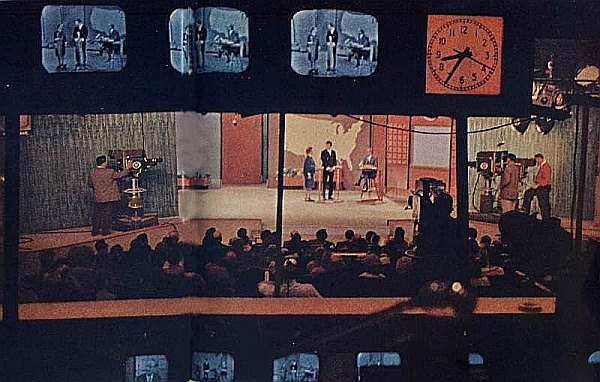
The show was done from NBC’s Burbank’s Studio 4 and was produced and directed by Greg Garrison. Among his Garrison’s first productions were ‘The Kate Smith Show’ and ‘Your Show of Shows’. He went on to produce and direct many television specials with Gene Kelly, Fred Astaire, Donald O’Connor and many others. He was probably best known for producing and directing this show and ‘The Dean Martin Celebrity Roasts’. He also directed one of television’s landmark 1960 presidential debates between John F. Kennedy and Richard Nixon.

During the summer months, Garrison kept Dean’s Thursday night time slot hot with some very good guest hosts. In 1966, Rowan and Martin hosted a few of Martin’s summer shows which were so well received that it put them on the trajectory as hosts of one of television’s most memorable series..’Rowan and Martin’s Laugh-In’.

As you see in the photos, the show started with RCA TK41s, but later graduated to TK44s around 1968. Enjoy and share!


Source

History With A Twist…Dick Clark Debuts A Landmark Song


History With A Twist…Dick Clark Debuts A Landmark Song

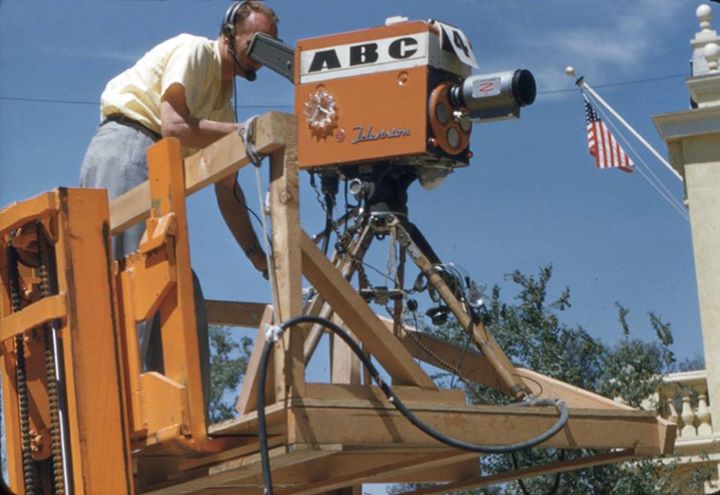
This video opens with Dick doing the intro in front of an RCA TK10 at ABC New York. This is August 6, 1960 and this is the first time ‘The Twist’ was performed on television, but this is not ‘American Bandstand’. It’s ‘Dick Clark’s Saturday Beechnut Show’.

‘American Bandstand’ was Clark’s hit weekday show, which aired after school from WFIL in Philadelphia, but on February 5, 1958 ABC gave Clark a 7:30 Saturday night slot on the network for the New York based Beechnut Show, which usually came from The Little Theater on West 44th Street in Manhattan, but for some reason, this night it was done from ABC’s studios on West 66th Street as you can tell by the bleacher seating.

‘The Twist’ was Dick Clark’s second venture with Chubby, and one of his first as a producer. The year before, Clark produced Checker on a novelty single called ‘The Class’ in which the singer portrayed a school teacher with an unruly classroom of musical performers. https://www.youtube.com/watch?v=T2zXff_8-6w

The song’s premise allowed Checker to imitate such acts as Fats Domino, The Coasters, Elvis Presley, Cozy Cole, and Ricky Nelson, Frankie Avalon, and Fabian Forte as The Chipmunks trio. Clark sent the song out as his Christmas greeting, and it received such good response that Cameo-Parkway signed Checker to a recording contract. That single became Checker’s first release, charting at #38 in the spring of 1959. Clark’s wife gave Ernest Evans his stage name by reworking Fats and Domino into Chubby and Checker.

Hank Ballard wrote The Twist and had recorded it in late 1958. The song became popular on a Baltimore television dance show hosted by local DJ Buddy Dean; Dean recommended the song to Clark. When the song proved popular with his audience, Clark attempted to book Ballard to perform on the show. Ballard was unavailable, and Clark decided to record the song with a local artist and who better than his friend Chubby Checker, whose voice was very similar to Ballard’s. Exposure for the song on ‘American Bandstand’ and on ‘The Dick Clark Saturday Night Show’ helped propel the song to the top of the American charts. Now you know the whole story. Enjoy the clip and share!

http://www.youtube.com/watch?v=xbK0C9AYMd8&feature=related

Chubby Checker – The Twist

Source

Now This Is Interesting….

Now This Is Interesting….

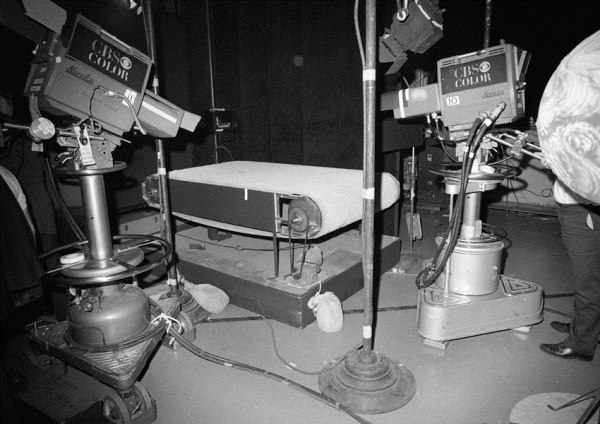
In all the photos I’ve seen of CBS Studio 50, I’ve never seen these “Stand By” and “Applause” signs on the proscenium as we see in the Western Union ad photo. Nor have I ever seen the audio control booth this close to the stage. There is a wide shot for comparison. Note Ray Bloch’s Orchestra is where this audio booth seems to be.

In the Lucy picture, you can see the booth where it was built in 1936 when CBS used this for a radio studio center. It looks to be at the end of the stage wing on the north wall, a good twenty or so feet from the proscenium. Anyone know when they moved the booth up? Enjoy and share!


Source

Apollo 11 Splashdown: Day 9

Here is the final article of the Apollo 11 series written for Eyes Of A Generation by Jodie Peeler on this historic event, complete with videos. Our thanks to Jodie for a job well done! Enjoy and share!
______________________________________________________

The conclusion of what was not only the most elaborate flight ever undertaken by humans, but the most complicated television programs ever aired, started around lunchtime EDT on July 24. The networks began their special coverage about an hour before the Apollo 11 command module would separate from its service module and re-enter Earth’s atmosphere.

Although the networks had their correspondents arrayed around the nation and world for reaction, in one area they had to pool their resources.

While competition was elsewhere, cooperation was the watchword aboard the aircraft carrier USS Hornet, on station about 900 miles southwest of Hawaii, a gallant World War II veteran awaiting the arrival of three men back from the Moon. This was no ordinary splashdown, either: not just the return of the first lunar landing mission, but President Richard Nixon was aboard, taking a quick detour during a diplomatic trip around the world, ready to deliver a personal welcome home to the three astronauts.

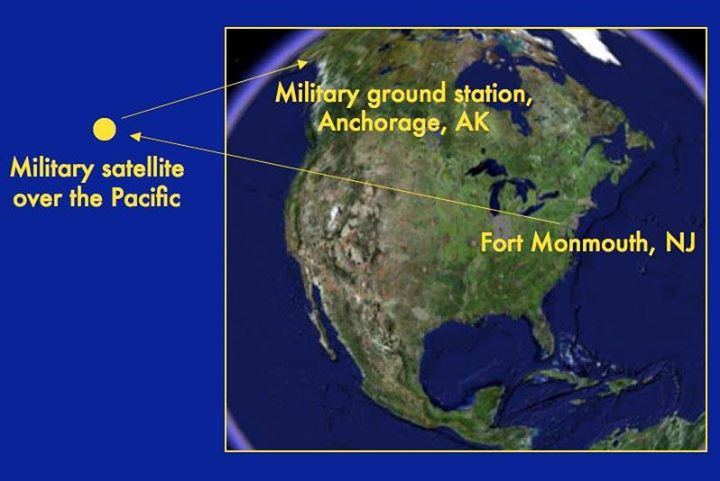
Deployed with Hornet were dozens of technicians, camera operators, engineers and journalists whose job it was to relay the events back home. Underneath a 22-foot inflatable radome on Hornet’s flight deck was a portable satellite earth station developed by General Electric and Western Union International, beaming live color television pictures from Hornet to Jamesburg, California via Intelsat III. For the Apollo 11 deployment, ABC was selected to provide cameras and remote units.

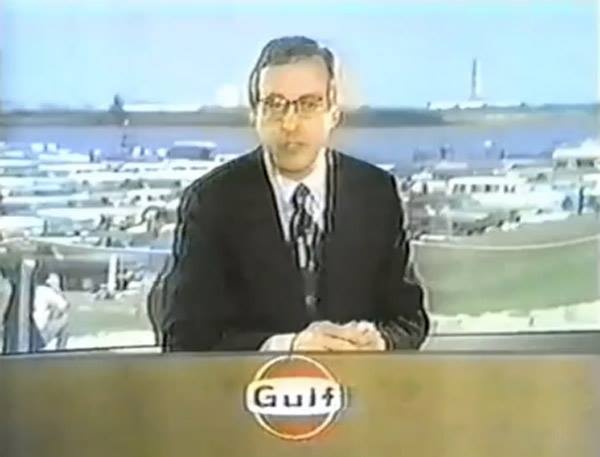
Although the television pool aboard recovery ships was typically a two-man team, for this deployment all three television networks had newsmen aboard: Dallas Townsend of CBS, Ron Nessen of NBC, and Keith McBee of ABC. Mutual correspondent Don Blair handled the radio pool.

Experience with live recovery transmissions from deep in the Pacific during the Apollo 8 and Apollo 10 missions had taught the networks, GE, Western Union and the Navy a great deal. While the live broadcasts from USS Yorktown during Apollo 8 had numerous glitches and dropouts, increased cooperation and troubleshooting meant the live telecasts from Hornet went beautifully. Although Apollo 11 splashed down too far away from the ship to be caught on television, correspondent Ron Nessen relayed the happy words “They’re back from the moon!” to the audience at home. A giddy Walter Cronkite exclaimed, “Hot dog! There they are and they’re all right! Hot dog! Apollo 11 has made it!”

A little while later Hornet was close enough to the scene for cameras to capture distant pictures of the astronauts being hoisted aboard the famous helicopter 66 for the short ride to the ship. The cameras aboard Hornet captured it all: the helicopter landing, being lowered to the hangar deck, and then being wheeled back alongside the Mobile Quarantine Facility. Briskly the astronauts, clad in suits meant to quarantine them, walked across Hornet’s hangar deck into the MQF. About an hour later, after each had an initial medical exam and enjoyed a quick shower, the astronauts were welcomed home by President Nixon during a brief ceremony.

With the astronauts safely aboard Hornet, it was over – not only the epic journey of Apollo 11, but also the epic television programs that brought the journey to the people. The closing paragraphs of the CBS book “10:56:20 P.M. EDT 7/20/1969” sum up the final moments of the greatest television epic ever broadcast:

“At 3:25 p.m. the final credits began to roll on the television screen – a visual record of the people who had contributed to making television history during the coverage of the Apollo 11 astronauts’ epic adventure. It took seven minutes to complete the honor roll – the longest roster in television history.

“At 3:32 p.m. EDT, [executive producer Robert] Wussler and [CBS News Vice President Gordon] Manning shook hands around the control room, with [Clarence (Red)] Cross, [Joel] Banow and [Richard] Knox, their producer, director and associate director, then with CBS President Frank Stanton and CBS News President Richard S. Salant, both of whom had been in the control room throughout the four hours of splashdown coverage.

“There was an air of celebration in the studio and editorial area. Then everyone started to drift away. The most memorable week of television in their lives had come to an end.”

As this series of essays ends, I’d like to add a personal note: the opportunity to relive these historic days, and examine them through the prism of television history, has been its own journey for me. It’s brought challenges, but it’s also been a lot of fun. I’m grateful to Bobby for letting me share these little essays with you each day, and grateful to all who have read them, liked them, and made their own contributions. To all of you, my thanks.

Now, here’s some links with video. A Western Union International commercial from prior to splashdown, showing the satellite system deployed aboard Hornet:
http://www.youtube.com/watch?v=YjJKSpF10GM

Re-entry and recovery as broadcast by ABC, with Tom Jarriel and Jules
Bergman:
http://www.youtube.com/watch?v=DNAcHNsZ57g


Source

At One Time, This Space Was Home To CBS Studios 41 and 42

This was the space formerly occupied by CBS Studios 41 and 42. I think this photo is from the early 80s and was probably taken when Donald Trump took over this space and re built two tennis courts here as the Vanderbilt Athletic Club. In 1966, a man from Hungary took over this space and installed a tennis court and an astroturf ski jump.

Source

CBS to Keep Colbert’s ‘The Late Show’ in New York

JUST IN! CBS/Colbert To Keep ‘Late Show’ At Sullivan Theater

First Story
http://variety.com/2014/biz/news/stephen-colbert-to-keep-late-show-in-new-york-1201267630/

Second Story
http://www.thewrap.com/colberts-late-show-staying-at-lettermans-ed-sullivan-theater/?utm_source=newsletter&utm_medium=email&utm_campaign=contactology

CBS to Keep Colbert’s ‘The Late Show’ in New York

CBS’ “Late Show” will remain in New York at the Ed Sullivan Theater with Stephen Colbert takes over hosting of the show next year, under an agreement announced on Wednesday by the network’s CEO Les…

Source

Follow Up…The CBS Mini Camera Strikes Again

Follow Up…The CBS Mini Camera Strikes Again

Here’s Walter Cronkite in a great 1957 publicity photo related to the upcoming inauguration of President Eisenhower. CBS would be deploying several of it’s new Intercontinental Electronics mini cameras at the event. As we saw yesterday, CBS first used these cameras for floor interviews at the 1956 political conventions.

After some digging, I’ve come to the conclusion that this camera was built in the US by Intercontinental using a 1954 design from France’s CSF Electronics, which was created in the late 1890s as the French subsidiary of General Electric. What we know today as the Thomson brand of electronics sprang from CSF. Enjoy and share!

Source

Classic! ‘Sammy Davis Jr. Show’ With TK41s From NBC Brooklyn


Classic! ‘Sammy Davis Jr. Show’ With TK41s

From NBC Brooklyn, here’s a clip from April 26, 1966, that opens with Sammy in front of a crane mounted RCA TK41. Behind the camera is NBC veteran Frank Gaeta.

https://www.youtube.com/watch?v=DXjKNl0C-AU


Source

Merv Griffin Gets A Ride On A Marconi Mark IV


Merv Griffin Gets A Ride On A Marconi Mark IV

This fun clip is from November 8, 1965. This was the first year of Merv’s Group W, syndicated daytime show and was done at The Little Theater at 240 West 44th Street in New York. This is now known as The Helen Hayes Theater.

In ’69, CBS picked up the show and moved it to late night to compete against Johnny Carson. The first season was done from The Cort Theater at 138 West 48th Street.

In the fall of 1970, Griffin relocated his show to Television City in Los Angeles, but without sidekick Arthur Treacher, who told him “at my age, I don’t want to move, especially to someplace that shakes”. From that point on, Griffin would do the announcing himself, and walk on stage with the phrase: “And now…, here I come!”

By early 1972, sensing that his time at CBS was ending, and tired of the restrictions imposed by the network, Griffin secretly signed a contract with rival company Metromedia. The contract with Metromedia would give him a syndication deal as soon as CBS canceled Griffin’s show. Within a few months, Griffin was fired by CBS. His new show began the following Monday and proved to be more successful than its network counterpart, running until 1986. Enjoy and share!

https://www.youtube.com/watch?v=iDs8JxxAnlU

Jazz guitar icon Jim Hall sits in with Mort Lindsey and the band but Merv insists on putting him through his paces in a mock audition from 1965. Merv shows o…

Source

July 23, 1962…First World Wide Television Broadcast Via Telstar


July 23, 1962…First World Wide Television Broadcast Via Telstar

On Monday afternoon on this date, 52 years ago, CBS News anchorman Walter Cronkite entered NBC’s studios at 30 Rockefeller Plaza to co-host this historic broadcast with NBC’s Chet Huntley. ABC’s Howard K. Smith was at the UN Building. The twenty minute broadcast from the US to Europe was slated to start at 3 PM eastern, but the Telstar signal was acquired a few minutes early so they started then.

Aside from the historic transmission event, the sight of Cronkite and Hunley working together is nothing less than extraordinary and you will love the sign off at 40:23 which made everyone laugh!

Just after that, NBC Newsman Merrell Muller takes over and implies that only NBC carried the US to Europe program live here in the US. A few hours later, all three networks did carry the Europe to US portion live with the hosts at NBC, but after seeing how well this went, I’ll bet CBS and ABC were sorry they opted out of this segment.

This is the only version of the entire US portion of the broadcast I can find and is queued to the start of the network coverage. As you will see, there are shots fed into NBC from all across the country including Cubs baseball from Chicago, President Kennedy in Washington, the Golden Gate Bridge in San Francisco, Mt. Rushmore, the Statue Of Liberty, buffalos on the planes, The Mormon Tabernacle Choir from Utah and much more.

In Europe and Canada, 100 million viewers tuned in and it seems that the baseball game was their favorite part. A few hours later, the tables would turn and Europe would broadcast live to the US with Howard K. Smith joining Cronkite and Huntley at NBC and all three networks would air this live, simultaneously.

Source

45 Years Ago Today…Apollo 11 On The Way Home: Day 8

45 Years Ago Today…Apollo 11 On The Way Home: Day 8

Here is the eighth of nine daily articles written for Eyes Of A Generation by Jodie Peeler on this historic event, complete with videos. Enjoy and share!
______________________________________________________

Apollo 11’s Television Cameras:

As discussed in yesterday’s post, television cameras were carried by the Apollo spacecraft starting with the first manned mission in October 1968. Here’s the story of the television cameras that made it possible for viewers at home to watch what was going on in space.

Apollo 7 and Apollo 8 carried a small black-and-white slow-scan camera developed by RCA. Designed to operate within the limited bandwidth available for television downlink at the time, the RCA camera had a 320-line progressive scan format at 10 frames per second, and had a one-inch vidicon tube. As described yesterday, the television pictures sent back by the spacecraft were converted on Earth before being sent to NASA and then to the networks. Although more advanced capabilities were available by October 1968, NASA flew the RCA camera because it was already flight-qualified.

On Apollo 9, the first manned flight of the lunar module took place in Earth orbit. The LM would require its own camera, and a Westinghouse team led by Stan Lebar developed a slow-scan black-and-white video camera for the LM. It used a very sensitive secondary electron conduction tube unlike any other tube readily available, meant to provide detail from what was likely to be a dark and shadowy lunar surface. Although on landing missions it would ride in a compartment on the LM’s descent stage, it was carried in the cabin on Apollo 9 so the astronauts could test it out.

For television historians, the most intriguing camera made its debut on Apollo 10, the first flight to send color television from space.
Westinghouse realized that a mechanical color system similar to that championed by CBS during the “color war” of the late ’40s, was not much more complicated than black-and-white and could be kept far more compact than a full-blown color system. The problem of conversion to NTSC was taken care of with conversion equipment installed in Houston. So, in a way, CBS had the last laugh as field-sequential color pictures sent back the first color television pictures of Earth in May 1969.

One problem with earlier Apollo television transmissions was that the astronauts had no viewfinder or monitor, so Westinghouse developed a small black-and-white monitor that could be secured atop the camera to let them see what they were shooting.

The two camera systems developed by Westinghouse – the color unit in the Command Module, and the black-and-white unit attached to the LM – flew with Apollo 11 two months later. Color television came from inside the spacecraft at several points during the mission. When Neil Armstrong emerged from Eagle on July 20 to begin his climb down to the Moon, a compartment on Eagle’s descent stage opened, allowing the black-and-white lunar camera to capture his first steps. Once he was on the Moon, he removed the camera from its platform and placed it on a tripod a few yards from the LM. It captured all of Armstrong and Aldrin’s historic Moon walk, and still stands where they left it in July 1969.

Later cameras improved on these innovations – the color camera was adapted for lunar use by the Apollo 12 flight in November 1969, and in time for Apollo 15 RCA designed a sophisticated color camera mounted on the Lunar Rover that could be controlled from Houston, a system that sent back some of the most vivid moving pictures of the entire Apollo program. However, it’s those two Westinghouse cameras from Apollo 11 that captured the eight days when mankind made its most dramatic step into the future.

For more information on the Apollo cameras, try these links.

Bill Wood’s epic “Apollo Television” essay features information about all the cameras of Apollo:
http://www.hq.nasa.gov/alsj/ApolloTV-Acrobat5.pdf

Tomorrow: Our look at Apollo 11 ends as Armstrong, Aldrin and Collins take a fiery ride home, and television brings the story’s conclusion to a watching world.


Source

Ultra Rare And HILARIOUS! This Is A LOL RIOT!


Ultra Rare And HILARIOUS! This Is A LOL RIOT!

Thanks to our friend David Crosthwait at DC Video in Los Angeles, here is a clip from a recently discovered reel of tape in Nevada. Jerry Lewis is guest hosting for Johnny Carson and…well…you’ll just have to watch this to see one of the funniest, impromptu bit’s I’ve ever seen. Enjoy and SHARE!

https://www.youtube.com/watch?v=MQYzkgsb2h0

This clip is courtesy of Carson-Entertainment-Group and Jerry Lewis Films. The Tonight Show Starring Johnny Carson: The Lost Clips. Guest host Jerry Lewis. T…

Source