- Home
- TV History
- Network Studios History
- Cameras
- Archives
- Viewseum
- About
CBS Studio 53…Inside Liederkrantz Hall, 1960
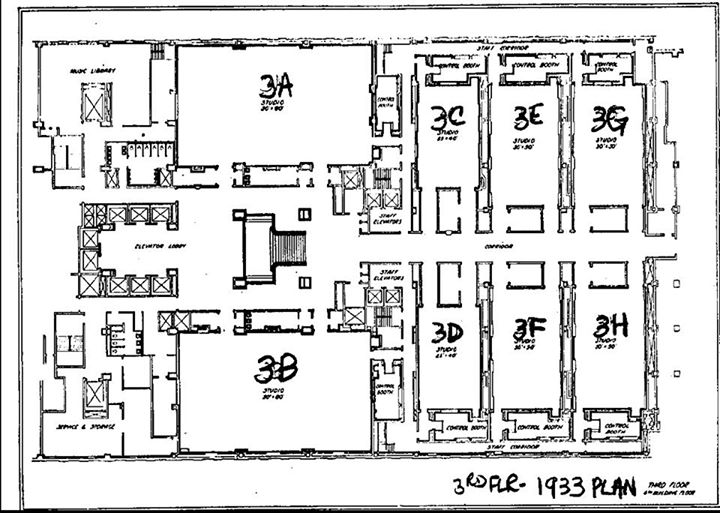
This was the smallest of the 4 studios which were numbered 53-56 with 1500 square feet of production space. Studios 53 and 54 were on the second floor and the only way to get props upstairs was via the building’s main “grand entrance” type stairway and big pieces either had to be assembled on the set or not used. More on the amazing history of Liederkarntz Hall in the next post.
Map of CBS New York Studios And Properties: 1960
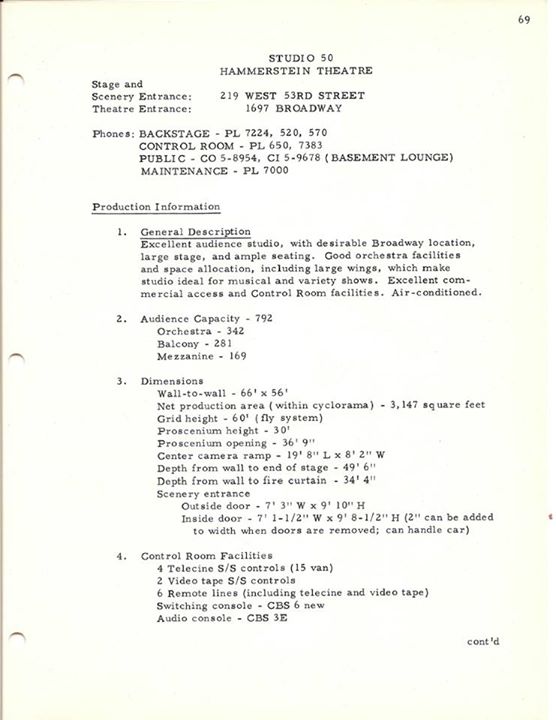
This rare map will give you an idea of how much real estate CBS owned and leased in the city in 1960. Thanks to someone with a red pencil, we see the studio locations circled. Notice that the Broadcast Center on W 57 Street is referred to as the Production Center, which was the buildings original designation as a CBS property. In the lower left quadrant you see the Grand Central studios location and just under it, the Graybar Building which housed CBS News offices, but no studios. Somewhat like ABC’s studio designations, the map maker used shorthand and calls Ed Sullivan’s Studio 50, TV 50 and so on for all the other studio locations. Tomorrow, we’ll see another rare map that shows the studios before and after consolidation into the Broadcast Center in 1964. Thanks to our friend Gady Reinhold for this very interesting piece of television history.
Eyes Of A Generation Camera Collection, 2009 News Story
Fortunately, I’ve lost 30+ pounds since this new story from February of 2009. It was shot and aired on Atlanta’s NBC affiliate WXIA, but was seen on 59 other NBC affiliates as well. Last week, a professional still photographer came up and spent 5 hours shooting the camera and me, and the dogs. Wait till you see these! The camera portraits put the RCA catalog covers to shame! I hope to get some of them up early this week as he is still in “post production editing”. Enjoy and share!
More Of The NBC Studio 6E “News Nooks”
Earlier in the week, we saw Lester Holt’s main ‘Nightly News, Weekend Edition’ location in 6E’s Media Room 1. Today, we’ll look inside the back up studio for that program…6E’s Media Room 2. This is a secondary production space used for interviews, and a times for live reporting. Thanks to Dennis Degan for taking these new pix earlier this week. We’ll see the other two rooms soon.
The Start Of Something BIG! Instant Replay…
In 1960, CBS paid $50,000 for the rights to cover the Winter Olympics in Squaw Valley, but paid $550,000 for the Summer Olympics rights that year which came, via couriered video tape, from Rome. Winter Olympic rights would never again be such a bargain, and sports nor television would ever be the same as this is the first time a video tape playback was used to determine the winner of an event.
During the Games, CBS broadcast 15 and a quarter hours of television focusing on ice hockey, speed skating, figure skating, alpine skiing and ski jumping. During the Games; in the men’s slalom event, officials who were unsure if a skier had missed a gate asked CBS if they could review tape of the event. This request gave CBS the idea for what is now known as instant replay.
While the first near-instant replay system was developed and used in Canada, the first instant replay was developed and deployed in the United States by ABC. During a 1955 ‘Hockey Night in Canada’ broadcast on CBC Television, producer George Retzlaff used a “wet-film”, or ‘hot kine” (kinescope) replay, which aired several minutes later. Slow motion replay was brought across the border to America a few years later by ABC.
CBS Sports Director Tony Verna invented a system to enable a videotape machine to instantly replay on December 7, 1963, for the network’s coverage of the Army–Navy Game. The instant replay machine was a modified quad video tape recorder which weighed 1300 pounds. After a few technical glitches, the only replay broadcast was Rollie Stichweh’s touchdown. It was replayed at the original speed, with commentator Lindsey Nelson advising viewers “Ladies and gentlemen, Army did not score again!” The problem with older technology was the difficulty of finding the desired starting point; Verna’s system used audio tones activated as an interesting event unfolded, which technicians could hear during the rewinding process.
Replay in slow motion from analog disk storage was tried out by CBS in 1965, and commercialized in 1967 by the Ampex HS-100, which had a 30-second capacity and freeze frame capability. Unfortunately one of the few remaining HS-100s was trashed last year as NBC continued the clean out at Burbank. Thank to Kevin Vahey for the great photo of and RCA TK11/31 in action on the ski jump.
‘The Actors Studio’, ABC’s First “Prestige” Drama Showcase
At 8:30 Sunday night, September 28, 1948, this half hour anthology series kicked off with ‘Portrait Of Madonna’, starring Jessica Tandy and Dick York. In the center photo, we see director David Pressman on the left, holding a mic as he talks to the studio during rehearsal. In January of 49, Marlon Brando would make his television debut on this show. The show was produced live each week by the The Actors Studio Inc. which was a nonprofit organization for actors and actresses in New York, and won a Peabody Award for it’s “uninhibited and brilliant pioneering in the field of televised drama”.
Exclusive Photos From NBC Studio 8H: Apollo 8 News Headquarters
The First Moon Mission: Part 4
Tomorrow, we’ll see the last three photos from this set, but today we’ll start in the 8H control room on the left. This Polaroid was taken a few days after the mission ended. The control room was on the 9th floor and in those days could be accessed from the studio by a staircase we’ll see soon in 8H game show pix. Back then, there was a lot of use made of the stairs as there was a large bathroom next to the control room. In the center, we see proof that NBC News men did actually walk on water…as Frank McGee strolls over the “ocean”. The cameraman to his left is the great Ben Franklin who was a true color veteran. Bill Goetz is on the Chapman Electra and just under him is floor manager Ed Pendergast adjusting his glasses. On the right, we see Frank Mcgee reporting on the splashdown operations while Don Mulvaney shoots the location of the recovery area with this 60 pound Norelco PCP 70 rig. I think the camera weighed 25 pounds and the rest of the weight is in the backpack and support arm. As always, thanks to NBC’s Bob Batche for being there with his 35mm.
The Story Of Telstar…The First Communications Satellite
Since we are knee deep in space launches and television’s coverage of them, I thought you would enjoy seeing this 1962 film on how the Bell System, in cooperation with NASA, developed the Telstar satellite, and participated in the launch and the subsequent successful transmission of signals to and from the earth and space.
Exclusive Photos From NBC Studio 8H: Apollo 8 News Headquarters
The First Moon Mission: Part 3
Above is NBC reporter Peter Hackes in front of the Apollo 8 capsule mock up, which is incredibly detailed inside and we’ll see that tomorrow. In the first photo below, the man at the podium is stage manager Bob Van Ry, one of the original SNL stage managers and classmate of SNL director Dave Wilson. Like some of SNL’s larger set pieces, this huge command module had to be brought up the freight elevator in pieces and assembled on stage. On the right, we see Frank McGee at this anchor position with Bill Goetz on the crane. The grey-haired man under the camera in the brown jacket is stage manager Ed Pendergast and the balding man in the brown suit is Ed Voss, a top-notch audio guy. Thanks to two 35-year NBC vets for their help on this…Bob Batche for the great photos and his friend Joel Spector for putting names with the faces.
Interesting PCP 70 Docking Platform
Above, from Bob Batsche’s Apollo 8 photos is Don Mulvaney with the Norelco PCP 70 portable camera. Below, from Tom McKeever’s Apollo 9 pix is NBC engineering’s ingenious, “homemade” docking platform for the PCP 70 mounted on a pedestal. I don’t think the dock was made to operate from, but it’s a convenient place for Don to park his rig and give his knees a rest.
Apollo 8 Pool Coverage
If you studied yesterday’s NBC operations coordination plan from Gemini 5, you saw the back bone of a structure that had been in use from the Mercury days on, and would be used through the Apollo missions. There would be changes and different assignments occasionally, but a routine familiar to all the players was a good thing. For coverage from NASA’s Manned Space Flight Center in Houston, NBC relied on KPRC’s GE PE 350s for their news reporting and pool feeds. Below is KPRC’s Steve Corbit on the scene in December 1968. Thanks to Art Hackett and Fred Schultz for the photo.
YOU WILL NOT BELIEVE THIS, But It’s TRUE!
Amazingly, I have just received an entirely new set of 30 photos from the NBC 8H Apollo 8 set, TAKEN AT THE SAME TIME as Bob Batsche was taking his! Tom McKeever’s photo of the elapsed time clock is on the bottom…Bob Batsche’s photo is on the top! I’m buying a Lotto ticket today! Tomorrow, I’ll post the more of Bob’s photos, and start with Tom’s, Unbelievable! What a great crew we have here! Thanks to ALL! Bobby Ellerbee
Exclusive Photos From NBC Studio 8H: Apollo 8 News Headquarters
The First Moon Mission: Part 2
As mentioned in the post just before this, the TK41 solo photo post, there was another anchor position which can be seen in the photo on the left. The darker space is a “green room” for guests, and in the lighted space, we can see what looks like Chet Huntley at the anchor desk. I think Huntley and Brinkley used this 9th floor space most, as John Chancellor and Frank McGee were usually posted at the anchor desk on the studio floor, but John and Frank would alternate up here too. I don’t think this was a permanent broadcast space, but with as many big missions as there were, it may have been kept available for several years. The middle photo shows the orbit map and elapsed time clock showing us that this whole set of 12 photos must have been taken at splash down on December 27, 1968. On the right is the studio’s “ocean floor” which shows the position of the recovery teams for several of the possible splash down points. Thanks to NBC’s Bob Batsche for being there and getting these great pictures.
Gemini 5, NBC Operations Coordination Plan: August 1965
This is a fascinating look at what it took to make it all happen. At NBC, 8H was ground zero and all of the NASA and pool feeds came in here via AT&T. Take a look at all of the locations ABC and CBS are pooling from. Of course NBC is feeding the pool too from lots of locations. Remember, this was all pre-satellite days and Ma Bell had to be in the loop weeks ahead of all this. Many thanks to our friend Gady Reinhold for this. Tomorrow, I’ll show you the map of CBS New York studios Gady just sent along with more CBS floor plans and spec sheets from 1960. Enjoy and share!
Flying Solo…NBC 8H Coverage Of Apollo 8
This shot was so cool, I just had to post it separately! This beautiful picture of an RCA TK41B shows cameraman Bill Goetz on the Chapman Electra crane in late December of 1968 in 8H. Behind the camera, you can see glassed in rooms. We’ll see these again in other shots, but for those of us old enough to remember, Chet Huntley and David Brinkley would team up in New York for space coverage and the brighter space on the right would be transformed into a birds eye anchor position for them…almost like sky booths at the political conventions. The darker room on the left was kind of a “green room” for guests and clients. I’m not sure, but I think that space may now be Lorne Michaels office. Thanks to former NBC cameraman and engineer Bob Batsche for being there with his 35mm camera.
That’s One Small Step For Man…
Leading up to the July 16, 1969 launch of Apollo 11, and continuing through their July 24th return, the eyes of the entire world were fixed on the three men seen here in a live interview with an unknown network. From left to right is Buzz Aldrin, Neil Armstrong and Michael Collins…the crew of Apollo 11. Armstrong was the first man to ever set foot on the moon, followed by Aldrin with Collins in the orbiting command module. These two GE PE 250s could be in the NASA building in Houston, but I think they are at NASA in Florida. NBC’s Houston affiliate had 250s, but so did some of the locally used auxiliary mobile units in Florida. Many thanks to our friend Martin Perry in Dallas for the photo.
NBC Studio 6E, The “News Nooks” & Weekend Nightly News Studio
On the left is the entrance to NBC Studio 6E which has 4 small studios and control rooms. Others 6E studio photos will follow, but today we are looking at Media Room 1, which is where Lester Holt does the ‘NBC Nightly News, Weekend Edition’. The desk should look familiar as it from the main 3C ‘Nightly News’ set and was first used by Tom Brokaw, and later Brian Williams. It was used there from 1998 till 2008, when The Global Media Center in 6E came into being. As always, our thanks to our friend Dennis Degan for the new photos he took this week for this series on 6E.
Conan & Jimmy Parsons Take A Trip To The ‘Big Bang’ Set
Somewhat like yesterdays Letterman video that gave us a good look at 6A, here’s a fun and interesting look at Conan O’Brien’s Warner studio, just a couple of doors up from ‘Big Bang’, which we’ll also see. Here’s the golf cart trip and a live look inside both studios.
https://www.youtube.com/watch?v=wRn69ytYRoc
Jim treats a CONAN audience member to a very special souvenir from “The Big Bang Theory.” More CONAN @ http://teamcoco.com/video Team Coco is the official Yo…
Exclusive Photos From NBC Studio 8H: Apollo 8 News Headquarters
The First Moon Mission: Part 1
Apollo 8, the second manned mission in the Apollo space program, was the first manned spacecraft to leave Earth orbit, reach the Moon and orbit it. This mission gave us the instantly famous “earth rise” photo. The three man crew was Commander Frank Borman, Command Module Pilot James Lovell, and Lunar Module Pilot William Anders. Their closely followed mission took place at Christmas time, launching on December 21, 1968 and returning on the 27th.
While on Christmas holiday, NBC cameraman Bob Batsche stopped in to wish some friends happy holidays and thankfully took his camera with him. These are the first three of a dozen that I will post here. More details are on the photos, so please click there and share these amazing, never before seen images.
The History Of Live Pool Splashdown Coverage…Part 1A
Our friend Jodie Peeler has written a great three part story on this subject with lots of detail, linked video and photos that I am proud to present here. Unlike today, bringing live television pictures from a ship at sea was a whole new ballgame and in this series, we’ll learn how it was done. More details on the photos, so click on all four included this this post. Thank You Jodie! Bobby Ellerbee
As NASA committed to its manned spaceflights taking place in the open before the eyes of the world, there came the problem of how to cover each mission’s end. The earliest flights took place before commercial TV satellites were a reality, and the best the networks could do was station a reporter aboard the recovery ship to provide voice reports; later, film or videotape of the splashdown and recovery would be shown by the networks.
This changed in late 1965 when the networks, with the help of COMSAT and ITT, finally had the capability to beam live television from the recovery ship via Early Bird. The system was ready to go for the planned October 1965 flight of Gemini 6, and a large satellite dish was temporarily mounted on the flight deck of the prime recovery ship, the aircraft carrier USS Wasp. Gemini 6 was postponed, however, when its rendezvous target vehicle was lost after launch. Instead, NASA decided to launch Gemini 7 in December 1965 and send Gemini 6A to meet up with it, the first rendezvous by two manned American spacecraft and an important step on the way to the Moon. With USS Wasp still selected as prime recovery ship, the seagoing earth station got a spectacular debut: Gemini 6’s return on December 16, and Gemini 7’s two days later. Both splashdowns were carried live by the networks, with pool coverage from Dallas Townsend and Bernard Eismann.
Here’s the first moment when CBS carried live pictures from the recovery ship, during the Dec. 12, 1965 launch attempt of Gemini 6A:
http://youtu.be/E9QVgFCe4b4?t=4m13s
Here’s where the CBS splashdown coverage of Gemini 6A begins:
http://www.youtube.com/watch?v=6L3idPfHsVc
And the moment when Gemini 6A astronauts Schirra and Stafford emerged from the spacecraft aboard USS Wasp:
http://youtu.be/ZGpAHvrap5M?t=5m01s
Although there were technical problems still to be resolved, and although the picture was lost at a few points, the first live “splashcast” demonstrated it could be done. The lessons learned will form the basis of the second part, as the historic Apollo missions to the Moon approached.