- Home
- TV History
- Network Studios History
- Cameras
- Archives
- Viewseum
- About
Followup Photo, Kukla, Fran And Ollie
This is an amazingly rare 1947 photo of ‘Junior Jamboree’ at WBKB in Chicago, starring “The Kuklapolitans with Fran Allison”. This was the first embodiment of the show on television, and this aired locally Monday thru Friday, from 6 to 7 pm Central Time. In case you missed it, see today’s story on the network debut of the show on this day in 1949. Enjoy and share! -Bobby Ellerbee
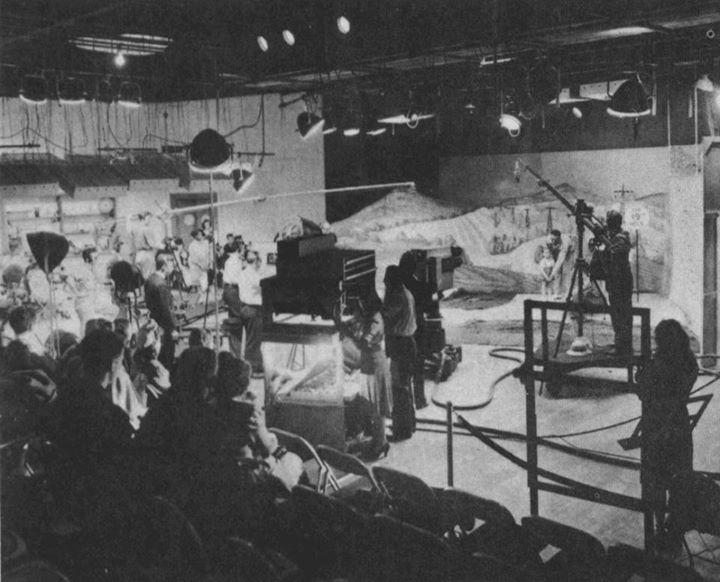
Followup Photo, Kukla, Fran And Ollie
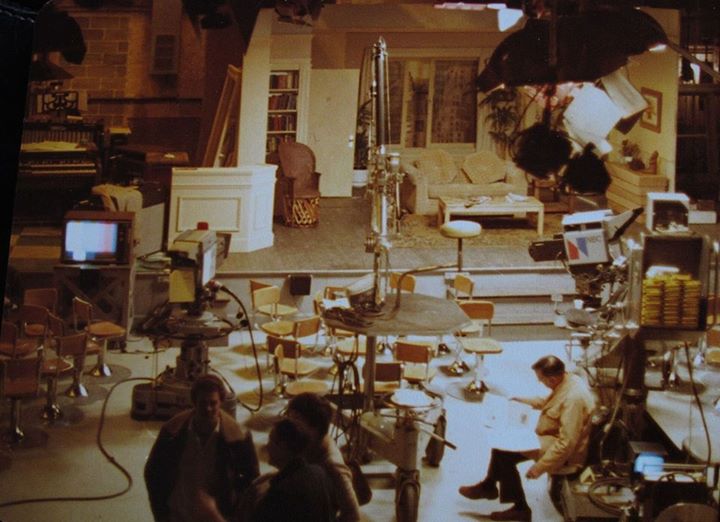
This is the KFO studio at WNBQ in 1951, three years after their network debut on this day in 1949. From left to right: Beulah Zachary, producer (seated); Harry Glyer, boom operator; Jack Fascinato, composer (at piano); John Kinsey, stage manager; Bruce Berquist, cameraman; Kukla and Burr Tillstrom; Jim Edwards, cameraman; John Casagrande and Jimmy Lynch (stagehands). Enjoy and share! -Bobby Ellerbee
Here’s A BIG SURPRISE! The First Time I Have Ever Heard of This!
When Bud Yorkin presented ‘An Evening with Fred Astaire’ October 17, 1958, he used the entire NBC Burbank facility…. all four-color studios and control rooms and all 16 TK41 cameras were used to feed the show live to the east coast and, to the video tape room there where a master and backup were recorded in color for playback to the west coast. The clip starts at the point Mr. Yorkin gives us this amazing detail.
A week or so ago, I posted a story on ‘An Evening with Fred Astaire’ which is the oldest surviving color videotape of an entertainment show. I had said it was done live to tape…broadcast live to the east and was the first big special ever recorded on color tape for playback on the west coast. Some argued that it was edited, but it wasn’t and here is the proof.
Granted, this was a big deal, but I have never heard of a production taking up a whole network facility for a show before. After the live portion, the cast went to The Beverly Hills Hotel to watch the color playback for the west coast. As Astaire arrived, he received a phone call from President Eisenhower, and one from Ed Sullivan. Astaire could not believe Sullivan had called with congratulations. The President, yes, but Sullivan’s call amazed him. Thanks to John Butler for the Yorkin clip. Enjoy and share! -Bobby Ellerbee
https://vimeo.com/261611927
By the way, at the link above is the full restored color video tape of the show with thanks to Kris Trexler.
January 12, 1949…’Kukla Fran And Ollie’ Debuts On NBC Network
Before we get to the history, a comment on this rare kinescope.
KFO actually started on Chicago’s WBKB around 1948 but moved to NBC owned WNBQ later in 48 and was a huge Chicagoland hit. The NBC network heard about it and decided to air it afternoons nationwide and the first network broadcast, live from Chicago, was on this day in 1949.
What we see here is a month before they made their network debut, so this is just for Chicago.
FYI, when the show was at WBKB, they were the ones that began shooting it with the Zoomar Field Lens…it looked so good, NBC continued with it. -Bobby Ellerbee
January 12, 1966…’Batman’ Debuts On ABC
There are a several rare video pieces here for you to see including this embedded clip (no audio) of a location shoot of a scene from the first episode with Frank Gorshin and Bert Ward.
In this clip, we see the competing casting of the two teams of Batman and Robin…Lyle Wagoner and Peter Deyell vs Adam West & Burt Ward. http://www.youtube.com/watch?v=c-BHYo4U0M4
In these two clips, Producer William Dozier talks about the cast in the top link and reveals the mystery behind the voice of the series narrator in the bottom link.
http://www.youtube.com/watch?v=bAnOWQqLi8I
http://www.youtube.com/watch?v=z-RQkk7ajV8&spfreload=1
By the way, this was one of the only primetime shows ever to air twice a week. The first show to do that was ‘Shindig’ and it’s interesting to note that ABC filled the two empty half hours with ‘Batman’. It aired in the same day and time slots as ‘Shindig’ who’s last episode ran a week before the caped crusaders took over. Enjoy and share! -Bobby Ellerbee
http://www.youtube.com/watch?v=mYEvhPCyocs
Rare footage of the 1966 TV series Batman showing the set up and filming of one of the scenes of the first episode. Frank Gorshin as the Riddler and Burt War…
January 12, 1967…’Dragnet 1967′ Debuts On NBC
After an eight year break, ‘Dragnet’ returned to television with this episode. In updating the story lines, Webb was particularly aware of the wave of teenage drug use, and a fair number of episodes have a “narko” theme. To differentiate it from the earlier Dragnet series, the year in which each season aired was made part of the on-screen title, so the series started as ‘Dragnet 1967’ and ended as ‘Dragnet 1970′. The entire series aired Thursdays at 9:30-10:00 pm and was directed by Jack Webb.
Here’s some interesting trivia about the show…
The pair of hands seen hammering the Mark VII logo at the end of every episode belong to Jack Webb.
For the sake of continuity, Friday and Gannon always wore the same outfits in every episode. According to Harry Morgan, he and Jack Webb decided to switch coats for one scene to see if anyone noticed. Because only Morgan was in the scene, no one on the set realized it until the scene had been shot. In the next scene, Morgan has on the correct coat. This is the only incident of faulty continuity in the series’ run.
When the revival was in the planning stages, Jack Webb had originally planned on bringing in his former co-star Ben Alexander to reprise his role as Officer Frank Smith. However, Alexander was appearing on the ABC series ‘Felony Squad’ and that network would not let him out of his contract to appear on the revival. Webb then chose Harry Morgan to play the new character of Officer Bill Gannon.
Enjoy and share! Over and out…Bobby Ellerbee
In Case You Missed This…The Restoration Of ‘The Wizard Of Oz’
This is a follow up on the Oz picture posted yesterday and a reminder that here at EOAG…the comments are the MOST AMAZING you will find anywhere! If you are not paying attention to them, you are missing A LOT! Many comments are from industry pros that were or are involved with these shows and events, and others come from people with a deep knowledge and interest on our subject matter. THANKS to ALL that share these rare insights, anecdotes and experiences with us, and to Glenn Mack for this great clip. Enjoy, share and read the comments! -Bobby Ellerbee
http://www.youtube.com/watch?v=x-6MYP0RxTI&feature=youtu.be
This featurette discusses the video and audio digital restoration of Victor Fleming’s 1939 classic “The Wizard of Oz”. Source: “The Wizard of Oz” disc one of…
On Several Levels…One Of The MOST INTERESTING Videos I’ve Seen
You are in for some big surprises! More than I can account for here in the text, so I urge you to just see for yourself. This is a whole episode of ‘Steve Allen’s Music Room’ that ran in syndication from ’84 till ’86.
I’ve started it at the place were Steve asks Doc about his early days in music. You will never guess who interrupts them and why, but you’ll be surprised to see who Steve’s sidekick/announcer (Bill Maher) was AND, by the awesome clip he introduces from ‘Tonight’. PLUS, just after that, Doc plays something most of us have never heard before…the original ‘Tonight’ show sign off song. Doc was in the band then and was featured on it every night during Allen’s stint as host. By the way, Steve wrote the song.
Later, Patty Page and Ann Jillian are guests. It good from start to finish, but the featured part I’ve written about here is just amazing on many levels. ENJOY AND SHARE! -Bobby Ellerbee
December 15, 1965…WSB Atlanta Goes Color With First RCA TK42
http://insidebobforemansbrainpart2.blogspot.com/2013/10/ruth-kent-colorvised.html
At the link above is a story I just got from our friend Bob Foreman. The article he sent is from the Saturday paper, just after the Thursday surprise Atlanta viewers got when ‘Today In Georgia’ debuted in color, making WSB the first station in Georgia with live local color. They were also the first station here able to broadcast color and I think that ability goes back to around 1956. WSB was one of the original NBC affiliates on both the radio and television networks.
I’ve had this photo for a long time of that first “colorvised” show, but never had a firm date or back up to the fact that WSB got the very first TK42. The story was, that RCA wanted to field test the new camera on ‘The Popeye Club’. It was the country’s top local kids show and RCA thought the colorful clothing of the 30 or so “clubhouse gang” members for each show would be a good color test.
An RCA engineer came to Atlanta with the camera to set it up and tweak it, and was still doing that when the second one arrived in mid January. I think he stayed in Atlanta for about three months doing tests.
Georgia legend Ruth Kent who hosted ‘Today In Georgia’ is seen here on that first day with some of the WSB management and engineering people. Notice the cameraman is not using pan handles, but the built in D handles (zoom and focus) on the back of the camera. That’s what they were designed for, but the ergonomic idea by our friend Harry Wright, at RCA, turned at to be a not so good idea after all. Enjoy and share! -Bobby Ellerbee
Congratulations To NBC’s Rick Fox…Retired Friday After 31 Years
Several people have asked about the unusually long hold on the opening shot of Friday’s ‘Nightly News’ broadcast and the single technical credit to a cameraman at the end of the show (below in Comments).
The cameraman in this screen capture is Rick Fox who’s been with NBC since 1984. Although he has worked a lot of other shows, I think he had been on the ‘Nightly News’ crew since the Brokaw days. Well done Mr. Fox! Enjoy and share. -Bobby Ellerbee
January 11, 1958…’Sea Hunt’ Debuts On 100 Stations In Syndication
Filming began September 23, 1958 and ended exactly four years later on September 23, 1961. The series was created and produced by Ivan Tors and ZIV Television. Initially, the under water scenes were shot in Southen California, but soon moved to South Florida and The Bahamas where Tors later created ‘Flipper’.
Pioneering underwater cinematographer Lamar Boren shot nearly all the underwater footage and would later shoot ‘Flipper, and the underwater sequences of three James Bond films…’Thunderball’, ‘You Only Live Twice’, and ‘The Spy Who Loved Me’. Below is the first episode of ‘Sea Hunt’. Enjoy and share! -Bobby Ellerbee
http://www.youtube.com/watch?v=BqCIEr8AFgs
Sea Hunt: Season 1, Episode 1 Sixty Feet Below (4 Jan. 1958) Racing against time, Mike Nelson attempts a risky rescue of a test pilot trapped in his plane’s …
‘Gone With The Wind’ Technicolor Closeup
Having seen one of these huge Technicolor camera blimps in the Oz photo earlier, I wanted to give you a feel for how big they really were.
On the set of ‘Gone With The Wind’, here is director Victor Fleming looking into the viewfinder. Behind him is camera operator Arthur Arling and cinematographer Ernest Haller.
The actual camera inside the soundproof blimp was about the size of a regular 35mm Mitchell, but it used three reels of film simultaneously and a larger than average motor, so it was fairly noisy. -Bobby Ellerbee
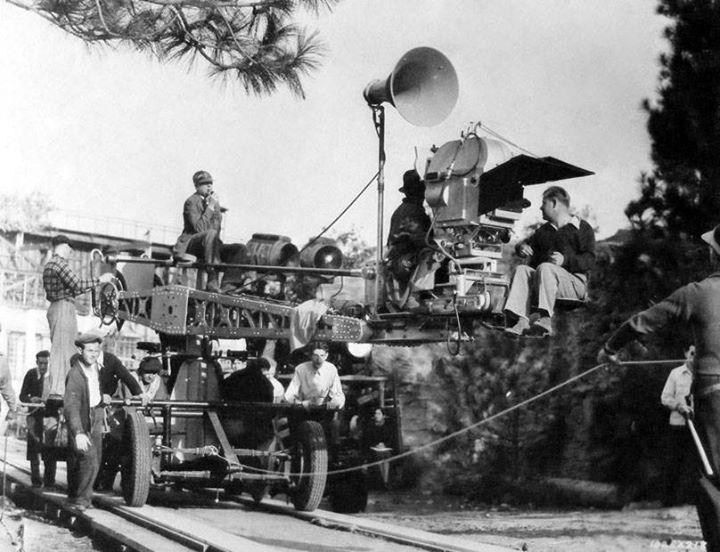
Heaving and Hoeing, Heavy Metal and Manpower
This is a location shot from the 1938 hit musical ‘Girls Of The Golden West’ staring Jeanette MacDonald and Nelson Eddy and a ton of newcomers, like Buddy Ebson who you’ll see in the trailer. You’ll also see a lot of crane shots made with this two-and-a-half-ton behemoth.
By the way, the rope is not for pulling the crane, but it is for pulling distance. Knots in the rope let them know when they got to the marks they had rehearsed. Enjoy and share! -Bobby Ellerbee
A Funny Thing Happened On The Way To Oz
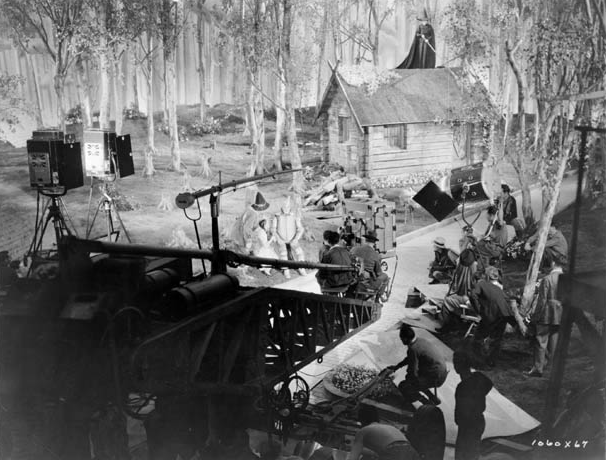
A few weeks back, I watched ‘The Wizard Of Oz’ for the umpteenth time on TCM. It’s still a fascinating spectacle…especially for those of us who grew up watching it on black and white sets and never knew till much later that most of it was in color. Here’s one of the huge Technicolor cameras shooting Margret Hamilton atop a house, just before she disappears in a beautiful orange smoke cloud. Enjoy and share! -Bobby Ellerbee
The Universal Court House Square
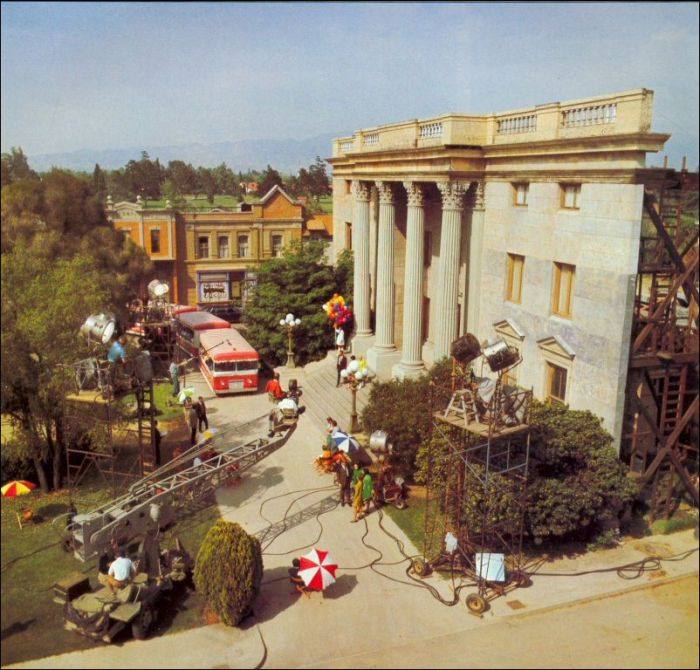
Most recognize this set from ‘Back To The Future’, but it’s been used in more productions than you can shake a stick at. The first time we saw it was with Ma and Pa Kettle in 1949. Enjoy and share! -Bobby Ellerbee
Early Color Testing Days At The Colonial Theater
It was late November 1952 when the four RCA TK40 prototype cameras arrived at The Colonial. There was a year of almost around the clock testing of cameras, monitors, switching and transmitting equipment. The first production models of the TK40, twenty five in all, were shipped from Camden on March 4, 1954.
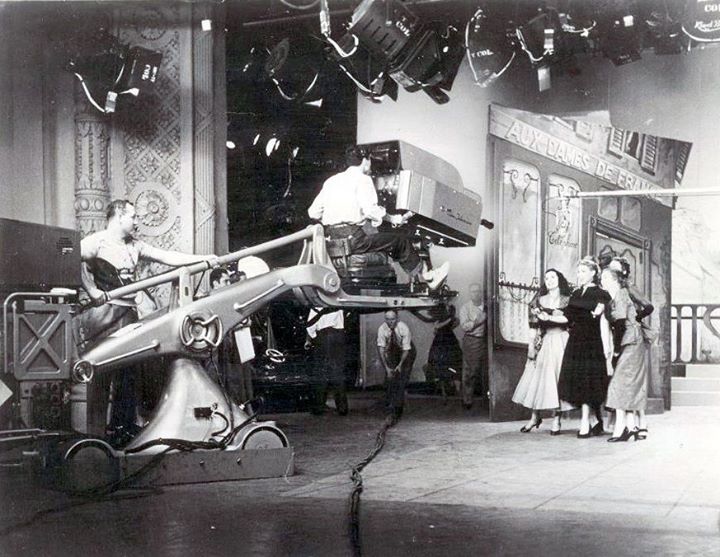
Notice in this photo from January ’54, there is no big cradle head…only a friction head under the camera. One thing the production crew learned in 1953 was that there was a need for a bigger, better pan head for the 375 pound camera. Houston Fearless sent a prototype cradle head in the summer of 53 and when the TK40s shipped in ’54, they all came with the new custom cradle head. Enjoy and share! -Bobby Ellerbee
By the way, the crane is the Houston Fearless 30B model.
Picture Parade #4…The Red Barber Baseball Box
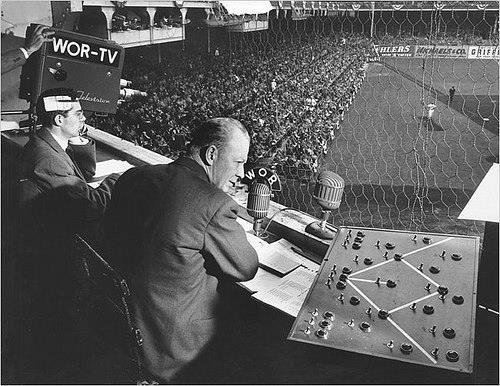
Red Barber was the first announcer to broadcast baseball on television. He knew a lot about how to help get the best out of a game and developed this box to “talk” to the director in the truck.
When he thought play action was going to be in a certain area, or there was some player or position he wanted to talk about, he would flip one of the switches to alert them to have a camera ready. Red’s position requests were solid red lights. When the truck wanted him to talk about a position or player, they flipped a switch on their board and Red’s board light there blinked. Enjoy and share! -Bobby Ellerbee
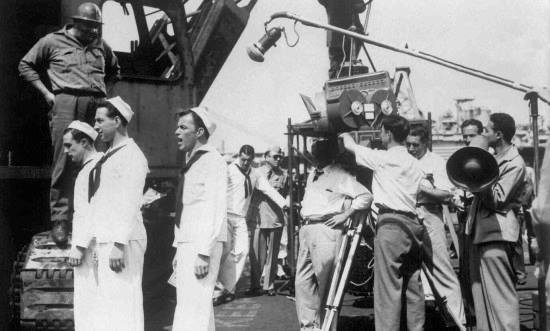
Picture Parade #2…’On The Town’, First Musical Shot On Location
This 1949 film starring Gene Kelly, Frank Sinatra and Betty Garrett was the first musical to be shot on location. Not all of it, but all of the outside scenes, were shot over a five day period in Manhattan.
It rained three of those days, but that was not the biggest problem. Both Sinatra and Kelly were at the peek of their fame and keeping fans away was the real problem. To help camouflage things, taxis and not limousines were used to get to locations, and the camera was hidden in a station wagon for street scenes. A broom handle was used as sound boom on the street.
When the movie debuted at Radio City Music Hall, the lines were the longest in the theater’s history. Oh… and Sinatra was so skinny, he had to wear butt pads to fill out the seat of his sailor suit. He tried very hard to keep this a secret, but word got out on the set and Gene Kelly teased him relentlessly. Enjoy and share! -Bobby Ellerbee
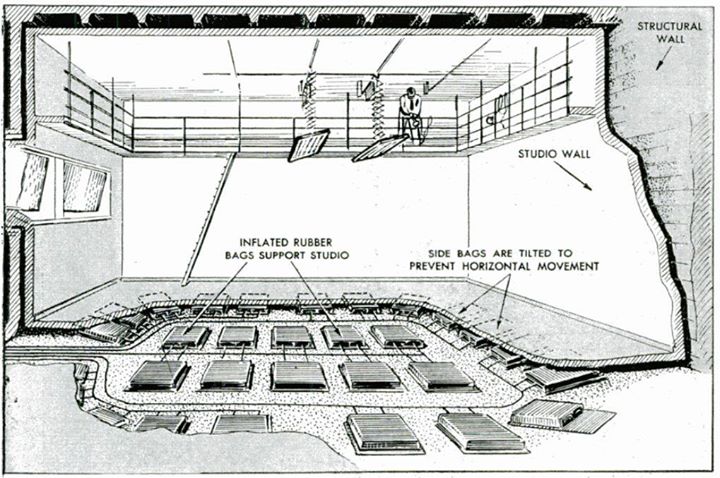
Picture Parade #1…NBC New York’s Air Cushion Studio Floors
Most never knew that under each studio floor at 30 Rock, there are air cushions to prevent vibration from the subway that runs directly under the building.
When Rockefeller Plaza was built in 1933, there was an elevated train that ran down 6th Avenue. In later years, it was moved underground and that’s when the problems started. I don’t know much about the when and where this began, but I remember reading about this around 1963. I thought it was fascinating, but remember something about big coil springs in the floors too.
I think this drawing is from the early ’60s and shows how inflated rubber bags were used to suspend the studio floor from the sub floor. If you know more, please chime in! Enjoy and share! -Bobby Ellerbee
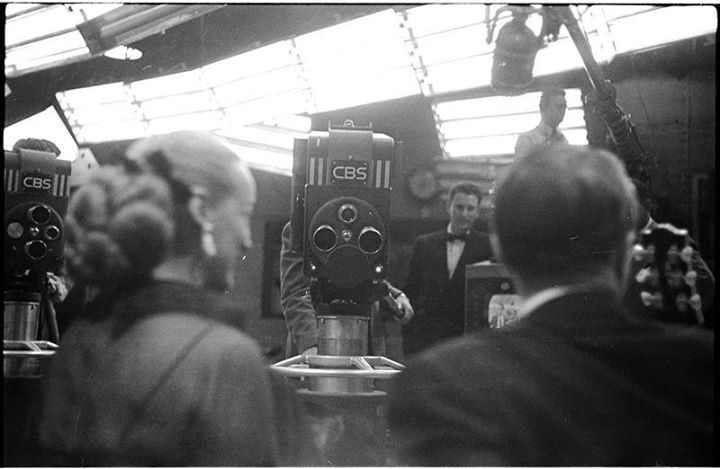
Picture Parade #4…CBS Studio 42 At Grand Central Terminal, 1950
This is Faye Emerson on her fifteen minute daily show the CBS Network. In 1947, CBS bought the RCA TK10s and 30s for their studios. These are TK30s with the exclusive CBS striped band on the viewfinder. Do you know why they were there?
Here’s the answer…these are actually handy gray scale charts that cameramen can use to keep their adjustments in line as the tubes tended to drift some. Without having to go to a test pattern chart, they could quickly swing to the camera next to them and adjust their gain, shading and alignment. Enjoy and share! -Bobby Ellerbee