Posts in Category: TV History

The Piccolo Crane…Ever see one of these?

The Piccolo Crane

Ever see one of these? This actually folds up on top of the wheel dolly and can hold 2 seated people and a camera. The link takes you to short video on how to set it up and if you don’t know anything at all about cranes, this is a good, little, easy lesson.

Source

ESPN 3D Sideline Cart, View A

ESPN 3D Sideline Cart, View A

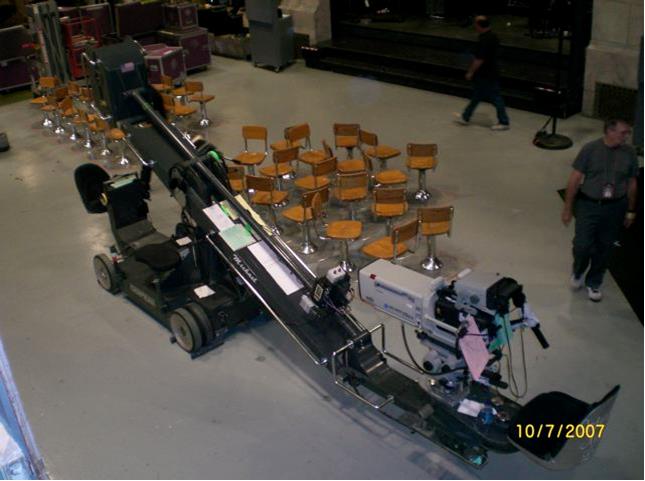
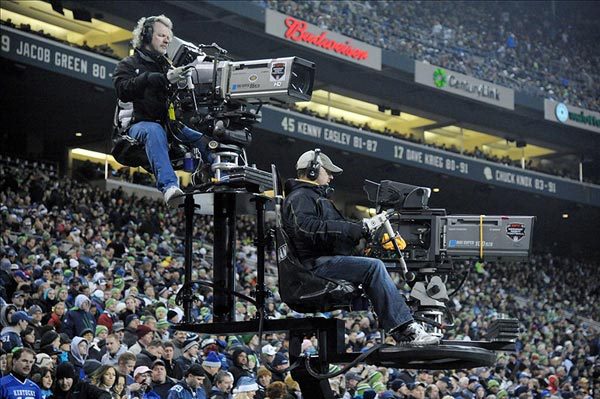
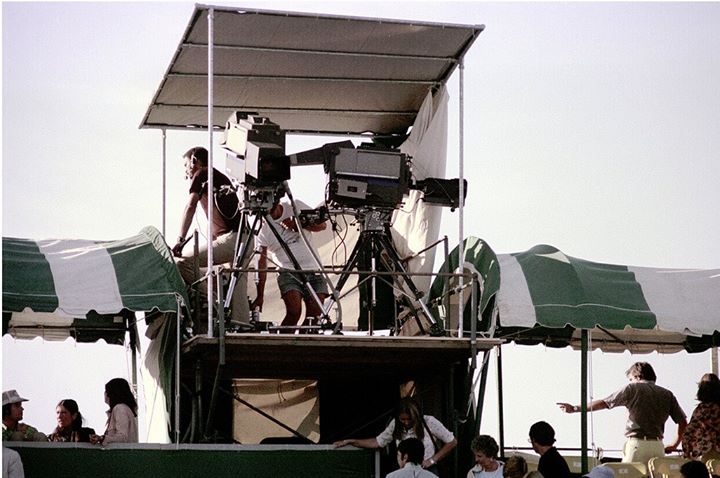
This is a modified Chapman Olympian base with 2 camera platforms. The lower one for the ‘human’ operator is a swivel turret that can go up about 20 feet. On the rear is an extendable boom arm that can go up another 20 feet above the operator when fully extended and has a robotic 3D camera on top. State of the art!

Source

ESPN 3D Sideline Cart, View B

ESPN 3D Sideline Cart, View B

This is a modified Chapman Olympian base with 2 camera platforms. The lower one for the ‘human’ operator is a swivel turret that can go up about 20 feet. On the rear is an extendable boom arm that can go up another 20 feet above the operator when fully extended and has a robotic 3D camera on top. State of the art!

Source

Heavy Metal The Illustrious Houston Fearless 30B Stage Crane.

Heavy Metal!

Here is the illustrious Houston Fearless 30B Stage Crane. This one at Radio Canada is carrying an RCA TK42 and is a Deluxe model. Most did not have the boom arm operator platform like this one. I could be wrong, but I think the 30B could crab, as well as be steered from either the front wheels or the back wheels. I think this had battery powered assist on steering, but I think it could also done manually. Fully loaded with this camera and the lead counter weights, this weighs well over 2000 pounds, but the movement is silky smooth! This was the best ride in the business.

Source

In Remembrance of Jim Henson

In Remembrance of Jim Henson

Source

No Studio Crane? Try This!

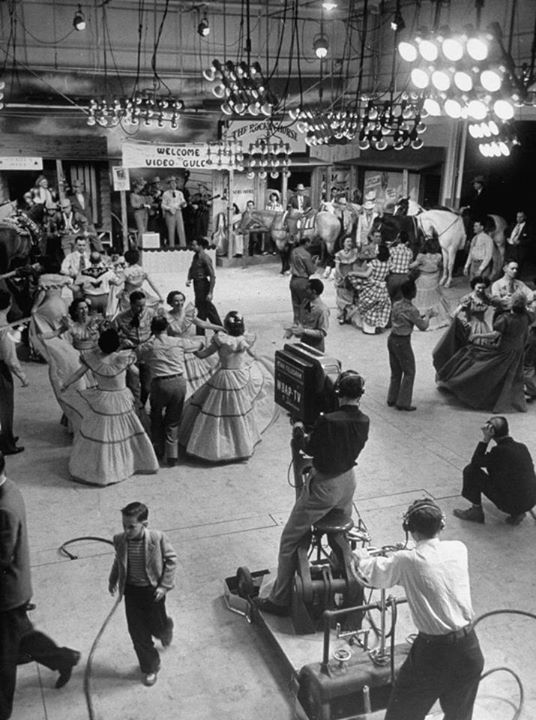
August 13, 1950: Hayloft Hoedown

Brand new in March of 1950, here’s real ingenuity at work at WHAS in Louisville, Kentucky. These Dumont 124s are shooting a Saturday night country music show and to get the great high shots without a crane, rolling scaffolding is pretty good alternative. Thanks to Craig Harper for the photo.

Source

Where the Sid Caesar/Imogene Coca Magic Started

Where the Sid Caesar/Imogene Coca Magic Started

The Admiral Broadway Revue is the only show known to be canceled because it was too successful…really! Admiral could not keep up with the demand for their TV sets so faced with the prospect of building a new plant or canceling the show, they canceled.

This was ground zero of what would later become the hugely successful, ‘Your Show Of Shows’. Admiral Broadway Review premiered on 28 January 1949, and was broadcast live simultaneously on both NBC and the now-defunct DuMont network. The show was telecast from the now-demolished International Theatre (also known as the Park Theatre) at 5 Columbus Circle in New York. The hour-long series was directed by Max Liebman, hosted by Sid Caesar, and also starred Imogene Coca. The last show of Admiral Broadway Revue was on June 3, 1949.

The series, oddly enough, was sponsored by TV set manufacturer Admiral, a company which was in direct competition with RCA (the parent company of NBC) and DuMont, which both manufactured TV sets. To see an episode, click the link.

https://archive.org/details/AdmiralBroadwayRevue

Source

“I’ve Got A Secret:..Philo T. Farnswroth, 1957


I’ve Got A Secret: Philo T. Farnswroth, 1957

Philo T. Farnsworth: The Boy Who Invented Television. http://farnovision.com Get the whole amazing story: http://farnovision.com/book.html Thumbnail sketch: …

Source

Today is Philo T. Farnsworth Day!

Today is Philo T. Farnsworth Day!

Below, you’ll see a lot of historical photos in this salute to the father of electronic television. I hope you’ll enjoy them, but most of all, I hope you’ll remember his determination to do what no one had done before. Although this true pioneer did get a lot of “arrows in his back”, he kept on and eventually won the battle with Goliath…RCA. Thank you Philo and thanks to your wife Pem for sticking with you through the rough spots. This is a photo from the 1936 studio in Philadelphia. Enjoy!

Source

Philo Farnsworth, Box Camera, Model 1

Philo Farnsworth, Box Camera, Model 1

This is the great granddaddy of all electronic television cameras! This is thought to be the first one Philo built and the date would be around 1926. I think the Smithsonian has this but I’m not sure. Anyone know?

Source

Philo Farnsworth, Box Camera, Model 2

Philo Farnsworth, Box Camera, Model 2

Farnsworth associate, Cliff Gardner is shown here with the second ever electronic television camera. The lens is on the left side of the box and you can see the opening of the recessed lens. This was probably taken in 1930.

Source

Philo Farnsworth, Mountable Camera 1

Philo Farnsworth, Mountable Camera 1

This is Philo’s first camera capable of being mounted on a tripod. With an old, still camera as a model, we’ve graduated from wooden boxes to a more manageable style. This is probably from 1931.

Source

Philo Farnsworth, Mountable Camera 2

Philo Farnsworth, Mountable Camera 2

This is perhaps from around 1934, and is Philo’s second camera that could be mounted on a tripod. Notice now the camera has a gun site style viewfinder and a hard body, having left behind the adjustable, accordion focus lens. This is Philo with the camera.

Source

Farnsworth Camera, Image 1

Farnsworth Camera, Image 1

Philo Farnsworth had built two or three cameras before this mid 1930s model, but all of the earlier cameras were either modeled after accordion lensed still cameras or box size table units. This is his first go at a commercial model. Operating the new camera is his associate, Don Pike and behind him is what could be the first version of this camera without the chrome striping.

Source

Farnsworth Camera, Image 2

Farnsworth Camera, Image 2

This is the mid 1930’s camera with it’s cover off.

Source

The Man Who Filmed ‘I Love Lucy’, Tells Us How It Was Done.

The Man Who Filmed ‘I Love Lucy’, Tells Us How It Was Done.

By: KARL FREUND, Director of Photography

The Lucille Ball-Desi Arnaz show was a challenge from the start. It was decided that, for the first time, TV cameras would be replaced with three motion picture cameras to allow more flexibility in editing and to improve the photographic quality over kinescope recording.

This, I felt, was a legitimate approach to the situation. I expected very little variation from the ritual of photographing regular motion pictures — but I had not taken into consideration the unique problems involved. I was soon to be faced with them.

First of all, a live show requires an audience. This necessitated a regular studio sound stage equipped with bleachers to hold some 300 people. Above the stage a series of directional microphones and loud speakers had to be installed.

To give the audience a clear view of the program, and to allow the cameras total mobility without interference from floor cables, the lights for the sets had to be placed above the stage.

It became obvious almost at once that the overhead light placement was hardly flattering to the photographing of the performers. While the print value seemed up to par when projected in a studio projection room, they showed too much contrast when viewed over a closed TV circuit. Thus, we were faced with the fact that the greatest difference between standard motion pictures technique and TV films is the subject lighting contrast, which is required.

The immediate question was what method we should use to obtain the desired compression in the positive print. The solution was fairly simple. After careful survey, we selected a method that would involve no departure from standard practice in processing laboratory operations. That is, in exposing the original negative, use a subject lighting contrast considerable lower than that normally used for conventional black and white motion picture photography and process both the negative and print in the normal way.

It requires four days to line up each weekly show of “I Love Lucy” and “Our Miss Brooks.” Two of these days are for rehearsals. At the end of the second day the cameraman sees a run-through during which he can make notes and sketches of positions to be covered by the cameras and instructs the electrical crew as to where lights are to be placed. The last two days are occupied by rehearsals with cameras.

Since a show with audience participation must go on at a specified time, this schedule must be religiously adhered to by everyone concerned, including the cast. An hour and a half is the actual shooting time.

To film each show we use three BNC Mitchell cameras with T-stop calibrated lenses on dollies. The middle camera usually covers the long shot using 28mm. to 50mm. lenses. The two close-up cameras, 75 to 90 degrees apart from the center camera, are equipped with 3″ to 4″ lenses, depending on the requirements for coverage.

The only floor lights used are mounted on the bottom of each camera dolly and above each lens. They are controlled by dimmers.

There is a crew of four men to each camera: the cameraman, his assistant, a “grip” and a “cable man.” Unlike TV, where one man generally handles the camera movements and views the results immediately, this technique requires absolute coordination between members of the crew.

Every movement of each dolly is marked on the floor for every scene. And since all the movements of the camera are cued from the monitor box, the entire crew works from an intercom system.
As for myself, I utilize a two-circuit intercom. This allows me to talk separately to the monitor booth and the camera crew on one; the electricians handling the dimmers and the switchboard on the other.

Retakes, a standard procedure on the Hollywood scene, are not desirable in making TV films with audience participation. Dubbed-in laughs are artificial and, consequently, used only in emergencies. Close-ups, another routine step in standard film-making, were discarded since such glamour treatment stood out like a sore thumb.

Source

Guess What This Door Used To Be…

Guess What This Door Used To Be…

Here’s a clue: in the 50s, people lined up here to see the most famous of all television shows.

Source

THIS Is A REAL News Team!

THIS Is A REAL News Team!

With election night just weeks away, take a look at the CBS team covering the 1964 election. The race was between Johnson and Goldwater and at the Broadcast Center, CBS was ready. L-R, Harry Reasoner, Roger Mudd, Eric Severeid, Mike Wallace, Robert Trout and Walter Cronkite. Unfortunately, they don’t make ’em like they used to!

Source

1954, Television In The Army


Now THIS is INTERESTING!

This is a 1954 production by the US Army on their use of Television in the military. There are a lot of different kinds of equipment shown here from RCA, Dumont, Dage more. Some of it is ‘pure army’, but that’s why there’s fast forward, right? Enjoy and let us know what you think. A lens I’ve never seen shows up at 22:27…anyone know what that is? Thanks to David Crosthwait for the link to this “Big Picture” episode.

Source

Some Interesting Production Notes On ‘The Birds’ from Alfred Hirchcock

Just for fun, here are some interesting production notes on ‘The Birds’ from Alfred Hitchcok who’s shown here with the stars…the birds. Also shown, Tippi Hedren, Rod Taylor, Jesica Tandy and Veronica Cartwright.

To keep the birds from flying around and on the ground, they were fed a heavy grain and whiskey mix.

The use of standard blue screen techniques for doing matte shots of the birds proved to be unacceptable. The rapid movement of the birds, especially their wings, caused excessive blue fringing in the shots. It was determined that the sodium vapor process could be used to do the composites. The only studio in America that was equipped for this process was the Walt Disney studio. Ub Iwerks, who had become the world’s leading expert on the sodium vapor process, was assigned to this production.

In the scene where Tippi Hedren is running and continually attacked, the birds were actually attached to her coat with nylon thread and were flapping to get loose. Very convincing.

There was no musical score for the film except for the sounds created on the Mixtrautonium, an early electronic musical instrument similar to a Moog.

To make the sound of the birds attacks more frighting, reel to reel tapes of the angry birds was played backward in the mix.

Finally, one ending never shot was a scene showing the Golden Gate bridge covered with birds. That would have been powerful!

Source